

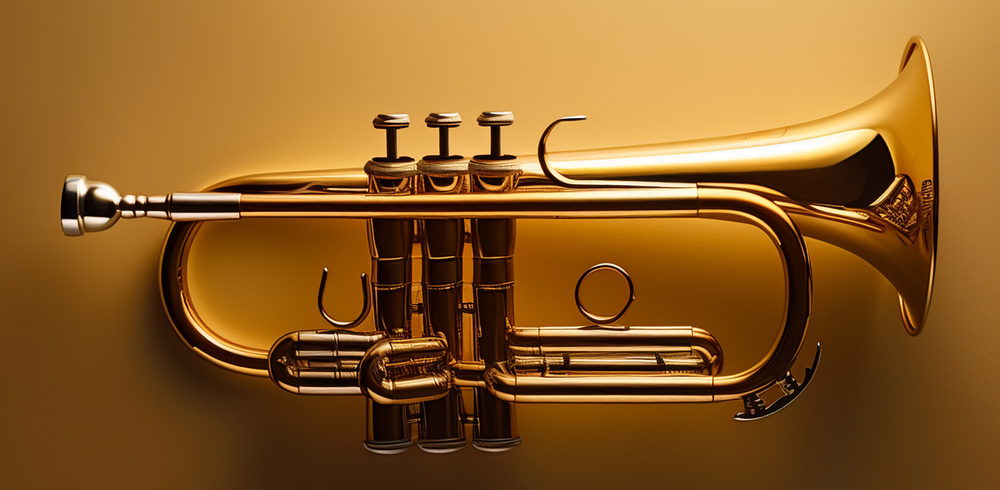
Soundpaint’s affordable wind instruments contain some hidden treasures.
Anyone engaged in contemporary virtual orchestration will likely be familiar with the name Troels Folmann. Since 2009 this voluble Danish composer has created hundreds of sample libraries, initially under the Tonehammer banner in conjunction with sound designer Mike Peaslee, then in creative partnership with producer Tawnia Knox, who co‑founded the snappily‑named 8Dio Productions with Folmann in 2011.
Based in West Hollywood, California, 8Dio’s extensive catalogue features epic choirs, cinematic percussion and a sprawling range of orchestral sample products that run the gamut from a solo oboe to the 240‑piece Majestica mega‑orchestra. The Legion series’ 66‑player bass, cello, trombone and tuba ensembles are similarly gargantuan, while the musically detailed Century Strings, Century Brass and Adagio string series feature more traditional ensemble sizes.
In October 2021 Folmann and Knox launched Soundpaint, a free, easy‑to‑use sample player jam‑packed with features (see box for more info). Accompanying the new engine was a free deep‑sampled 1928 vintage Steinway grand piano and an intriguing assortment of high‑quality new instruments. The remarkable thing about these products was their price — in a world where sample developers routinely charge hundreds of pounds for their wares, many of them cost $20 or less.
After nearly four years of development, Soundpaint’s catalogue has grown into an Aladdin’s cave of affordable instruments that promise many hours of fun for the acquisitive sample user. I found much to admire in this astonishingly diverse collection, so to get started I’ll shine the spotlight on Soundpaint’s solo woodwinds and brass.
Solo Woodwinds: Flutes
Soundpaint’s seven solo woodwinds made their debut some years ago as the rather expensive 8Dio Claire Woodwinds Kontakt library. The collection has now been re‑formatted for Soundpaint and can be bought as single instruments at decidedly affordable prices. Recorded from close, Decca Tree and wide microphone positions in the amazing concert hall of the Cultural and Congress Centre, Zlín, Czech Republic, these woodwinds feature some exceptional specimens.
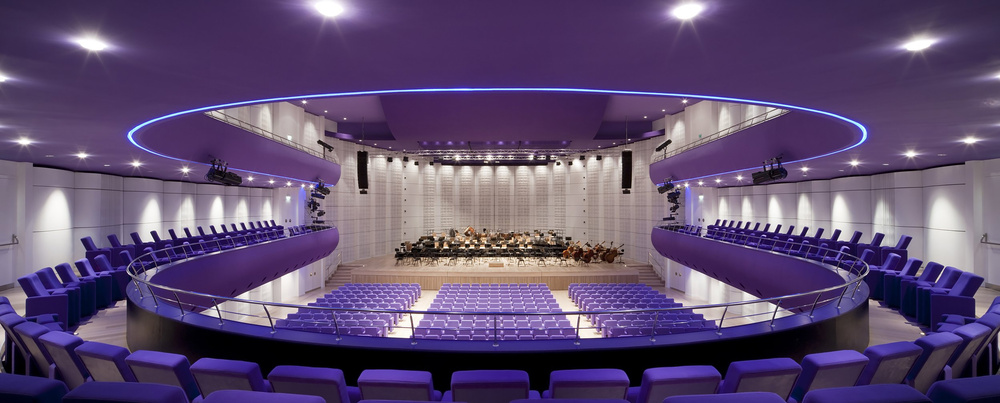 The concert hall of the Cultural and Congress Centre, Zlín, Czech Republic, venue for the recording of many of the libraries on review here.
The flute family is represented by the 2004 Flute Platinus, 2001 Piccolo Shire and 1987 Alto Flute Savana. An unnamed flautist sets the tone with some beautifully expressive performances — her platinum instrument’s sweet‑sounding high register is perfect for romantic themes and dramatic swirling note flurries. The versatile piccolo can also tug the heartstrings with romantic melodies, evoke visions of a Hobbit‑ridden English countryside with rustic melodies, or burst your eardrums with piercing fortissimo shrieks. All good stuff, but if you want one flute to rule them all, the alto flute’s sultry, breathy mellow tone, superbly consistent timbre and infinitely stretched range can sound like a complete flute family when played chordally.
Solo Woodwinds: Reeds
In the reed corner we have the 1967 Clarinet Paris, 1982 Oboe Amore, 1995 English Horn Lorium and 2010 Bassoon Firebird. Played with no vibrato in the orchestral style, this Bb clarinet is unsuitable for hot Dixieland jazz but will function perfectly in a traditional score. I like the instrument’s effortless smooth deliveries and liquid, rounded tone, the only small flaw being the noticeably unclean attack of its mf sustains’ E5‑F5 register.
Formerly known as Claire Oboe Virtuoso, the Oboe Amore is not an actual oboe d’amore, but has a strikingly bright, plaintive and distinctive sound of its own — great for underscoring cinematic love scenes and panoramic nature shots, and also effective for incisive stabs. The bassoon is a tour de force: its lyrical vibrato legatos render soulful melodies with uncanny realism, and it excels at supportive bass lines, blasting marcatos and staccato rhythm ostinatos.
Much as I enjoyed these instruments, I have to reserve my highest praise for the English horn (aka cor anglais). It is absolutely stunning: warmer and darker than the oboe with a wonderfully poignant low register, it sounds equally magical high up in the oboe range. An ultra‑expressive legato style incorporates emotive dynamic swells, while ‘Legato FX’ programs use quiet breath noises and key clicks to enhance realism. A playable instrument, and a brilliant example of woodwind sampling.
Woodwind Artics
The woodwind players perform a near‑identical set of articulations consisting of unlooped regular and legato sustains, marcato long notes, staccatissimo shorts, major and minor second trills and major and minor up and down octave runs. Each instrument plays between four and eight types of ‘arc’ (medium‑length notes with expressive built‑in dynamic swells). The oboe and flute also perform straight crescendos.
While the excellent legato mode can handle very fast playing, its note durations seem a little short — a reminder to program occasional pauses for breath! Though the instruments’ vibrato is baked in, you can use Soundpaint’s time‑stretcher to adjust the vibrato speed, and also to alter note durations and attack speeds.
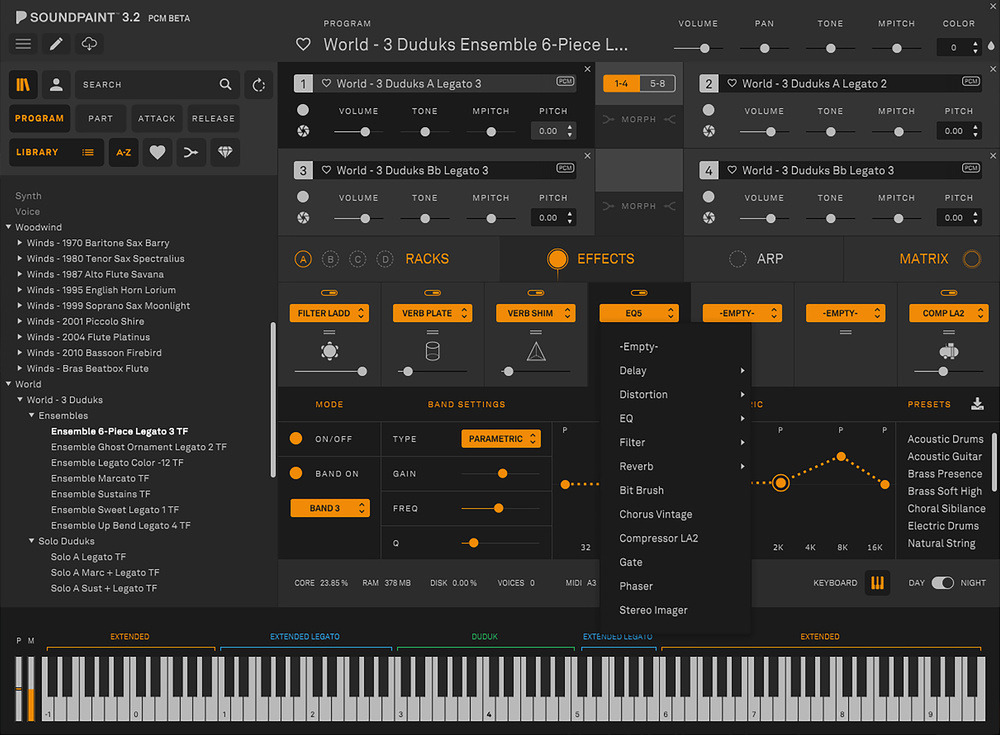 Eight years in the making, the Soundpaint engine contains a wealth of creative features.
Three Duduks
The duduk is an Armenian double reed woodwind instrument, described by ethnic winds specialist Dirk Campbell as “a cool, transcendent sound, best used with a minimum of background”. The instrument (a wooden pipe punctuated by a row of finger holes with a mouthpiece inserted at one end) might appear rudimentary, but its sound has an unforgettable, haunting voice‑like quality. Skilled performers can generate a range of sophisticated and expressive performance techniques, including bent notes, multiple grace notes and an impassioned vibrato.
Soundpaint’s three duduks were built in the keys of A, Bb and C, but thanks to chromatic sample mapping each one can play in all 12 keys. You can choose between sustain, marcato and legato articulations, the latter offering simple unornamented notes, single and double grace notes and slow inter‑note portamento slides. These legato variants are presented in keyswitchable four‑way programs, so you can switch between straight legatos, grace notes or slides in real time.
Also included are layered ensemble and sound design programs, which work well for chordal passages and bass drones. Overall, an enchanting and beautiful‑sounding trio of instruments, a worthy addition to Soundpaint’s catalogue.
Solo Brass
Recorded in the aforementioned Zlín scoring hall, Soundpaint’s Century Solo Trumpet and Solo Flugelhorn are 100 percent musically and sonically compatible with the solo woodwinds. Both were originally part of 8Dio’s Century Solo Brass, a seven‑instrument Kontakt collection now beginning a migration to the Soundpaint format.
The solo trumpet is a winner, offering a large menu of bright, super‑confident, well‑tuned performances including looped sustains and polyphonic legatos with and without vibrato, marcato shorts, staccatissimos, swells (called ‘soaring’ for some reason), long and sfz crescendos, ‘arcs’, trills, flutter tongue, and double and triple tongue, some of which come in Harmon and straight mute variants. The flugelhorn, a magnificently fat‑toned, mellow instrument often associated with jazz, matches the trumpet for quality but omits the fancier artics. At the current prices, both are an absolute snip.
Jazz, Latin and pop producers might prefer Soundpaint’s Fire Brass, a brass trio drily recorded at Feeling Studios in Cali, Columbia. Operating under the names of 1984 Trumpet Fire, 1989 Fire Trombone and 1992 Fire Saxophone, these instruments collectively cover the idioms of big band jazz and pop horns, whipping out unrestrained, in‑your‑face artics such as the overblown ‘frullatos’. While suitable for hot rhythm work, they also perform conventional artics (including legatos), so could be used in an orchestral setting.
Saxophones
Our final instruments were recorded at Gorbals Sound Studios, Glasgow, from close and room positions. The fancifully named 1980 Tenor Sax Spectralius, 1999 Soprano Sax Moonlight and 1989 Baritone Sax Barry deliver a lorry load of articulations (including runs, scoops, triplets and ‘daa da da’ mini‑phrases), but I’ve a feeling most people will take one listen to their utterly realistic legatos before compulsively reaching for their credit cards and buying all three.
I slightly preferred the tenor and baritone instruments’ timbre over the soprano — however, I very much enjoyed the slow, dreamy fade of the soprano sax’s ‘Somber Arcs’ program, a great textural backdrop for meditative melodic explorations.
Troels Folmann has long been an advocate of hybrid sounds, so it’s no surprise that the Soundpaint factory programs include many sound design and effects‑based creations.
Conclusion
Troels Folmann has long been an advocate of hybrid sounds, so it’s no surprise that the Soundpaint factory programs include many sound design and effects‑based creations. These atmospheric, sometimes transformative concoctions are not separately presented in the browser, so don’t be surprised when looking for a close‑miked oboe if you end up with something resembling the distant piping of the god Pan. In that vein, I enjoyed the program ‘Memory MJ’, a mystic, tranquil flute echoing from some far‑flung galaxy.
Also worth mentioning are Soundpaint’s ‘hidden gems’, factory programs featuring instruments from different libraries. When I installed one of the woodwinds the display suddenly shouted, “Congratulations Dave, you’ve unlocked new hidden gems!” (A bit sinister really — how did it know my name?) Nevertheless, it’s a fun marketing tool, and some of the layered multi‑instrument programs sound great.
If you’re looking to accompany the above‑mentioned melodic instruments with filmic ambiences, textures, synths, pads and vocals, I can recommend Dunescape 2.0, a much larger and somewhat more costly library, which spans the sonic spectrum from delicate to cataclysmic. To spice up your rhythm tracks, you might also fancy the pulsing textures of Rhythmic Aura Acoustics, a former 8Dio product. I mention these additional libraries to give an idea of the wider capabilities of Soundpaint, a forward‑looking company whose instruments have caught my imagination and inspired my creativity.
Soundpaint Engine
The free Soundpaint engine uses a proprietary audio format called Real‑Time Samples to play back its recorded material.
All instruments can have 127 discrete dynamic velocity layers, with musical realism enhanced by the UDS (Ultra Deep‑Sampled) versions supplied for some instruments. These contain identical material to the standard instruments, but introduce an additional set of real‑life round robin for repeated notes.
Soundpaint’s HAL III (Hyper Acoustic Legato) technology offers limitless polyphonic legato. This means you can play cohesive, joined‑up, single‑note melodies on (say) a woodwind instrument, then instantly switch to chords on the same instrument and enjoy equally smooth inter‑chord note transitions.
Eight years in the making, the Soundpaint modular interface contains the core engine, a downloader‑cum‑installer (which handles updates), and a user sample import (USI) with a built‑in editor. You can drag and drop your samples onto the keyboard, adjust their ranges and stretch them across multiple keys, then save your work as a single instrument ‘part’. Soundpaint also supports keyswitching and time‑stretching, has a built‑in arpeggiator and boasts a comprehensive effects section which includes a beautiful Lexicon‑style reverb.
An intriguing feature of this sample player is ‘part morphing’. This enables you to modulate the sound of one part using another part, with a slider controlling the morph mix. A single program can have up to four sets of morphing parts, which opens up brain‑boggling possibilities. Having heard Troels Folmann modulate a grand piano with an orchestral recording of Grieg’s ‘In The Hall Of The Mountain King’, I’m already a fan!
The Soundpaint player works as a plug‑in and in standalone mode on Windows 10+ and Mac OS X 10.14+ systems. For full specifications, see the company website.
Pros
- An extremely affordable selection of high‑quality, ultra‑playable solo wind instruments.
- Contains some stellar solo woodwinds.
- The woodwinds were recorded from three mic positions in a fabulous European concert hall.
- The three duduks sound lovely.
- The Soundpaint player is fun to operate.
Cons
- None to speak of.
Summary
Showing a keen awareness of musicians’ budget constraints, Soundpaint make their excellent products available at knockdown prices. There’s nothing cheap about the sound — some of these solo woodwinds are among the best I’ve heard and deserve serious consideration by all orchestral sample users.
Information
Solo woodwind and Solo brass instruments $20 each, duduks $30, Fire Brass bundle 2.0 $50, saxophones $30 each.
Solo woodwind and Solo brass instruments $20 each, 3 Duduks $30, Fire Brass bundle 2.0 $50,
Saxophones $30 each.