

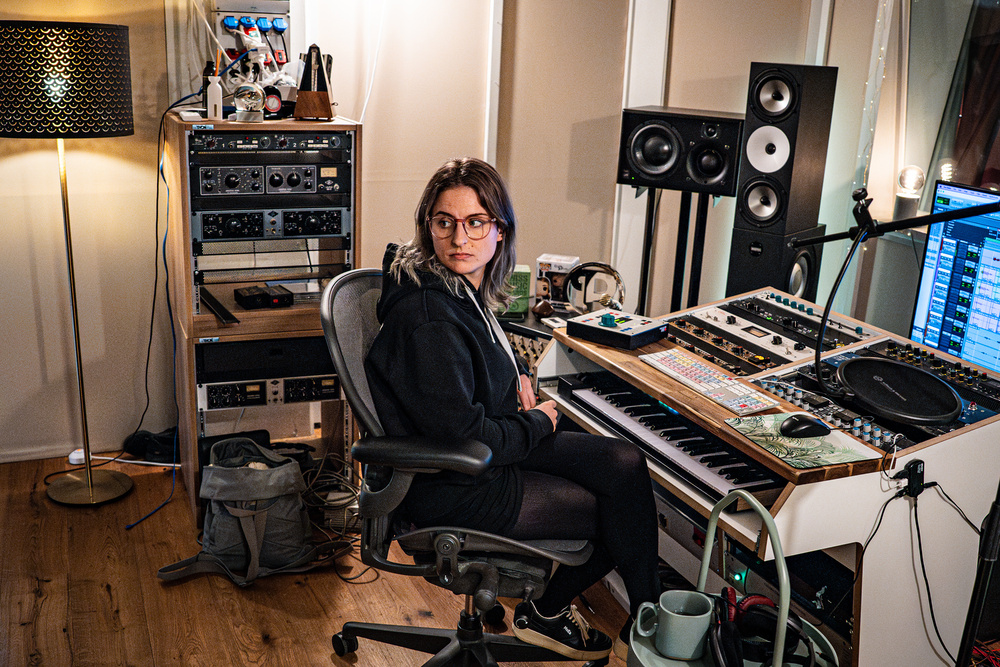
 Anna Murphy at Soundfarm Studios, where she has worked since 2011.Photo: Elia Meier
Singer, composer, engineer, producer, mastering engineer and hurdy‑gurdy virtuoso, Anna Murphy is a woman of many talents.
A household name within the metal community, Anna Murphy rose to fame as hurdy‑gurdy player and vocalist in the band Eluveitie, which she joined at 16. Since then, she has developed her own solo project Cellar Darling, and been part of numerous other acts including Fräkmündt, Maer, Lethe and Nucleus Torn. In parallel to her career as an artist, Murphy has also worked at Lucerne’s Soundfarm Studios since 2011, and more recently joined the mastering team at Zurich’s echochamber.
Although Murphy was born into a family of opera singers, she forged her own path: “I grew up in a nice, artsy, empathetic, and very kind bubble, a very privileged environment as well, because I’ve always been surrounded by artists and music. The funny thing though was that when I was a teenager in high school, I stopped playing instruments. I wasn’t really interested in music from about the age of 13 to 16, and I wanted to study. I was interested in philosophy and history. I didn’t really want to pursue the artistic path, and then things just changed rapidly. The genes took over, I guess. Now, I can’t really imagine doing anything else.”
Remarkably, Murphy taught herself how to play the hurdy‑gurdy only three months before joining Eluveitie. She then rapidly cultivated her abilities as a vocalist after the group’s founder, Chrigel Glanzmann, asked if she could sing. Murphy’s early explorations as a sound engineer and producer were likewise self‑guided, though she would eventually find mentors. “I just always wanted to take things one step further. I really enjoyed making my own demos at home, so I just got more and more into the audio production part.”
Eventually Eluveitie’s Meri Tadić, who has also joined forces with Murphy in godnr.universe!, asked Anna to mix a solo album for her, and Murphy became part of the Soundfarm team when Marco Jencarelli, a friend of her uncle, invited her to take up an apprenticeship. “I learned how to record, how different microphones work, how the recording software works, and how to mix. With every production that I did, I just learned a little bit more. It’s been a really rewarding journey.”
Farm Favourites
Over the years, Murphy has updated the equipment in her space at Soundfarm: “Being a studio engineer is a very expensive passion, especially if you like analogue gear, which I do. I worked in the box for many years. Now, I’m getting into what analogue equipment does, how it sounds, how it feels to use it. Since I am a human being that makes really fair studio wages, I can only get a new piece of gear every once in a while. But it also makes it more special. I cherish it more than if I could just buy tons of stuff all the time.”
The gear that Murphy selects naturally varies based on the particular project: “For vocals, I don’t have one go‑to microphone, because the choice of mic depends on the type of voice, the type of genre, the type of sound. I really love the [Neumann] U87. But if I were to be recording something for a lo‑fi type of project, it would be way too nice. So, sometimes, I might actually use a dynamic microphone rather than a condenser just because of the sound I’m going for in the end. For bass and guitars, it’s kind of the same thing. We have a lot of amps. I like recording real amps, real cabs. I always record separate DI tracks as well, just in case you want to tweak, or you messed up the amp settings and need to re‑amp or do something else.
“We do a lot of live recordings at our studio because we have so many rooms and such a big space, so complete room separation is possible. You can stick the drums in one room, and you could put the guitars and the amps in another room. We have three recording rooms. We have three control rooms. So, it’s more like a communal studio. But we like each producing our own things, pretty much.
“I think the most important thing, at least for me, is what am I hearing. If I have speakers that don’t really give me good feedback, then I’m not going to get good results from my recording. My Amphions are really nice, so I enjoy mixing on them. My favourite piece of gear as a mastering engineer at echochamber is the Terry CEQ. A true vibe machine!”
Comfort Breaks
Murphy has travelled to other recording facilities, such as Los Angeles’ Seahorse Sound Studios, where she produced, engineered, mixed and performed on 2024’s Rust & Glory by the pirate‑themed, San Diego‑based act the Dread Crew Of Oddwood. “Obviously, at first, I was a bit nervous because it’s a completely different setup with different gear. Just because you’re a sound engineer, that doesn’t mean you can just walk into every studio and get how things are wired and everything.
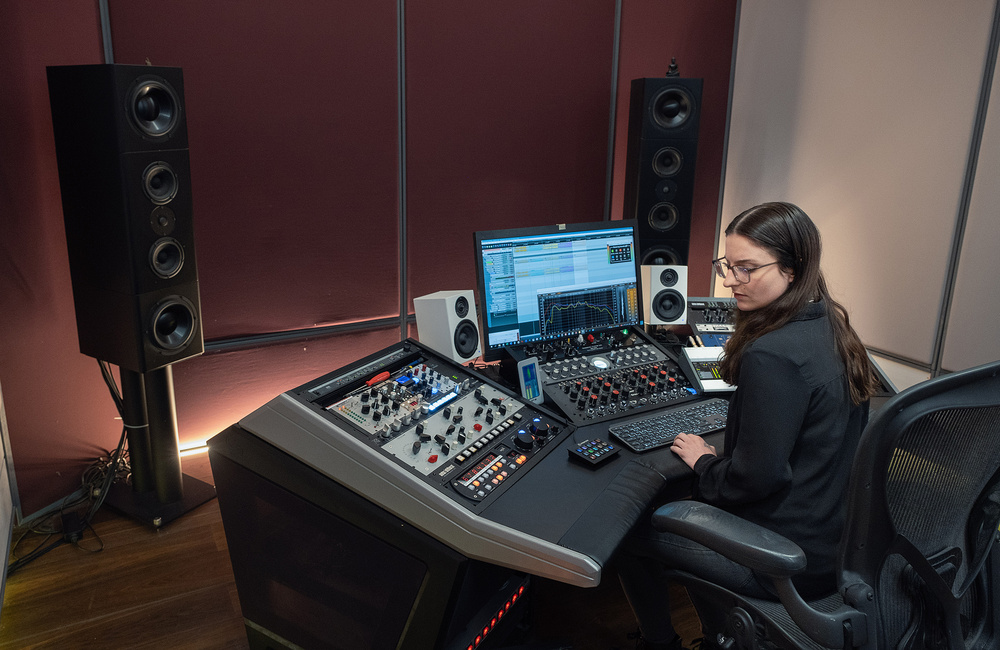 As well as recording, mixing and making her own music, Anna Murphy is also a mastering engineer at Zurich’s echochamber.Photo: Urs Gantner
“I think it’s a lot about making people feel comfortable and/or productive in an atmosphere, because, let’s be honest, that’s one of the only reasons people still record in studios. I mean, it’s really tough because you have the greatest home recording gear. It’s totally possible to record everything with your laptop at home. You can even mix stuff yourself, and you can have AI master it. So, why go to a studio? Of course, there’s the fancy gear and the room acoustics and everything, but I think the feedback you get from another human being is one of the main reasons. Just the way that you interact with someone who understands your vision as an artist can make your music better, or it can make you perform the way you want to perform. It’s good if you can kind of read the room when you’re in this profession, and you can figure out what a person needs.
Anna Murphy: The more that artists and musicians know about the subjects, the better they can communicate with producers, with mixing engineers, with mastering engineers.
“I give a lot of workshops as well about mixing and recording. Even if a lot of people aren’t really into the science and technical stuff, I think it’s great if they learn more. The more that artists and musicians know about the subjects, the better they can communicate with producers, with mixing engineers, with mastering engineers, because sometimes we’re not talking about the same thing. You know, somebody says: ‘I want it to be brighter. I want it to be more compressed.’ We might have completely different perceptions of those terms. So, the more knowledge you have, the better results you can achieve in cooperation with other people. That’s something I’ve come to cherish a lot when I can work in a team. It’s not about agreeing with each other necessarily but just communicating in a way that’s beneficial.”
Opening Up
Working in teams over the years has made Anna Murphy more accepting of external input into her own music. “Because, again, I’m pretty much doing the 50/50 thing — I’m as much an engineer as I am an artist — it’s easier to take a step back from my own songs. It used to be like: ‘OK, this is my song. It has to be perfect. It has to be like I envisioned it.’ And everybody in the chain of making that song come to life somehow had to do whatever my vision was. Now, I’ve completely come away from that. I have more distance from it. I have a healthier relationship with my ideas. I like finishing a song from A to Z by myself before we record it, but I also like just playing around with ideas and finishing something that was only a rough sketch.”
Anna Murphy’s hurdy‑gurdy playing is prominent in her own project Cellar Darling, not least because “Our guitar player, Ivo Henzi, does not like playing solos, so I decided I would try some on the hurdy‑gurdy.” Murphy actually has two different hurdy‑gurdies as well as a special preamp for each, all of which are manufactured by Schertler, with whom Murphy has a long‑standing partnership. “You can kind of compare the electric and acoustic hurdy‑gurdies to the acoustic guitar versus electric guitar. They have completely different purposes. The acoustic one obviously has a much nicer, warmer, more powerful sound just due to it being an acoustic instrument. So, for that, I usually just use one or two microphones, and I don’t really use the sound of the pickup in the studio. I have the Yellow Single preamp, and it’s a really nice piece of equipment that I sometimes use to get the direct pickup sound. The electric hurdy‑gurdy is really low, so it’s cool for practice. It’s cool for live purposes because it’s not as sensitive. My acoustic hurdy‑gurdy would pick up so much drums from the back when we’re playing live that it would pretty much be unusable. So, I definitely need two different ones.”
Any tips for miking this unusual instrument? “As with everything, it depends on the context and the sound I want to achieve. For a pure, clean sound I use Brüel & Kjær or DPAs, either mono or stereo. This especially within a dense context with lots of other instruments. If I’m going for something either more ‘vibey’ or there’s a lot of focus on the hurdy‑gurdy alone, I’ll use large‑diaphragm condensers. Placement is usually aimed towards the bridge of the instrument, far enough to catch a good amount of warm resonance but also the clacking of the keys.”
Murphy is also an accomplished player of the flute, nyckelharpa, bass and keyboard instruments, and seizes opportunities to experiment with these instruments in the studio. For example, she reveals: “There’s something that I really like doing on the piano. You know how there are the hammers that are hitting the strings? On an upright piano, that is. I’m not talking about a grand piano. I like covering the strings with some type of cloth. Basically, what that does is it cuts off the resonance, so you kind of only get the sound of the hammers but not the notes. You only get a hint of the notes that are being played. I like using that as a percussive type of sound.”
Partnership Programme
Murphy is a close associate of Norway’s Manes, who began as black metal pioneers before metamorphosing into a radically experimental outfit with the release of Vilosophe (2003). Their genre‑defying music is a natural fit for Murphy, who mixed and provided guest vocals for their most recent full‑length album, Slow Motion Death Sequence (2018), as well as the two‑song vinyl Young Skeleton (2020). The driving force behind Manes is Tor‑Helge Skei, who says: “Our collaboration has just expanded more and more, and she has also become more and more involved with Manes, adding vocals, instruments, and especially the mixing.”
“With Manes, I think the biggest challenge is getting a balance of all the tracks,” explains Murphy. “There’s so many different things going on. There’s acoustic drums that were played by a musician, and then there’s beats, and loops, and electronic drums. There’s synth. There’s regular bass. There’s tons of guitars and tons of different vocals. So, that’s the challenging part because there has to be a certain amount of transparency to have a song that you can hear, but too much transparency is just boring.”
Manes’ main vocalist, Asgeir Hatlen, added to the challenge by recording some of his parts with his phone. “Obviously, I’m a studio engineer,” says Murphy. “I have to tell people they should record with a microphone and not with their phone. But it shows that the most important thing about a song or a great vocal is the performance, the timbre of the voice, the expression within the voice, and not how it was technically made. So, that’s the thing: Hatlen has so much character in his voice. He can record with a phone, and it’s great. Not a lot of singers can do that. And I think it’s nice to also have a challenge for mixing. I think if you approach mixing in a too clean way, or if everything has to be perfect and audible, it often gets boring.
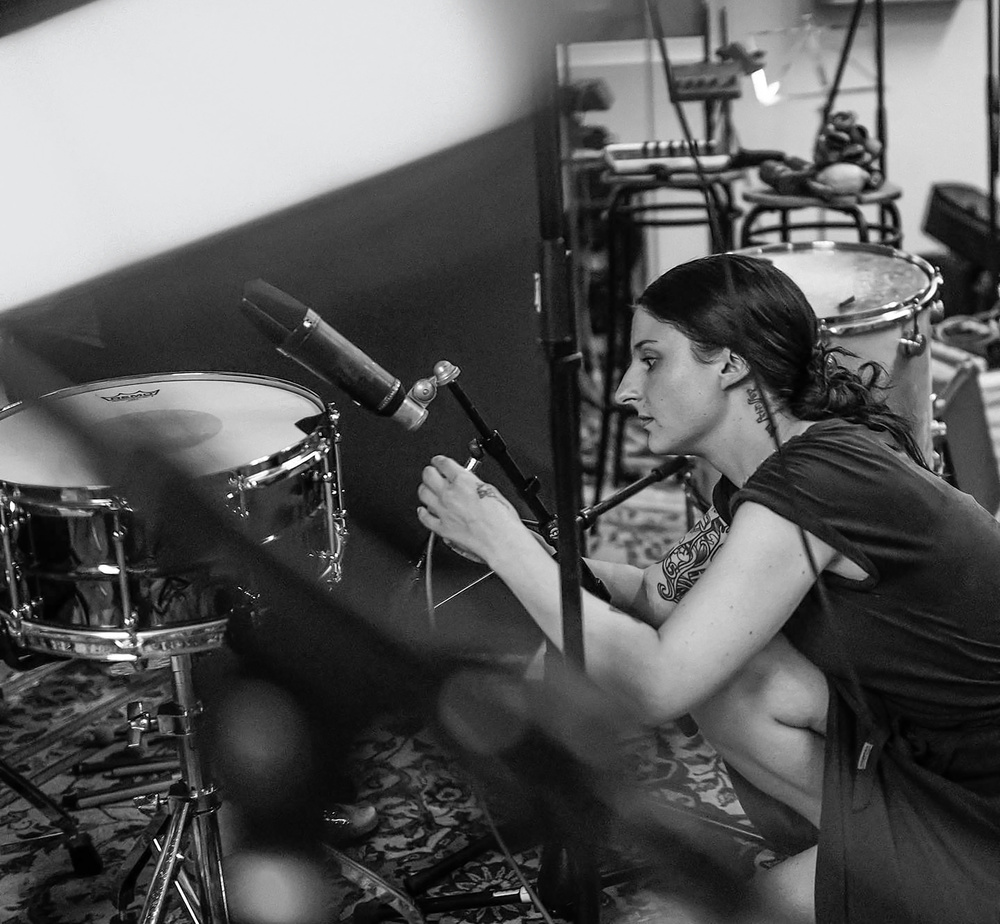 Fine‑tuning drum mic placement at Soundfarm.Photo: Frost & Fog
“I think with mixing, it’s important to have a vision. Sometimes, the artists will give you the vision, or the song is already telling you how it needs to be mixed. And sometimes, as an engineer, you need to be more creative than you expected. So, I think it’s just easiest to go with your gut. Sometimes, things need an extreme amount of space. Sometimes, they need to be dry in order to get a certain effect. So, I just kind of go wherever the song takes me.”
Skei and Murphy also record as a duo under the name Lethe. “Back in, 2013, I think, I was uncertain about what I wanted to do, and posted some blurb on the blog‑ish thing I was doing back then about maybe trying to do an album with cover versions and asking a few vocalists to contribute,” recalls Skei. “Shortly after, I got an email from Anna. She had just started recording some songs for her solo album. Honestly, initially I was quite unsure about the music itself, but I thought: ‘Wow! What an awesome voice!’ So, we decided to try a few cover versions — Black Sabbath and 16 Horsepower, I think — which were great. And then, she recorded vocals and some other instruments on a few other song ideas I had, and we worked together on the arrangements and finalisation. And these turned out amazing! After all of this, after sending lots of musical ideas back and forth, and talking more about what we wanted to do with music and also her technical skills related to studio and mixing, we quickly decided that we had to do something properly together, an album or something. And the seed for Lethe was born. We finished the first album pretty quickly, and we’re still here, more than a decade later, working on new music!”
Murphy and Skei both produce Lethe’s content, Murphy mixes it, and Jencarelli has handled mastering. Skei incorporates all types of samples, as well as archive material that was recorded by different collaborators for other projects, and guest contributions. From his Cernobyl Studio, he also makes his own plug‑ins and software.
Dream Job
Recently, Anna Murphy has been spreading her wings even further, providing music for open‑air productions of Shakespeare with Freilichtspiele Luzern. “I think I started composing last autumn, and then we started rehearsals in the spring, and the performances were throughout June and July. It was really, really fun. We did A Midsummer Night’s Dream.
“I’m kind of a control freak when it comes to live sound. The plan was for the production company that was running the whole thing to do all the mics for the actors and actresses. I just thought it wasn’t possible to get the best possible result if they also mixed the music, because that’s about another eight channels. So, I decided to mix it myself and then just sent them a stereo track of the music.” It sums up the approach of an artist who always wants to take responsibility for the presentation of her own work. It’s an approach she is hoping to pass on through her involvement with Helvetiarockt, an organisation promoting gender fairness in the music industry. “As far as advice goes, don’t let people make you feel inferior,” she concludes. “In order to do this job, I think musicality and empathy are more important than the technical jibber‑jabber. There’s a lot of great women in sound engineering. Don’t be scared. Don’t be shy. Or, rather: you can be scared. You can be shy. But don’t let that stop you.”