

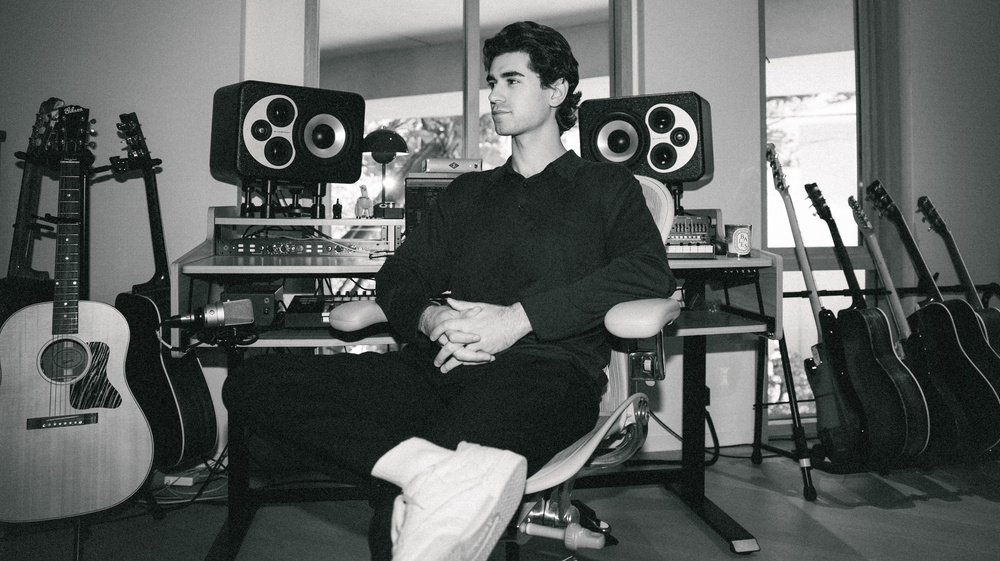
 Adam Yaron in his Los Angeles home studio.
There is nothing ordinary about the success of Alex Warren’s breakthrough hit — or its signature sound, created by producer Adam Yaron.
At the time of writing, Alex Warren’s ‘Ordinary’ is enjoying an incredible 12th week at number one in the UK. It’s also topped charts in the US and at least 18 other countries. “It’s truly surreal,” says Adam Yaron, the song’s producer and co‑writer. “I’ve been so grateful for the overwhelming response — it hasn’t fully sunk in. The day we started writing the song, Alex, our two co‑writers, and I immediately felt there was something special about it. Alex believed in the song from day one, and worked hard to get it heard. The song has turned into everything we could have hoped for, but nothing that we actually expected.”
Out Of The Ordinary
 ‘Ordinary’ appears on Alex Warren’s debut EP, You’ll Be Alright, Kid (Chapter 1).
‘Ordinary’ was written by Alex Warren, Cal Shapiro, Mags Duval and Adam Yaron. Yaron co‑wrote, and was the executive producer on, the whole of Warren’s debut extended play You’ll Be Alright, Kid (Chapter 1), released last September, and has the same roles on Warren’s first album You’ll Be Alright, Kid, released on July 18th.
“Alex has a rare ability to connect with people, and platforms like TikTok helped amplify that,” says Yaron, “but at the heart of it, it’s the music and his artistry that carried the song’s success. It’s interesting. The first verse doesn’t match the second verse at all. It has a completely different melody structure. It’s a very dynamic track. Normally a hit needs to be punchy from the start, but ‘Ordinary’ grows very slowly and takes you on a journey. Perhaps it’s the quirks, dynamics and otherness that listeners keep coming back for.
“We wrote ‘Ordinary’ after several singles from the album had been released in 2024. The first one, ‘Before You Leave Me’, started propelling Alex forwards, especially in Europe. ‘Save You A Seat’ connected on a much deeper level because of its lyrical rawness and sonic authenticity. That song was the first one we collaborated on with Cal Shapiro, a close friend and collaborator of mine. It’s a powerful song. Alex came into the studio and said, ‘My wedding’s coming up, and I’m gonna save a seat for both of my parents who passed away, so they can be there in spirit.’
“Shortly after that, Mags Duval, the other writer on ‘Ordinary’, entered the picture. The four of us, Alex, Mags, Cal and I, co‑wrote ‘Carry You Home’ on the first day that we all worked together, and then the next single, ‘Burning Down’, which Joe Jonas later featured on and marked Alex’s first to impact Top 40 radio. These songs made it clear that the four of us work really well together, and led us to doing a writing camp for two weeks in December 2024 at Perfect Sound Studios in Los Angeles, where a lot of the upcoming album, including ‘Ordinary’, was born.
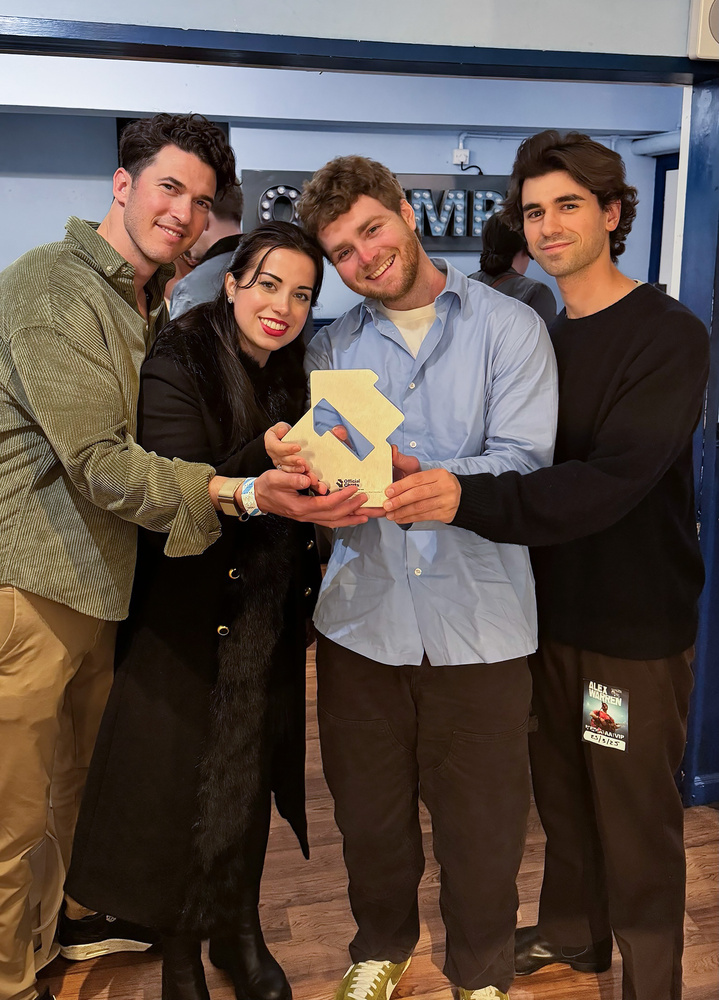 Co‑writers Cal Shapiro (far left) and Mags Duval (centre left) celebrate ‘Ordinary’ topping the UK charts with Alex Warren (centre right) and Adam Yaron.
“It was very much an upward curve with Alex. With each release, we gained more and more momentum. The support from his incredible manager Brian Sokolik, and Mikey Parker, his A&R, have been key to propelling the music forward. But most important is Alex’s talent for delving into the creative process and presenting the music to his audience so authentically. After we wrote ‘Ordinary’, he was convinced that it needed to be the next single. He wanted the world to hear it. It came out in early February of 2025, which was very quickly after we completed it.”
On The Bounce
According to Yaron, the quartet of songwriters “bounces around” various places to work, including Yaron’s home studio. The Perfect Sound Studios sessions in December 2024 proved particularly productive. “We sometimes go to studios when we want a more elaborate setup, with extra instruments and so on, and we booked the two weeks at Perfect Sound because we could be in this isolated place together, and work freely without needing to go home every evening. It was just the four of us, and a lot of our initial writing process involves me playing guitar or piano, and all of us throwing around melody and lyric ideas. It’s rare that I am at the laptop at the infancy of a song.
“About halfway through our stay, on the 9th of December, we had finished our song for the day, had dinner and were about to watch a movie together in the living room. Cal had brought a rubber bridge guitar, and I picked it up and started noodling, playing the opening riff of ‘Ordinary’. Mags said, ‘Oh, I like that, keep playing.’ We were all in the living room, and it was completely informal. Mags started to hum some melodies, as did Alex and Cal. We have endless voice memos of us starting to piece together what became the chorus.
“So we were all bouncing off each other and at a certain point we had a general sketch of the chorus, still not knowing what the verse was going to be. Then we said, ‘OK, that’s good for now,’ and we watched the movie and let the idea marinate. I don’t know why we did that, because usually when we have a spark, our instinct is to run with it and get it finished . But we were comfortable knowing we could really dive in with fresh minds and ears the next day. When we woke up, we started crafting the verses, and perfecting the chorus melodies and lyrics that we had been playing with the night before. It was also at that point that I tracked the guitar in Logic, and added other things, and we started shaping the song.”
Shifty Character
The instrument that plays the arpeggio riff that opens ‘Ordinary’ has been the source of some online debate. Adam Yaron reveals all: “It took us a few days to get all parts of the song together. We were still very much writing when I recorded the guitar, with all three of them still working on the chorus lyrics in the control room. The moment that we unlocked the overall vibe of the song was when we had the guitar, and I added the kick, and those roomy claps and percussion‑like sounds, which I later layered in my studio. Once we had those three elements we understood the feeling we were chasing in the rest of the song.
“This Logic session was more chaotic than usual — in a good way. We were just following instincts, throwing paint at the wall. It was very spontaneous. One example of us just trying things was that I recorded the guitar in G major, and at some point we felt that the chorus was not climactic enough. So I pitched up the guitar, step by step, to find the key that worked best. We ended going up seven semitones, so we were in D major! This brought out one of my favourite parts, the low chorus start and then the octave jump up. It adds so much dynamics to the song.
Adam Yaron: Instead of replaying the guitar with each semitone we went up, it was easier to use the Waves SoundShifter pitch plug‑in.
“Instead of replaying the guitar with each semitone we went up, it was easier to use the Waves SoundShifter pitch plug‑in in Logic, in our minds simply as a placeholder. Any rational person would later have put a capo on the guitar and replayed the part, but it sounded really cool. So why change it? So the secret of the sound of that arpeggio is the SoundShifter plug‑in! After that we recorded most of the other live elements in the song, including two more rubber bridge guitar parts, Hammond C3 organ, piano, choir and lead vocals. While I played all the instrumental parts, and am credited as producer, Alex, Mags and Cal all contributed incredible ideas, and the record would have sounded very different without them in the room.
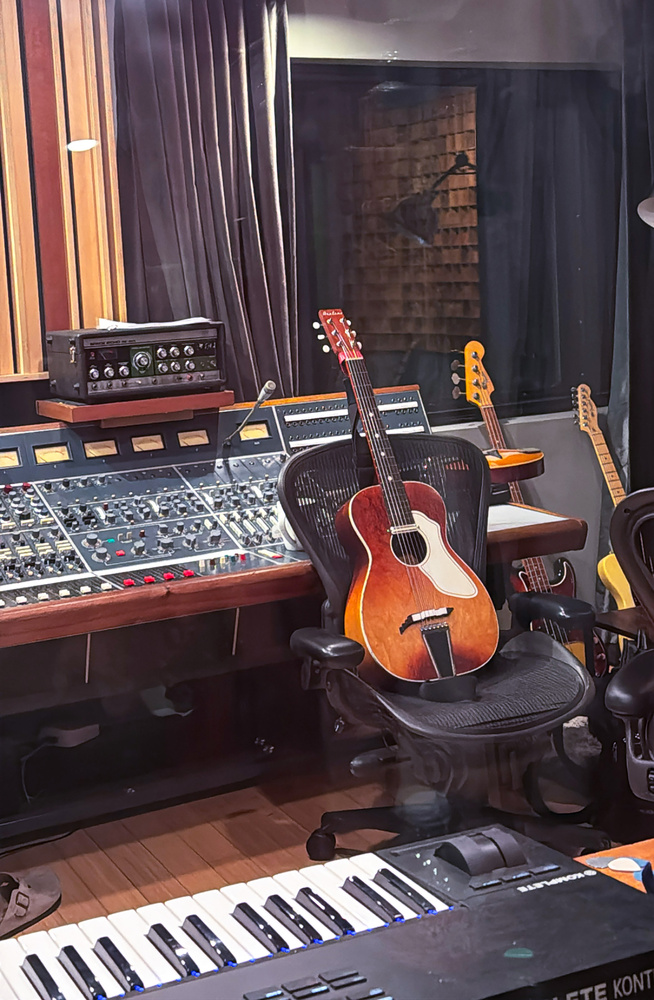 The ear‑catching arpeggiated sound that runs through ‘Ordinary’ started life as a rubber bridge guitar, shown here at Perfect Sound Studios where the song was written.
“The studio was great, and we made good use of the equipment there, in particular the Neve 8014 console, which is from the early ’70s and that they had restored. It sounded incredible. We recorded pretty much all mics through that. For the acoustic guitars, I used a Neumann KM54a and a U47, which I think was from the late ’50s. The 54 gave a stronger transient response and the 47 added warmth and body. I used several acoustic guitars on the album, but on ‘Ordinary’ only the rubber bridge one, playing the main riff, and two layers of counter melodies and more whimsical parts.
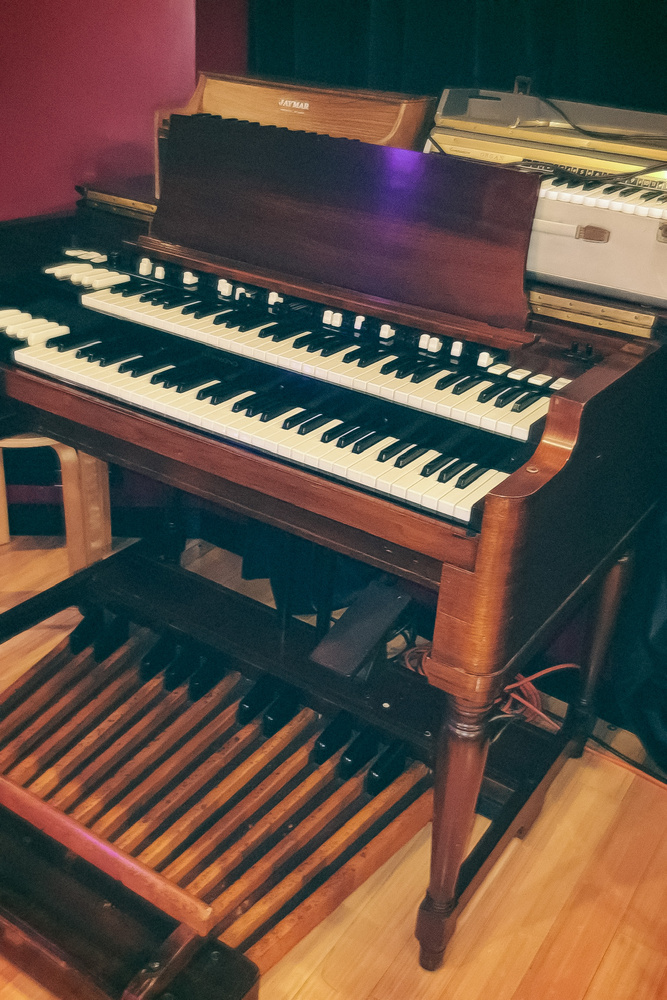 ‘Ordinary’ made extensive use of Perfect Sound’s Hammond C3 organ.“I layered quite a few Hammond C3 organ overdubs. I don’t remember the specific mics, but the setup was left, right and underneath. A lot of the low end in ‘Ordinary’ comes from the organ, though I later added a few synthy Juno‑like bass sounds from Spectrasonics Trilian for the sub frequencies. The C3 gave a rich low end that we really loved. The piano was a Yamaha C7, and we had a left and right mic and a [Neumann] U87 underneath, plus a room mic.”
Choral Singing
One stirring aspect of ‘Ordinary’ is the gang vocals, or what Yaron calls the choirs, where the treatment applied to the rubber bridge guitar made another appearance. “The choirs were sung by Cal, Mags and I. We spent a whole day arranging and singing them. The three of us got into the booth and built the parts with a great deal of precision. I didn’t tune them, it’s all very organic. We used three mics so we could capture a lot of texture and width: a U47, a Telefunken 251, and the KM54a in the centre. I probably should have done a matched stereo pair, but we were going fast, everything was off the cuff. We weren’t overthinking it. Those mics were already set up, so we just got a level and started singing.
“We recorded the choirs before the final vocal. We had a scratch lead vocal, but I really wanted for Alex to sing over something that felt as grand as the final track was going to be. However, we had a moment early on when tracking him when we thought, ‘Wait a second, it’s a little too high!’ At first I was panicking, thinking, ‘Oh my God, I spent a whole day recording these choirs. Do we have to redo them?’ So another iteration of SoundShifter appeared in the project. In fact, we had gone eight semitones up from G at that point, and were in Eb major. So we went down a half step with the piano, the choirs, the organ, and of course from eight steps to seven steps up with the rubber bridge guitar.
“I’d never use the SoundShifter on a lead vocal, and I was wary of doing it on the choir. But in fact, it gives it a darkness and otherworldliness, and helps make the record sound the way it does. So all the choirs that you hear are as a group pitched down a half step! It was a weird workaround. I’d never done it before, and I probably will never do it again. But it worked for this song. We really wanted to make sure that it sounded like this ethereal sonic landscape. And if you mute the choirs, it’s not the same song any more.
“So Alex sang his lead vocals in D major. We recorded him with the Neumann U47, going into the console as well, and then a Tube‑Tech CL‑1B, which I use often on Alex. He’s such a dynamic singer, it’s really helpful to have that compressor on the way in to catch some of the dynamics as he gets louder and softer. I also adjust the gain. Alex has such a rich textured voice, and the U47 captured him beautifully. It’s a bit darker than a 251, which I would normally use on him. But there was something about the darker tone of this song that worked really well.”
Finishing Touches
After the two weeks of sessions at Perfect Sound Studios, Yaron returned to his home studio, where he finalised the arrangement and production, so it could be sent to mixer Alex Ghenea, son of Serban.
“I really tried to elevate what we did, keeping the integrity of the feeling of each song. I spent a long time in my own studio alone! It’s pretty humble. I have Barefoot Sound MicroMain45 monitors, and a Universal Audio Apollo X8 interface. I love using UAD plug‑ins, and carry a UAD‑2 Satellite when I go to other studios, though I wish they’d make it smaller as it’s so hefty. My electric guitars go through a Kemper amp simulator, and I have a Telefunken 251 that goes into a BAE 1073 mic pre. I also have lots of guitars and an upright piano here.
“Finishing ‘Ordinary’ involved vocal comping, adding samples and synth stuff, electric guitars, percussion, and heavier drum programming. The number one thing was finding ways to support the main arpeggio guitar part in the song, which I did with a couple of Omnisphere spiccato string patches that cut through a bit more. As the song goes on, there are more layers. I played them exactly matching the guitar part. For most of the song they just give a feeling, more than that you can actually hear them, but in the choruses where it gets really big these patches are more pronounced.
“While the MIDI was on the grid, I kept the rubber bridge guitar part pretty loose and human, though there were some guitar notes that I had to tighten up, as I’m not a perfect player. What’s great in Logic is that it allows you to change the percentage of quantisation. I rarely do 100 percent. If I want things really tight, I set the level of quantisation to 80 percent or something, so things still have room to breathe, without being messy. Perhaps influenced by my love for the character and imperfections in classic records, my general approach is that if it feels good, don’t touch it. I really want things to feel human and alive. For this reason I did not quantise or tune the hundreds of choir tracks that I ended up with.
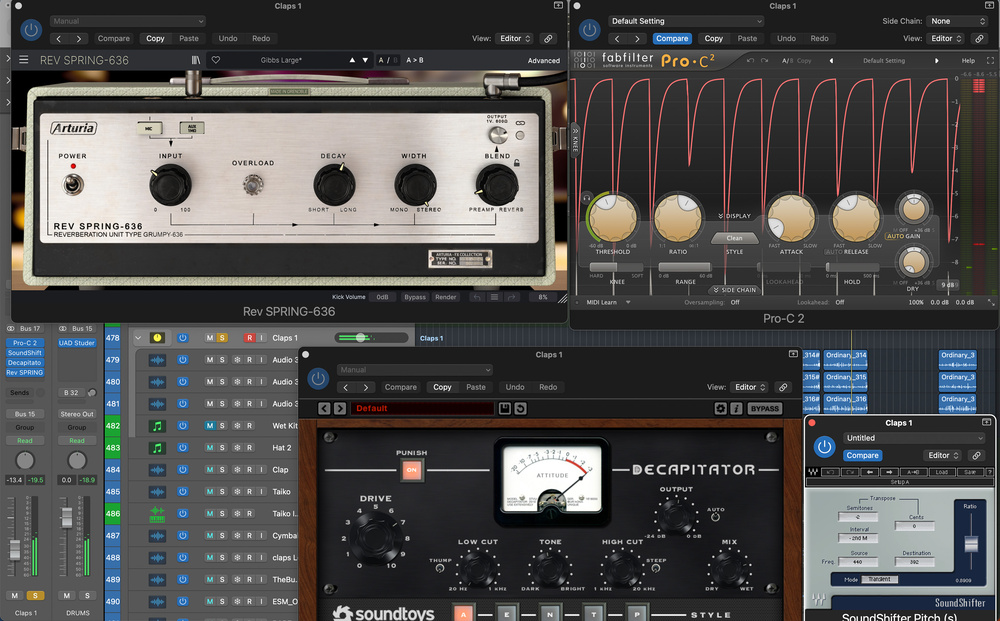 The handclaps that mark each quarter note were heavily processed in Logic.
“For the same reason, there are very few samples in this song. I recorded a lot of the percussion, including the handclaps, live in my living room. That gives a little bit of life. I also added some driven electric guitar power chords in the choruses, for more grit and saturation, and to give the song a little bit more bite. There’s an additional buzzy, very aggressive synth sound that does the same. There’s something orchestral about this song, and one of the last things I added were timpani on the downbeats of the choruses, going with the bass line, to give more sustain and add to the orchestral feeling. I used a free Spitfire plug‑in that I got a few years ago and that sound great.”
Staying Inspired
As Yaron’s work on finishing the sessions progressed, his rough mixes became more and more involved. “When I get towards the finish line, I definitely obsess over what I’m doing. By contrast, I try not to listen to a session too much while we’re still writing the song. For example, I generally don’t bounce the song to stereo until I feel like we’ve communicated the general vision enough. Only once I feel there’s enough for me to latch on to will I make a first version bounce and send it to everybody to see what they think.
“I try not to get too used to the very first version because it’s easy to lack imagination if you’ve heard it too many times. At the same time, there comes a moment when, unless there’s anything glaring, you have to let go a little bit and trust that your initial inspiration and the initial thing you were excited about informs the end product. That’s what we tried to do on ‘Ordinary’ especially. Everything in the record is from that initial inspiration.
“As I’m finishing a record, I spend a good chunk of time on transitions between sections. How are we getting from the pre to the chorus? How are we getting from the chorus to the second verse? What are the dynamic shifts? And what can I mute? Usually if I mute something and I forget that I muted it, I delete it because clearly I didn’t miss it, so it’s not important enough to keep. Also, I tend to add plug‑ins to sounds when I put parts down, so I don’t forget. As a result there always are lots of plug‑ins in my sessions that are disabled, because I tried something, and if it later didn’t feel good any more, I turned it off.
“Of course, while rough mixing I’ll be adding plug‑ins to get it as close as I can get it. In the case of the rubber bridge guitars on ‘Ordinary,’ I treated the group with the three guitar parts with some EQ from FabFilter Pro‑Q 3, cutting low end and a tiny bit of high end, no idea why. There’s a Soundtoys Decapitator, not doing too much, and the UAD 1176LN Rev E adds some tone and glues the sounds together. There are tons of organ parts in the session, and they sounded great as they were. So it’s just the C3, with no plug‑ins. On the pianos I cut low end and added some high end with Pro‑Q 3, and the UAD Distressor also glued everything together. Like with the organs, I mostly let the instrument speak for itself, having made sure we got the mics right.
“There’s not a lot going on in the drums and percussion. Just the kick, the claps recorded in my living room, some toms, and the timpani. The quarter‑note claps do what a hi‑hat would normally do. I put the Arturia Rev Spring 636 spring reverb on them for a little bit of a vintage vibe. It rolls off some of the highs and gives it a nice texture. I again used SoundShifter, to pitch the claps two semitones down, in this case just to darken the sound and give them a different feeling. Finally, there’s the Decapitator again, which is a classic go‑to for me. I’m doing pretty heavy saturation as well as compression, to level everything out. On the drum bus I had the UAD Studer 800. I find it reduces some of the width sometimes, but it does something to glue together the drums in this song. And it’s just adding a little bit of saturation and grit, makes the drums cut through in a more aggressive way.”
Peak Performance
With regards to post‑producing the vocals, Yaron stresses: “Relying on the performance is number one for me every time. If I don’t have a good performance, there’s little I can do. Luckily, Alex is a very gifted vocalist, and every time he gets to the microphone, it takes the song to new heights.
“In terms of processing, it’s subtle stuff. I normally have a Pro‑Q 3 going into Logic’s de‑esser, and I love how the UAD 1176 sounds on his voice. Sometimes I use a less aggressive UAD LA‑2A to add some tone. I also really like the Overloud Gem Dopamine [enhancer] to add some top‑end excitement.
“For delays I’ll use the Soundtoys EchoBoy and Waves H‑Delay, and for reverb the Valhalla Vintage Verb, often just on the default setting, as it sounds good immediately. I also like UAD’s Capitol Chambers a lot. I treated the choirs very minimally. We had done hundreds and hundreds of takes, so I needed to do quite a bit of comping. We already had some compression on the way in, so it was just Pro‑Q 3, carving out some mud in the low end, some light compression, and I definitely used the Gem Dopamine, as well as the Vintage Verb. The choirs sounded great, so I did not need to reinvent the wheel.
“With the master bus, my first go‑to is iZotope Ozone 9. I love the Maximizer. I go to the loudest part and allow Ozone to see what’s going on, and suggest a setting, and I work with that. Usually I also do some subtle EQ, and the Imager is great if I want more width. It really depends on the song. Sometimes I’ll use the UAD Studer 800, though not on ‘Ordinary’. I’ll usually end the mastering chain with the FabFilter Pro‑L 2 [limiter], just trying to make sure there’s no clipping and to see if I can get some more loudness. My favourite mixers make it a point to keep the integrity of what I was going for and then they elevate it. Alex [Ghenea] is one of them, and he did a great job on ‘Ordinary’. We always believed ‘Ordinary’ had something special — but the way people have connected with it is beyond anything we imagined!”
Adam Yaron
Born 26 years ago in LA, Adam Yaron grew up in a musical household. “My mother is a classical pianist and teacher. I grew up listening to her playing. I rebelled against playing classical music once I started hearing Stevie Wonder, Billy Joel, Elton John, Carol King, etc. I also learned to play some guitar, and was drawn to the classic rock my dad played around the house. In high school I discovered Top 40, and developed a love for more modern pop music. All the while, I was writing songs by myself and playing them with my two little brothers who are also very musical. Eventually, in 2016, I went to the USC Thornton School of Music, where I studied songwriting, met likeminded writers and producers, and fell in love with the creative process.
“Before USC I’d been dabbling in GarageBand, but I did not consider myself a producer. I studied with Patrice Rushen who is an incredible pianist, composer, artist and songwriter, and she was one of the catalysts for me delving more into arranging and producing. During my first two years at the USC I learned how to recreate, in a live setting, legendary pop songs dating back to James Brown, Aretha, Roberta Flack, the Beatles, Jackson 5, Earth, Wind & Fire, Stevie, all the greats, picking apart every single element in these productions. That was a really formative time for me, and shaped my ear and understanding of what goes into a memorable and impactful arrangement.
“After I graduated, Barbara Cane of the BMI became a champion of my songwriting and she helped me get into sessions and meet many other young writers. Because it was during Covid, I was collaborating a lot over Zoom, and met a lot of people that way, while getting in my 10,000 hours. I was eventually introduced to Alex, and we have been working together nonstop for four years. That’s part of the reason the success of ‘Ordinary’ is so meaningful; we’ve been on this journey for so long.”