

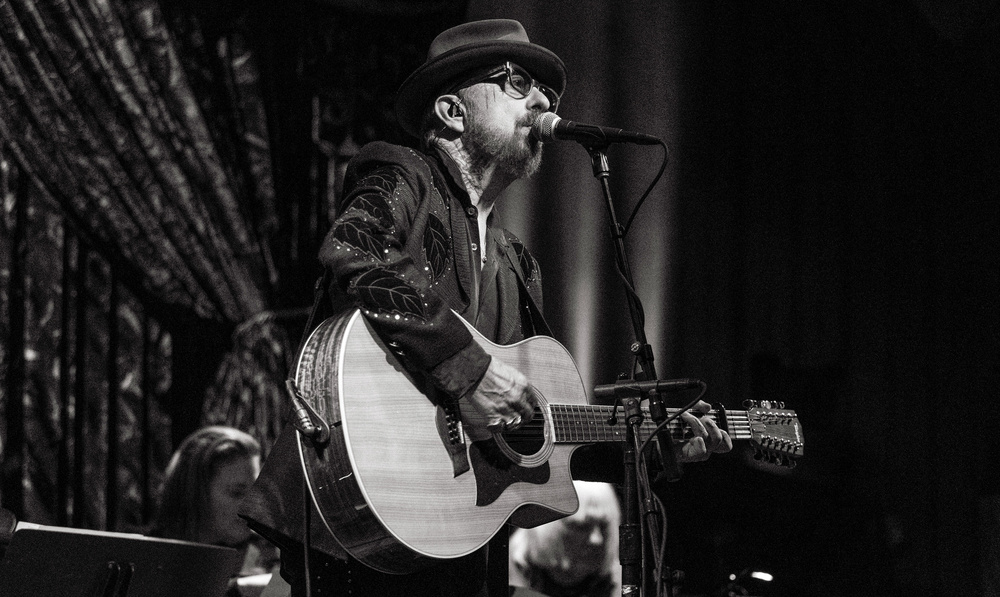
 Dave Stewart performing songs from Dave Does Dylan on PBS TV.
As one half of Eurythmics, Dave Stewart created a chart‑topping blend of soul music and electronica. Now he’s paying tribute to his earliest influences.
“When I was a kid, I had two Bob Dylan albums — The Freewheelin’ Bob Dylan and Another Side Of Bob Dylan — and I was just fascinated with the lyrics,” recalls Dave Stewart, co‑founder of influential ’80s synth‑pop duo Eurythmics. “And I used to sing these songs when I was about 16 years old in the folk clubs of my home town of Sunderland.”
Almost 60 years later, Stewart has paid tribute to this formative influence by recording an album of covers titled Dave Does Dylan, recorded in a minimalist fashion that retains the simplicity and directness of the originals.
“It depended on where I was,” explains Stewart. “Sometimes I’d be in a hotel room, sometimes in my home studio in the Bahamas, and sometimes in Nashville or sometimes, God knows where. We — Jesse, my engineer, and I ‑ always take a couple of mics with us on the road so that we’re able to record into the laptop. So, I’d just sing the song live straight into the iPhone and I would post the recording on Instagram, and people would react to it and go, ‘I love that song and it sounds really good. Why don’t you put it out so we can get it?’ Then management said, ‘Why don’t we make some vinyl for Record Store Day?’ So, we did a vinyl run of about 3000 for Record Store Day.”
Stewart’s go‑to microphones for the road weren’t extravagant by any means. “They’re not fancy or special but very reliable Shure mics,” says Stewart. “Basically, two Shure SM7Bs — one for the voice, and one on the guitar — and sometimes we used an Audio‑Technica AT5045 on the guitar too, depending on where we were.”
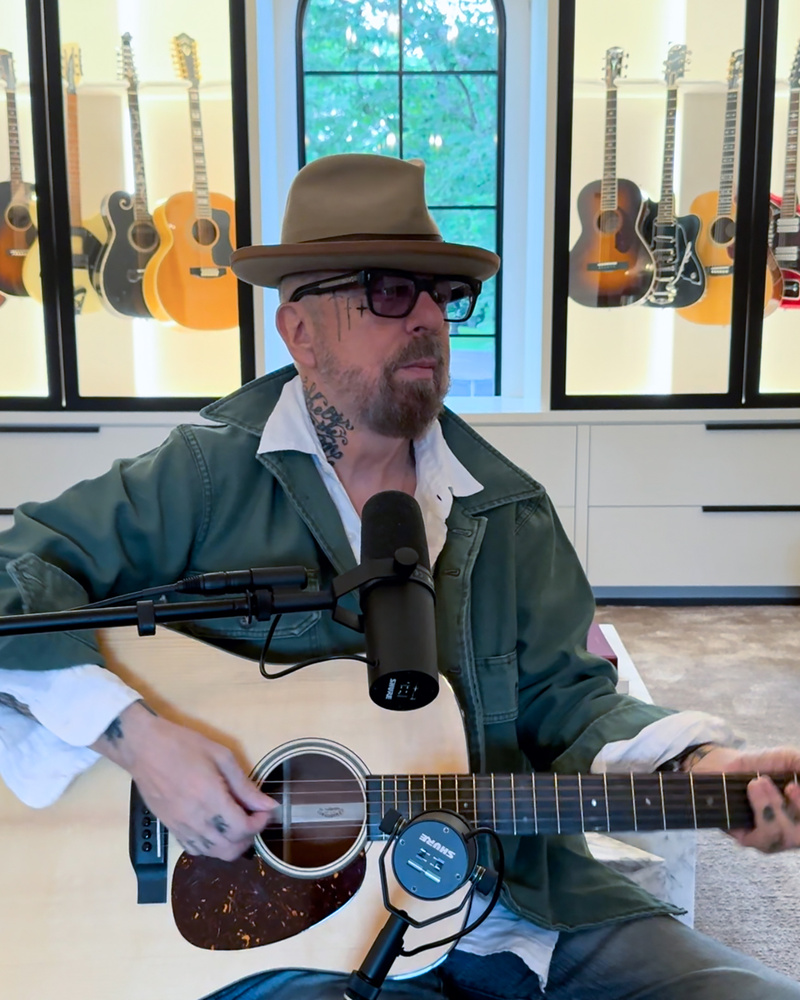 Dave Does Dylan was recorded very quickly, using two Shure SM7B dynamic microphones.
When it came to guitars, Stewart’s choices were more varied. “Again, it depended on whatever guitar I had with me at the time,” he says. “One of them was an Australian‑made miniature 12‑string Maton which I used on the track ‘Shelter From The Storm’. I also used my blue Takamine that I originally bought back in the ’80s, as I was using it for concerts and we’d have it in my hotel room. I also used this beautiful limited‑edition Martin that John McBride, who owns Blackbird Studios in Nashville, gave to me for my birthday. It is made out of the wood of a ship that sank like 200 years ago. Martin made a very small amount of these guitars out of this wood. Also, an old 1948 Gibson LG‑2 parlour guitar. I have around eight guitars in my studio in the Bahamas, and about 16 guitars in my little home studio in Nashville.”
Tour Management
Dave Stewart first appeared upon the scene in the late 1970s with pop‑rock group The Tourists, fronted by his then girlfriend and later Eurythmics partner Annie Lennox. The group released three albums in quick succession: their self‑titled debut in 1979 was followed later that same year by Reality Effect, yielding two UK top 10 singles with ‘I Only Want To Be With You’ and ‘So Good To Be Back Home Again’. Luminous Basement appeared in 1980 before the group disintegrated while on tour in Australia. It was while they were licking their wounds and contemplating an uncertain future in a hotel room in the Australian country town of Wagga Wagga that Stewart and Lennox stumbled upon an idea that would alter their lives.
“I’d brought in my suitcase this tiny little miniature sort of plastic synthesizer called an EDP Wasp,” recalls Stewart. “You couldn’t press a keyboard down and it was like a Stylophone and was black and yellow like the colours of a wasp. But what was great about it was that you had the basic synthesizer controls where you could change the sound. And at first, I was trying to make it sound like a didgeridoo. Then I started playing just very simple bass lines on it. As Annie and I were in the hotel room, Annie started singing along a bit to what I was playing. We were just messing around but we kind of vaguely had this idea that just the two of us writing songs could be quite good. When we got back to England we decided to pursue the idea. We’d been living together for about four years, in a squat at first, but now were living in this apartment. So, all we ever did was see each other and talk to each other 24 hours. It was just us two. We started to get folie à deux so we decided we should live apart — so Annie moved upstairs, and I downstairs.”
In early 1981, both Stewart and Lennox headed to Cologne, Germany to begin the recording process for the Eurythmics’ debut album In The Garden with German producer Conny Plank, who had worked with leading Krautrock groups such as Neu!, Cluster and Kraftwerk. By this point Stewart had added further gear to his sonic arsenal, and working with Plank gave Stewart an education in the art of recording.
“I had gone to a music shop and got a little bit more additional gear for the Wasp,” he says. “I got a Caterpillar master keyboard and a Spider sequencer and basically when I wired them together, I could start sequencing the Wasp and it was really powerful‑sounding. So, I got really into that and then I got a couple more other things: a Roland TR‑606 Drumatix, which is another little drum machine, and a Roland Space Echo, and I was making all this kind of weird...
You are reading one of the locked Subscribers-only articles from our latest 5 issues.
You've read 30% of this article for FREE, so to continue reading...
- ✅ Log in - if you have a Digital Subscription you bought from SoundOnSound.com
- ⬇️ Buy & Download this Single Article in PDF format £0.83 GBP$1.49 USD
For less than the price of a coffee, buy now and immediately download to your computer, tablet or mobile. - ⬇️ ⬇️ ⬇️ Buy & Download the FULL ISSUE PDF
Our 'full SOS magazine' for smartphone/tablet/computer. More info... - 📲 Buy a DIGITAL subscription (or 📖 📲 Print + Digital sub)
Instantly unlock ALL Premium web articles! We often release online-only content.
Visit our ShopStore.