

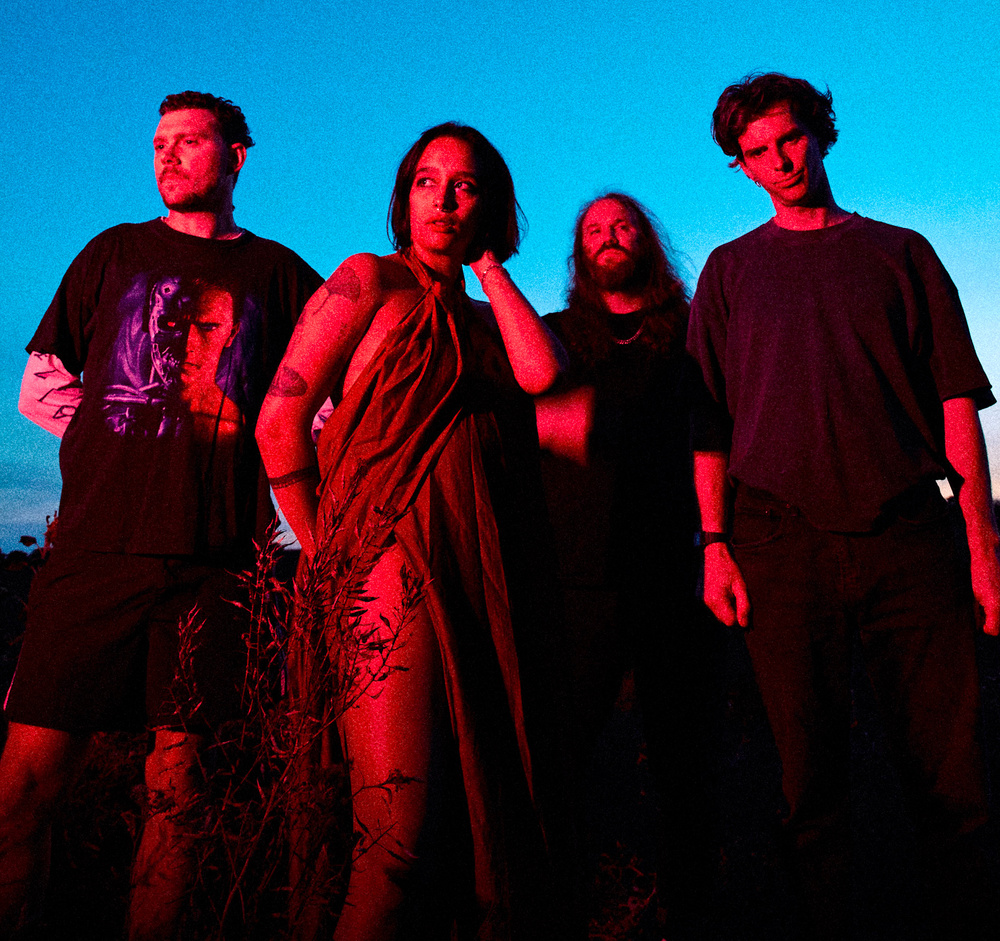
Mandy, Indiana are a four‑piece band from Manchester via Berlin, made up of Scott Fair, Valentine Caulfield, Simon Catling and Alex Macdougall. Produced by Fair, their recent second album URGH is a prime showcase for his idiosyncratic approach in the studio.
At the moment I can’t stop listening to
Recently, I would say the Oneohtrix Point Never album Tranquilizer, which came out last year. I had a strange relationship with music last year: I got rid of my Spotify after all of the allegations about Daniel Ek and his investments in military weapons technology came out, and I went oldschool and just bought a record whenever I could afford it. Sometimes you just come across an album that really reminds you of why you fell in love with music. And that’s what Tranquilizer was for me when I when I first heard it. It’s music that I feel is for an overactive mind, which is what I have! When your brain is constantly going from one thing to another all the time, his music sort of matches that. In fact, listening to the latest Mandy, Indiana single the other day, my wife just said, ‘I like this one, because it doesn’t change too much. I can dance to it!’ But yeah, I do love it when tracks constantly take hairpin turns and turn into something else. And Daniel Lopatin [Oneohtrix Point Never] is such a master of that.
The artist I’d most like to collaborate with
Death Grips. I discovered The Money Store years ago and have had that album for a long time, but I never really went beyond a certain point with it. Then, a couple of years back, we played a couple of festivals where they were also on the bill, and I finally got to see them live. I just became obsessed with the rest of their catalogue, with them as performers, and it was a massive inspiration for this new Mandy, Indiana record. I really enjoy how Zach Hill plays over the top of himself, live. I think that’s such an interesting and unique way to approach that music. Our drummer, Alex, is a really impulsive and energetic drummer as well. I think it’d be great to see him play alongside Zach Hill, and then having MC Ride bouncing off Val, vocally.
The first thing I look for in a studio
I prioritise the space above any kind of gear. An engineer can choose the mic or what compressor or what preamp to put it through. I’m not as bothered about that. I care about how the source sounds in the space, you know? We recorded drums for the first album in a cave, for example. Which was a bit of a nightmare, but also incredible. And it sounds amazing. On this one we were in this studio in Leeds, underneath a big sort of village hall where they do theatre productions and stuff. And we used the theatre as the live space to record the drums. We were actually supposed to do some drums up there and then some in another little drum booth. But we didn’t have time to set the booth up, so we actually ended up constructing a type of drum booth in the theatre, using these big baffles! It’s bizarre: the driest drums on the album are still being played in that massive room.
The person I would consider my mentor
I’ve never really had a ‘producer’ mentor, to be honest. I started recording young, you know, nine or 10 years old, with a tape recorder. I very much would consider myself self‑taught — which is not to pat myself on the back — my production techniques are very flawed! If I ever produce for anybody else, I always make them aware of that. “Hey, you’re not getting, like, a ‘producer’ with me, you’re getting some kind of... weird thing.” So there really wasn’t anybody who I was learning from as a producer when I was younger. As I said before, I was just in a room by myself, messing about with stuff, getting it wrong and thinking, “Oh, well, that sounds cool anyway!” And a lot of that isolation and kind of loneliness then went into the music, you know. It wasn’t like I was really antisocial. I had friends, but nobody really understood it the way that I did, or threw themselves so deeply and passionately into it as I did. Even so, production was always just a necessary way of getting my ideas out. Some people do revel in the equipment, they love the gear, and that becomes part of the process as well. But I just needed some way of getting what was in my head into the physical realm, into the world. If I could have just spat it out without a production phase, I would have.
Scott Fair: With references, I don’t reach for stuff that I know I can do. I don’t have to refer to stuff that I’m confident in. I’m referencing things that I can’t do.
My go‑to reference track or album
I used a lot of different references on this album. One that I probably came back to the most would be ‘Baby, I’m Bleeding’ by JPEGMAFIA. Another pretty industrial‑influenced hip‑hop track. He uses a lot of blown‑out 808 sounds, which is something that provided a big jumping off point for the album. That was a sound that I really kind of fell in love with, and was constantly trying to find interesting ways to use it. He uses a lot of side‑chaining of different elements to bring things forwards in the mix. Obviously the kick drum is a kind of go‑to for a lot of producers with that, but he’ll do it with samples. And it’s like, “Did he mean to do that!?” I love that about his production in particular. He just does not give a fuck about conventional techniques. It’s just about what jumps out the most, what’s the most arresting, the most confusing and most disorientating. That’s an approach that we utilise a lot, trying to trick people into thinking that you’re in one space, but then switching it to another, or having one element be in its own space, and then another element be in a completely different space. His use of reverbs, his drum production, the way he uses samples...
With references, I don’t reach for stuff that I know I can do. I don’t have to refer to stuff that I’m confident in. I’m referencing things that I can’t do.
My secret weapon in the studio is
I use this plug‑in, CamelCrusher, which is obviously a super well‑known distortion plug‑in. It’s something I used years ago and kind of forgot about, but after I upgraded my setup, I wanted it back because it has this specific sound. And I got it, but now the interface doesn’t work on it for some reason; so it manipulates the sound but you can’t look at it when changing the settings! You have to automate anything that you want to change! And I still use it all the time. It forces me to stop just looking at plug‑ins and use my ears. It creates a lot of character on percussive sounds, a lot of bass sounds, even on vocals and things.
The studio session I wish I’d witnessed
Recently, I was reading about Nirvana’s last studio session, where they did the song ‘You Know You’re Right’, which was recorded just months before Kurt died, and released some years after. I listened to it again recently, and I was just like, what’s the story behind this? Like, where did this come from? I’ve always had a fascination with him as a human being. I think it would be very sad to witness that last session, but I’d be very curious to know what the atmosphere was like, what his mental state was like. And, I mean, that is a powerful song as well. The lyrics are absolutely devastating.
The producer I’d most like to work with
BJ Burton, who did the Low records Double Negative and Hey What. His production on those two records in particular is a massive inspiration for me as a producer, just in terms of the use of noise, or ‘over‑using’ certain studio techniques to create music in a more experimental fashion. Just to witness those studio sessions would have been something incredible as well, just to hear what those songs were before his involvement, because the songs seem like they were written in a more traditional fashion. It’s his manipulation which really makes them transcend, I think. It’s the kind of distortion that you don’t often hear in records. Just pushing distortion to its limits. It feels quote‑unquote ‘wrong’ that he’s doing that. Like, he’s abusing the music with distortion!
The studio experience that taught me the most
Well, I have to say the drum session in the cave that I mentioned earlier. That was definitely a big contributing experience to my whole philosophy, about recording being about what’s happening in a specific time in a specific place, influenced by an environment and that imparting something to the recording. The track ‘2 Stripe’ particularly transports me back to being in that space. The interior of the cave looked kind of Martian; it was all this orange sand, just because of the rock type. And there was this pool of water. So it really was like being on another planet. I think they filmed Doctor Who or something there as well.
It was a really long way from where we parked the car and we had this big analogue desk with us and some outboard gear, and then all the mics and all these drums, and we were ferrying everything between the car and this cave. And it was a f**kingf**king nightmare. It really was. It was a very long day. It was interrupted by a cave diver at one point. It didn’t necessarily go down as a super great decision, but I think it was impulsive. And that’s what I like. I get bored by convention very easily.
The advice I’d give myself of 10 years ago
Don’t care as much about trying to do things properly, and lean more into your idiosyncrasies. Don’t worry about doing things to the ‘highest possible standard’, or some kind of industry standard. Just focus on figuring yourself out and what’s different about you and how that affects the style. You know, the first, like, few times that I heard some of the stuff I’ve been producing on the radio, I was just like, “Oh! They’ll play this on the radio? I guess I don’t have to worry about anything!”