

 Photo: Brett Sayles
With the right tools, you can capture a good vocal take in most rooms. And if you can’t, AI processors are opening up new possibilities...
One of the clearest giveaways that a recording was made in a project or home studio rather than a professional studio is the sound of the vocal. Boxiness, early reflections and uneven low‑mid build‑up typical of bedrooms, lofts and home offices mean that even when the performance is strong, the acoustic fingerprint of a small, untreated room can be difficult to escape.
Effective acoustic treatment is the best solution, but many people simply can’t treat their recording environments properly. Space constraints, rented and shared living arrangements or the temporary nature of a setup often force people to work in rooms that are too small or too lively to allow for a clean capture. And although we can reduce ambience capture by working extremely close to a capacitor microphone, this strategy introduces its own problems: over‑prominent breaths, lip and mouth noises and excessive proximity effect, which subsequent heavy compression or high‑frequency enhancement will only accentuate.
Professional facilities use purpose‑built booths, designed to provide a neutral, dry acoustic, or larger rooms where reflections occur later and more evenly, avoiding many of the problems common in small domestic spaces. But for home and project‑studio users, what can be done to improve vocal recordings when the ideal solution, tracking in a suitable, well‑treated space, isn’t an option?
This article explores the practical alternatives. We’ll look at passive acoustic tools, hybrid capture technologies, modern AI‑based cleanup options and the increasingly viable world of AI‑generated or AI‑revoiced vocals. Each approach addresses a different facet of the problem, and while none is preferable to a genuinely well‑designed recording environment, they can go a long way toward mitigating the shortcomings of a compromised space.
On‑mic Absorption
An accessible way to reduce room coloration is an on‑mic absorption system. The product that defined this category back in 2006 was the sE Electronics Reflexion Filter (https://seelectronics.com/products/rf-pro), which introduced the now‑familiar approach of placing a semi‑cylindrical absorber directly behind the microphone. Its patented multi‑layer construction combines different materials to target multiple frequency ranges, and when positioned correctly, it can provide a worthwhile improvement. The main thing that these devices do is to reduce the amount of vocal sound entering the room, rather than reducing the amount of room sound that is captured. However, in setups where the vocalist is facing a nearby wall, the Reflexion Filter can help reduce the strong early reflections that hit the microphone off‑axis, which in a cardioid mic are the most coloured and intrusive.
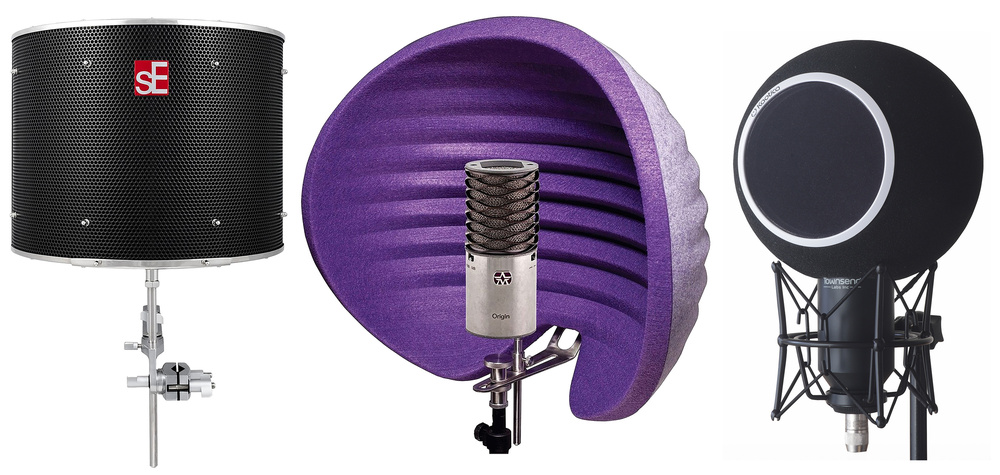 Reflection filters can help limit the amount of vocal sound that escapes into the room as ambience. Options include the original sE Electronics Reflexion Filter (left), the Aston Halo (centre) and the Kaotica Eyeball (right).
Positioning and support, however, matter. One common mistake is placing the microphone too far back inside the curve of the filter, which in my experience increases tonal coloration. The physical weight of the unit also means lightweight stands will struggle to support it properly. Aston’s Halo (www.astonmics.com/EN/product/halo) takes a more enveloping approach. Instead of the conventional semi‑cylindrical shape, it also curves both above and below the microphone, addressing one of the weak points of earlier designs. This broader coverage makes it more effective at reducing reflections arriving from vertical angles.
Kaotica’s Eyeball (www.kaoticaeyeball.com) is a different interpretation of the same idea. Rather than mounting absorption behind the microphone, it encloses the mic in a sphere of varied foam densities, with an integral pop filter. It’s compact, easy to position and provides consistent absorption from all directions.
One drawback shared by larger reflection filters is their impact on the performer’s sight line. In the same way that large gobos can isolate a performer visually as well as acoustically, a bulky on‑mic filter can reduce communication and line‑of‑sight — a consideration worth bearing in mind during vocal sessions.
There are many other options in this category, including the Adam Hall RF1, Vicoustic Flexi Screen Ultra, Primacoustic VoxGuard and Auralex MudGuard.
Portable Vocal Booths
A long‑standing workaround for recording vocals in a poor acoustic is the improvised booth made from absorbent household materials. Duvets are the default choice for many, and while they do offer some attenuation of mid‑ and high‑frequency reflections, heavier packing blankets generally perform better. There are also purpose‑made acoustic blankets available, which provide a more predictable and consistent result. For those who want an effective and visually attractive solution, a product such as the GIK Acoustics PIB Portable Vocal Booth (www.gikacoustics.net/en-gb/products/pib-portable-vocal-booth) offers a more convenient, repeatable solution. At 2m tall by 1m wide, this broadband absorber is vertically hinged and used free‑standing. It can be positioned individually or in multiples around the performer to create a controlled acoustic environment in much the same way as a homemade gobo, which if made correctly is an excellent solution. GIK publish performance data showing useful absorption extending down to 160Hz, which is adequate for vocal work. It’s a portable, professionally designed product which is a practical option for users who need reliable performance without installing permanent treatment.
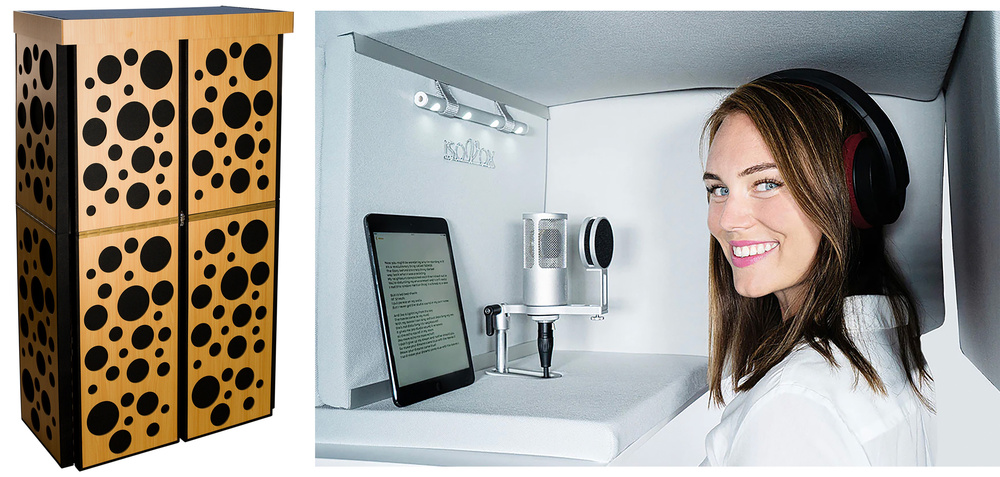 If you can’t build a permanent vocal booth in your studio, portable options are available, including the GIK PIB (left) and the IsoVox portable vocal booth.
An alternative approach is offered by the Isovox 2 (https://isovoxbooth.com/en-gb/pages/isovox-2-portable-vocal-booth), which takes the basic principle behind on‑mic reflection filters and pushes it to its logical extreme: a fully enclosed miniature vocal booth that sits over the shoulders and surrounds the singer’s head. This design provides a high degree of acoustic control, dramatically reducing the influence of the room — as long as your singer is comfortable with placing their head in a box! It also represents a significant investment, but should deliver a controlled and repeatable sound.
There are many variations on the idea of creating a temporary booth from portable elements, and foldable, easily stowable acoustic treatment panels are a popular approach. When deployed around the performer, these panels can form a surprisingly effective makeshift...
You are reading one of the locked Subscribers-only articles from our latest 5 issues.
You've read 30% of this article for FREE, so to continue reading...
- ✅ Log in - if you have a Digital Subscription you bought from SoundOnSound.com
- ⬇️ Buy & Download this Single Article in PDF format £0.83 GBP$1.49 USD
For less than the price of a coffee, buy now and immediately download to your computer, tablet or mobile. - ⬇️ ⬇️ ⬇️ Buy & Download the FULL ISSUE PDF
Our 'full SOS magazine' for smartphone/tablet/computer. More info... - 📲 Buy a DIGITAL subscription (or 📖 📲 Print + Digital sub)
Instantly unlock ALL Premium web articles! We often release online-only content.
Visit our ShopStore.