

 Photo: Marwan Elgamal @TheHighClubLondon
MsM’s bedroom studio in North London helped put grime on the map. Since then, both engineer and music have gone on to bigger things...
"Back in the day, if I got a really bad‑sounding rough mix, I used to think ‘Oh, this is going to be an easy one! I’ll get to show off!’ But those ones can be the most difficult, because often there’s no direction. It’s when you get a song where the rough mix is decent and it has the feeling — they’re the most fun, because you just have to figure out what they love about it and embellish that more. My job is to take what’s already there and give them a ‘more’ version or to help them get over their own finish line. I want to make it so that your song makes you happier.
"Some engineers might hear that and say ‘That’s just you being lazy!’ It’s not, because I’m working just as long hours, just as hard. Knowing when and what is the skill. I’ve known artists who have had stuff mixed by some of the most well‑respected mix engineers, and it’s gone out with the producer’s own mix in the end. Why? Because the mixer changed too much of what they loved. I remember when I first started mixing for people and I’d spent ages on a song only to send it off and hear ‘Yeah, we’re going to go with the rough.’
"That’s how I learned. On the job.”
Grime School
Most engineers do their learning away from the public eye. Not so Michalis Michael, aka MsM. After the teenager found his first mixing console in the boot of a stolen car, his bedroom studio became the focal point for this country’s first authentic urban genre. Leading grime artists such as Skepta, JME and Wiley recorded their most important tracks there, and MsM is still the engineer of choice for all of them, and Skepta and Boy Better Know in particular.
"I’d been DJ’ing with Majestic since we were 11 or 12 years old. Eventually we joined a crew of MCs and DJs, going on pirate radio stations and discovering new music and new technology together. JME says we were just more bored than other kids!
"I’d already started making beats on an old PC with Fruity Loops, and Music 2000 on a Playstation. I had a lot of DJ gear too: turntables, CDJ’s from when they first came out, drum machines. I’d nick what I could off my dad, he was a musician since he came to England. That’s how he earnt a living and it was around me my whole life. Then when the whole stolen car mixer thing happened it just sparked something in my head. I’d always seen studios and big mixers and loved how it looked, and this was an old Soundcraft 16 or 24‑channel desk. It felt like I had to learn about it and see what it could do. I remember thinking ‘Right, I’m gonna have a studio now,’ and asking my dad and his friend Sugar (RIP) for a breakdown of what was needed. I had no clue.
 A relic of the early days: MsM’s first electret mic, used to record many early grime vocals.Photo: Andy Nicholson / twogoldteethcouk"My dad gave me a battery‑powered small‑diaphragm pencil mic. It was meant to be part of a stereo pair for some tape deck, I think; it was a terrible mic, but it made all the difference as it was so sensitive. We’d been using dynamics ‘til then. Between that and the mixer, all of a sudden I was getting clearer vocals and my friends loved it.
"My booth was my wardrobe. I would open the two doors to the wardrobe, stick the mic in the middle and hang blankets on either door. We made the first mixtape Boy Better Know — Shh Hut Yuh Muh that way. That was all done on boredom and a love of music. Same with the first few Skepta albums, ‘Too Many Man’ and a lot of grime music from that era: from a bedroom in North London. There was no industry for us to get into, we were just making music we liked, with what we had. I look back and think about those days, and it really was basic stuff: that old pencil mic, which then led to a Rode mic, M‑Audio Audiophile 2496 soundcard and the mixer as my pre/EQ, Tannoy Reveal speakers, Cubase with the Kjaerhus free plug‑ins. We were just excited that we could even make a song at home.”
Chip Tunes
As word got around the developing grime scene, more and more artists started beating a path to MsM’s door. "I was in my room watching a Risky Roadz DVD with JME, and I get a knock at the door. I opened it and Wiley’s standing there. That’s literally how we met — someone I’d listened to in school on radio, tapes, bought his vinyls. He said JME had told him there was a studio here so here he was!
"So he’s come upstairs, we started recording, and me and him just got on straight away. A couple of months into sessions and things were getting busier but now with people I didn’t know, rather than all my local friends. The studio was my mum and dad’s house, and eventually that ran its course… plus the weed smoking wasn’t an option. That led to Wiley saying ‘We need to get you a studio,’ and within a few weeks or so me, Wiley and Godsgift have gone to look at a place to rent and decided on it the same day.
"That was a fun time but also crazy. I was getting calls from all sorts of artists hearing about ‘studio time’ and meeting new people. I did some of the early Jammer stuff, the Movement’s stuff there, Frisco’s mixtapes, the BBK stuff, some stuff for Skitz Beats and Esco (RIP). We had an early MTV feature on JME in the studio those times too, that was sick.
"After around six months or so of what felt like the beginning of a new chapter, the studio was robbed… with me inside it! It was a big setback at the time, but in hindsight, probably one of the best things that happened to me. After that settled, JME and my Dad got some money together again and bought a Focusrite Platinum Voicemaster, an M‑Audio interface, a Rode NT1A, Tannoy Reveals, and set up at home again, as basic as it gets.
"We were still doing Wiley’s Tunnel Vision stuff in the new setup back at my mum’s house. I think there was 10 volumes in the end. Ten mixtapes. I didn’t do them all, but I did a bloody lot of it! In those days if it wasn’t JME or Skepta, I was definitely in studio with Wiley. Them lot kept me busy.”
It was inevitable that sooner or later an artist would cross over from the grime scene into the mainstream, and when this happened, MsM’s career got a boost too. "I was in PC World, and I got a call from Wiley saying ‘M, I’m outside your house! Come here!’ I got home to find Wiley and a young MC who I didn’t know at the time. Wiley said this kid was sick and I was gonna do his mixtape. That kid was Chipmunk. To cut a long story short, me and Chip put in a lot of hours, got his mixtape League Of My Own out and also began working on the I Am album. He started to get a buzz in the commercial world and he eventually got a deal out of it, and all of a sudden I was in conversation with Sony. That was my first encounter with major labels. They were fun times, man, watching this kid go from just a local lad to a star in a matter of a year or two. Which wasn’t that easy in those days.”
Learning Curve
Although it was MsM’s big breakthough in terms of chart success, however, the Chipmunk project also showed up his inexperience. "They didn’t let me mix it, and they were smart for doing that. At the time, it hurt, because I’d spent a year plus working on this album and they just took it from me and gave it to somebody to mix, but with hindsight, that was the right thing to do. I didn’t know how to mix an album. I knew how to operate all the equipment, how to record, how to use Cubase — but I wasn’t listening or set up how I should have been. As silly as it may sound, there’s also an admin side to mixing for labels that I wasn’t aware of in those days, that would have been a struggle.”
Within the grime scene, however, MsM was getting too busy for home studio life again, and after a year or so, decided to set up another commercial studio with his old friend Majestic. "Around 2009 I got that second commercial spot with Majestic. Some of my best studio sessions happened there. Me and Skepta basically locked ourselves away for a few years in that room, made loads of shit, released loads of shit, went on tours, doing shows up and down the country and going back to the studio after. Or before.
"Those were my boot‑camp days, my training in knowing how artists work and understanding the social level of this job — the psychology, even. That two‑, three‑year period in Barnet is what really taught me what artists want, how to be in the studio. It trained me to stay up for 18‑hour sessions, it taught me how to be drunk in a session and still work, it taught me my limits of smoking in a session before it all went wrong... And it was just me. I was the cleaner, the owner, the manager, the engineer, everything.”
Discomfort Zone
After years of doing everything, MsM started to feel he wanted to dedicate more of his time to mixing. He thus made the fateful decision to start working with another British engineer looking to make it big, and spent the next couple of years assisting, with a short period working in Atlanta, Georgia and a spell in Britannia Row Studios in London. However, things didn’t work out as well as he’d hoped for, and having sold all his equipment to fund the assisting period, MsM eventually found himself without a studio to call his own. Looking back, though, he sees the experience that he gained in this time as the missing piece of the puzzle.
"Those two years of being away from my room and my circle — I don’t know if I’d have learned some of the stuff any other way. One time I remember in Barnet we were sitting in my old room, and Skep turned around and said ‘Why don’t we sonically sound like this producer’s drums?’ and I vividly remember turning around, pointing at my rack and going ‘It’s because we haven’t got enough of this.’
"Looking back now, I really believed that. I really believed that I didn’t have enough things to make us sound good. And while assisting, I got taken out of my comfort zone, thrown into a few sessions where it was me and a laptop, and I was watching people do songs from artists that I listened to, and I’m going ‘Huh? They’re just using Waves’ RComp, and they’re spending 10 minutes on it. They’re just flying through this with plug‑ins. What the fuck’s going on here?’ And because I was no longer mixing, I was watching. I started listening. Ironic. Because my hands were no longer in use, I’m just sitting there going ‘He’s changing the release time, I can hear what that’s doing now!’ And I was amazed at how simple the process was and how few things they were using, but the amount of impact on the sound was blowing my mind. I was like ‘I’ve got all these plug‑ins, and I’ve never heard this!’”
No longer assisting, MsM set up once again in his Mum’s house and started to rebuild his career, helped by the fact that grime was, at last, gaining wider recognition. "It was so ground‑level popular that people in the industry knew something was going on. So I started mixing again. I was mixing with just a laptop and some speakers, and it was working. I was doing mixes that people were going ‘Yeah, this is sick.’ All of a sudden I’m not blaming the lack of anything, it’s just wax on, wax off, wax on, wax off — every day. It was a nasty few years, but I came out the other end much better off.”
Back In The Room
MsM’s experiences in America also left him with what he calls "a new‑found appreciation for acoustics”, and it’s noticeable that most of the products he enthuses about belong in the monitor chain. These include several high‑end converters — the Lynx Aurora(n), Prism Lyra and Dave Hill Quantum DAC — plus Amphion speakers, Audeze headphones and Sonarworks room‑correction software. "Once I had set up a room and started getting things to translate, it all made sense. And that was when the penny dropped: you are being sold a dream by most of these equipment companies, that you are going to buy this and it’s going to fix that, when really what you need to care about is the chain from the file in your computer to your ear. If you can get that bit right, you’ll find that you learn to trust what you hear. Then the rest gets easier.
 Visible in this broad shot of MsM at his mixing position are the distinctive Amphion monitors — he has two pairs and rates them very highly.Photo: Andy Nicholson / twogoldteethcouk
"I don’t even like commercial rooms now, because they’re all so lazy. I went to a room recently where somebody had tweaked the crossover to the mains, thinking it was an EQ — but nobody told me when they put me in the room! So I spent the first two hours wondering why things sounded weird, until I threw up my mic and measured. No‑one’s checked before I’ve paid my £600 to come in for the day, have they?
"I think mix studios should now be like mastering rooms: two, three sets of speakers, great acoustics, good converters and some select pieces of outboard. We haven’t got many really good‑sounding mix rooms in London. In fact, none, really — not for mixing — and that’s why I speak about room correction and treatment so much, and how you need one with the other. I use room correction in all commercial rooms. Ask anyone who knows me: what’s M’s conversation going to be if you ask me what speakers to buy? It doesn’t matter. Go buy a load of treatment, get some room correction, learn what’s going on — then pick your speakers later. You’ll get another year out of your speakers, maybe two, before you outgrow them.”
All About The Artist
"I always wanted to mix,” insists MsM. "I knew I wanted to mix, because I prefer the lifestyle of mixing. I get to be on my own, I’m an organiser, I like to organise things and colour‑code things and clear things up. It’s in my nature to OCD a bit, so mixing suited me.” Nevertheless, he admits that it was not until he returned from his assisting gig, nearly a decade into his career, that he really mastered the core skill of "learning to listen”, focusing on the music rather than the equipment or his friends’ reaction.
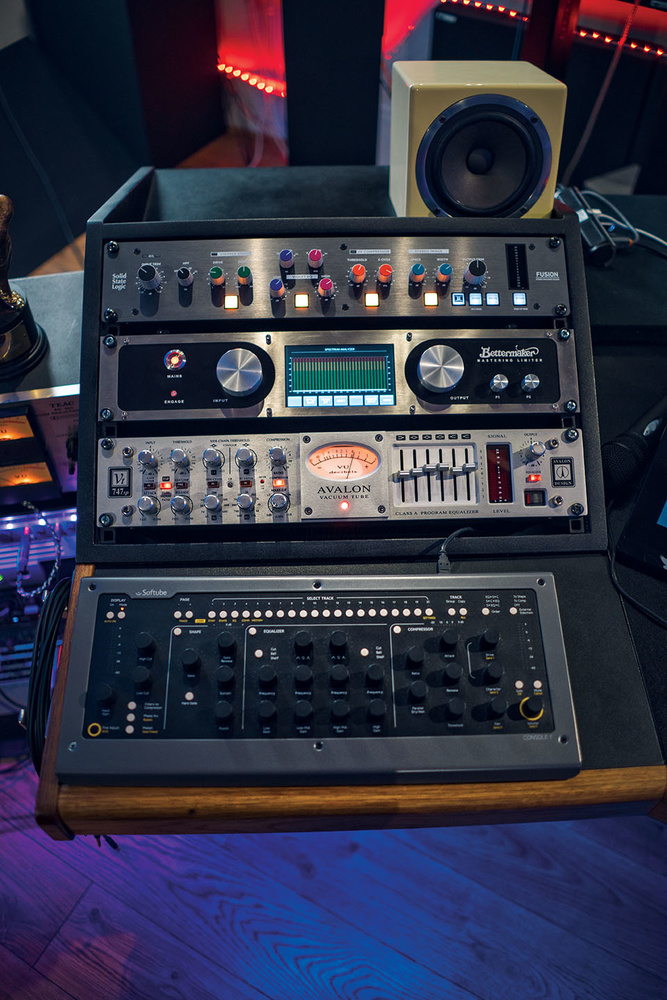 Although he often works mostly in the box, MsM owns a few choice pieces of outboard gear including (from top) the new SSL Fusion processor, Bettermaker Mastering Limiter and Avalon stereo compressor/EQ. There’s no conventional mixer, but the Softube Console One controller (bottom) provides hands‑on control.Photo: Andy Nicholson / twogoldteethcoukBy contrast, the other key element in his skill set was one that he developed very early on, and which still helps to set him apart from other engineers. "If you have the opportunity, try to communicate with the artist. Actually find out what they listen to, what they like, what they want. You’ll go further that way than listening to your own references and trying to match that. They might not like that! ‘What do you think your best‑sounding song has been?’ That’s one of the easiest questions to ask a person. Listen to it. ‘What did you like about it?’ Do some YouTube‑ing. If you start mixing their stuff without having heard anything they’ve ever done, good luck. I’ve done that, and I’ve messed up. I’ve done it plenty of times, where I’ve sent them something that sounds amazing in my mind — it’s not what they wanted, though. So there is a skill in changing it enough to be better, but without making them go ‘Huh? What the hell’s going on?’
"I care more about the artist’s thoughts than anything. I also think one of my skills is identifying what needs what. Skepta comes in and he works very differently to someone like an A&R at a label, who needs a mix done by the morning. It’s two different processes. Skepta will come in here and, usually, what we finish on the day is what’s going out, or very close. I have to be mixing while we’re working, and that’s a completely different mentality to when I’m in here on my own with a coffee, my socks and sandals and some notes from an A&R or manager via email. It’s completely different, but at the end, the artist still needs to be happy, and that’s all I care about.”
In today’s world, even new artists are usually coming from a position where their tracks are already blowing up on YouTube or Soundcloud. A mix engineer who’s going to work with those artists needs to understand and respect what they’ve already achieved, regardless of any technical deficiencies. "If they’re putting songs out and getting millions of views, you can’t come and tell that artist how to do it all. Some of them you can have a conversation with, but there’s not a guarantee that they’ll listen. It’s your job to listen, then act on what you hear. How many times are you going to try to save the world before you actually do your job and just do the mix?”
More Than Mixing
When MsM says that he wants to focus on mixing, then, he’s talking about forming a partnership with an artist, which incorporates many aspects of what would once have been called production. "I like to see myself as overseeing things and communicating with artists. If you want to get to the point where you’re doing this for a living, I think it’s about finding artists and developing that relationship. Those mixers that do their interpretation of the song, and if you don’t like it, fuck off — they wouldn’t work in my scene. Every artist is different. If you try to apply the same method to everything, you might think you’re building your sound, but in the process you’re going to piss off a few people.”
As an example, he describes the recent project he did with singer and rapper IAMDDB, where his experience told him not to even attempt to work on her vocals without the artist present. "A lot of artists that write to these instrumentals they get, they don’t care about the instrumental parts or elements; they see it as a whole. As long as you keep the essence of it, you can fill out the bottom end, fill out the top end, do all this other stuff — they just care about the vocals and a feeling. IAMDDB was all about her harmonies, and delays and reverbs and the gaps between things. I’d studied her stuff so much that I knew she had to be there to do that. I can make it up if you want, but I know the best result is when you ask her: what do you want? And it worked out brilliantly, because she came in and we got on. It clicks.”
At the other end of the spectrum, deadlines and budgets often make this sort of personalised approach impossible. "More often than not you get mixes where you know it’s not going to be like that, and you know that it’s just a quick turnaround and you’ve got to get it as best you can. I had it recently with an album where there was no point asking for the dry vocals, because so much work had been done in the rough. I say ‘Send me your Logic session,’ and I see a compressor, CLA Vocals with the reverbs and delays on, another compressor after it, a delay after it and a reverb after it. You know it’s impossible to get the vocal and the effects separate, now. Now you’ve made something, you’ve committed. That’s the equivalent of going to tape. I have to use that, now.”
Tracking
Although he prefers to focus on mixing, MsM is still in demand as a recording engineer. "I still record for Skepta, BBK, Casisdead, Professor Green… I still record every now and then for a few of my friends, but that’s because of our relationship. Skepta’s coming in later today, and he will probably have a song on loop while coming up with ideas, or he’ll make a beat then and there and write to it. Or at least we’d start mixing the beat — I tend to mix his instrumentals as he’s writing. It gives me something to do while he’s in his zone and I think he gets inspired when the song takes shape. That’s his way of working, and I have to respect that. That’s how he works best.”
Once again, he says, the key skills are communication, the ability to make the artist feel comfortable and understanding how they like to work. "I do less recording now than ever, but as I grow older and more confident in it, I don’t wait to find out. It’s how I break the ice even with new people. ‘How have you recorded in the past? Do you double your leads? Do you do ad libs? What do you call an ad lib? Because everyone’s recording at home with their friends now, the lingo can get confusing. Some people call BVs ad libs, ad libs stabs... I try to get our words right at the beginning so I know what you’re calling it and you know what I’m calling it. Good communication. I see too many shy engineers kill the vibe.
"Simple things like asking people ‘Do you wanna listen through something? Do you have tuning on in your headphones? Do you want reverb?’ rather than assuming. Find what they’re used to, and do it better. Most of these people have recorded at home or recorded in a studio before, they’re probably used to a way of working. It’s my job to not make it difficult. I don’t want to ever go ‘Sorry, I can’t do that for you.’”
 MsM credits his success partly to the fact that his longstanding clients, like JME shown here, are also friends.Photo: Andy Nicholson / twogoldteethcouk
Dap Tones
One of the characteristics of good engineers is that they never stop learning, and MsM is no exception. The latest eye‑opener for him has been working with former N‑Dubz singer Dappy on his solo hit ‘Oh My’. "Dappy’s sessions have taught me a lot about vocal recording and mixing in a short time period because he’s so particular. I’ve known him to leave sessions if the engineer isn’t keeping up. We’ve got a nice setup where I have his recording sessions going on in one room with Joseph Hartwell Jones — who does a lot of recording sessions for me while I’m in the next room working on a mix.
"Dappy’s used to a certain way of working. He likes to hear it in his headphones how it sounds when he comes out the booth. Don’t change it when he leaves the room, get it right on the spot! Then the pressure really is on you, sitting there, to decide what the final vocal chain is going to be like. When he leaves, he wants to be happy with the balance, the rough effects, what’s going to be on there. It doesn’t matter if it’s 3am, 5am — he won’t leave until he’s happy with his vocal balance. Then it’s ‘M, do your thing.’ When he hears the final mix, all he wants to hear back is the same vocal balance between the elements, with a beat that’s got a load of life in it now. If I change the delay on his vocal, when he hears the mix, that’s all he’s hearing. He doesn’t care what I’ve done to the kick drum. He needs to feel like it’s his rough, but someone’s put a pump in it and inflated it to a bigger version.
"Speaking of Dappy, his last project was a [Sony] C800 and a Slate [VMS modelling] mic, all the way through, cutting between the two. No‑one’s been able to figure out where I’ve cut it! I don’t even know where I’ve cut it any more. We rented the C800 in and there was a day when we couldn’t get it, so I improvised. It worked. I love the Slate mic for that reason alone. If the C12 is being used in another session, for example, I have no issue punching in with a virtual mic and keeping going. If Skep’s been away recording somewhere and I don’t have the same mic, I can just go through emulations to find something that sits closer to the one he used. Shit like that’s cool!”
A Dying Breed?
In the long term, MsM foresees a time when the role of external ‘specialist’ engineer will become less of a thing. "Artists will have their own producer‑engineers. There will still be guys that the labels rely on or hire, but I think that more and more artists are going to have their own person who will eventually do it all. Because that is what is happening already. Skepta: own engineer. Drake: own engineer. J. Cole: own engineer. Wiley: own engineer. The turnaround and amount of content being created is fast and picking up pace. Artists don’t want to wait. There’s many things contributing to it but I’m seeing it happen. In the final analysis, once again, it’s all about the relationships. Keep the artist happy, and you keep yourself in demand.
"As much as I make my living off this, my biggest clients are some of my best friends — so luckily for me I got to learn on the job. They will tell me, ‘You fucked that one up.’ They’re not scared to tell me ’Stop being a idiot, you’re being too industry. Why do we need to master? Why? You’ve made it sound sick, it’s not going to get sicker.’”
Mastering & Limiting
"Most engineers I know are being their own mastering guys now, either because they don’t trust anyone, or because they’re forced to due to time constraints,” says MsM. "I speak to a lot of engineers now who say ‘Who do you use for mastering? Because I’m sick of this. I’ll get to the point where we’re all happy — and then it changes.’
"JME gave me the example once: it’s like if someone knocks on your door and says ‘Gimme your wife… I’ll bring her back and she’ll be better.’ He’s not interested in that. He loves what he’s making as he’s making it. As soon as he said that, I’m like ‘That’s why you’re my friend, Jamie.’ He’s too smart. Because my ‘clients’ are my closest friends, I get to understand things from their perspective in a non‑professional way.
"I used to always say ‘I don’t believe anyone that does their own mastering,’ because I think you need another room for perspective’s sake sometimes. On an album, I still agree with that. There’s an art to a seamless album, transitions, tonal balance, and the second opinion. However, we live in a singles‑based music culture, there are times where we need an edit and a PA mix for a last‑minute show and I have to be able to get that as loud as the master or everything else in the set. I can get things up to any volume and be fine: ‘‑6 LUFS loud as shit? No problem. And I’ll make sure it will sound good.’ Even when I send things to mastering I deliver two files, one limited and one without a limiter, with a picture of the limiter settings I’ve used.”
Delivering a mix with limiting in place isn’t just about preventing mastering engineers from doing too much, though. "Nine times out of 10 they’ll use my limited file because it sounds better. With some mixes, you take the limiter off, and it’s like ‘No‑one’s heard this!’ I always used to find that really weird. No‑one knows this mix that you’re now sending to the mastering engineer. In those scenarios where the limiter is integral I’ll just turn down the master fader or the output of the limiter so there are no overs.”
In fact, says MsM, hitting the output limiter hard is often a core feature of the grime sound. "Back in the day when we were making songs, it was an MP3 or a WAV file, and vocals on top. I had no say on the instrumentation, just ‘Fit that vocal in without sacrificing the beat.’ When these producers were sending me these files, usually, they were pinning their master output, and it was clamping things down. What’s being pinned down, usually? The loudest things: so, drums. So when I then get grime mixes later on in life with all the stems, most of those people are used to that sound, and I had to find a way of mimicking that. I would have busses set up in Pro Tools where I would use little bits of limiting everywhere. All you do is add a tiny bit of it in. You just pin the drum bus, with control, and all of a sudden your whole mix sounds a bit more like it used to, back in the day. I have control over it now, and I can give it that squashed sound, but one that I can tame, add more, add less.”
We didn’t know we were doing it, we didn’t know that it was creating a sound, but it’s like people who run things through old Akais to get ‘that thing’. This is my version of it in the grime world. In the early days I was limiting vocals, I didn’t even know what I was doing: throw an L1 on it, pin it, all of a sudden there’s a grime vocal. Sibilant, splashy as you like. Now, the difference is that I will treat it so the splish and the splash doesn’t come through as much, or at least I would set up the plug‑in chain so that I have the control. But there is an element of looking back and saying ‘I remember what we were doing wrong, but this is also what some people loved about it.’”
Tough Tracks
In his early years, MsM’s mixing difficulties weren’t only down to inexperience and poor acoustics. There was also the fact that he often had little to work with beyond vocals and a bounced stem of the entire backing track. "I probably got more of that than anything else in the early years, just MP3s and WAV files and vocals on top. Those early years taught me so much about how to fit things in without having full control. It’s like having one hand in a boxing match — my right hand’s bloody good now, because that’s all I had! I feel like I’ve got an advantage over some people, because most people that I speak to now have come up in studios: ‘Oh, I worked on an SSL in a tuned room for 20 years...’ Well, I didn’t even touch an SSL until 2008. I was dealing with an MP3 from Fruity Loops and a vocal recorded under a staircase.”
Although it’s less common now, MsM still sometimes ends up having to ‘mix’ songs where he’s only given a stereo two‑track bounce of the backing track to work with. What are his top tips for making this work?
"I will EQ the instrumental always, maybe some M‑S stuff to just suit what I need it to do. Something I wish I’d had when I was younger is [Wavesfactory’s automated EQ plug‑in] Trackspacer. For instance, if you find where the vocal’s most defined compared to the instrumental or where it’s being masked, put Trackspacer on, experiment with it only affecting the mono signal, and get it so it’s just cutting through. When I was young I was doing it manually using M‑S EQ, but if you do it with an M‑S EQ it’s not dynamic, it’s permanent. If I do it with Trackspacer, when he stops MC’ing, that bit comes forward a bit more, so you can get a bit more life out of it.
"Headroom is something that not enough people working in the box consider. Even at a basic level, if you don’t want to understand the science behind it, most engineers know that if you’re on a board and you’ve got trims, you can pull down Pro Tools stuff before you’re hitting all of your outboard. People don’t understand this in the in‑the‑box world. They think that you load the audio file in and put a plug‑in on it and everything’s fine — they don’t know the signal path, they don’t realise that what you’ve loaded in could be clipping already, so the first signal your plug‑in sees is too much. If that plug‑in’s not designed well, you’re feeding it a clipped signal, basically, it’s just a mess. I pull down [Pro Tools] Clip Gain to make sure I’m feeding the mixer and plug‑ins a good workable level. There’s no set number, I just make sure I gain‑stage from step one. That’s actually my most important tip for mixing in the box: gain staging.”
What’s In A Name?
MsM’s unique status within the grime world is, in a small part, down to a joke that got out of hand. "I used to tag MSM everywhere as a kid, then it kinda stuck. But the whole ‘MsM Engineer’ thing, almost as if it’s one word, that was JME. On ‘Deadout’ he said ‘MsM... Engineer!’ in some piss‑taking voice — and it stuck. People started saying it to me. We’d go to shows and someone would say ‘Oh, you’re MsMengineer!’ One word, they didn’t even know the separation.
"It was like a joke at first. At the beginning of the song he was actually cussing me, he was calling me names. I said to him ‘Say my name at the beginning of the song,’ and as I pressed Record he says ‘You’re a dickhead!’ But it turned into a thing. People used to just say my name in songs at the beginning, Wiley used to do it quite a lot; he’d say my real name, he’d say ‘MsM’. But I meet people now who say ‘When I was in school I used to hear this and never know what it was — and it was you!’ To know that that stuck, and that other artists noticed it — it helped a lot. It worked in my favour.”