

Future Proofing
By the time Ken Scott and Emre Ramazanoglu started work on the Atmos mix at RAK Studio 4, with its state‑of‑the‑art Genelec monitoring rig, the producer had already done a good deal of detailed preparation work. “The original Ziggy sound was very much — quote unquote — the ‘glam rock’ sound. And that was fine for the ’70s but it needs to be beefed up a bit. It needs to be modernised. So one of the things that I did was I went in and I added samples to the drums. Initially just a snare and kick, not replacing anything, just adding to the original sound, to beef it up a bit and make it more modern. As it went on, for one thing, back in the day, I hated cymbals. I now quite enjoy cymbals. So we found in doing this: ‘Hang on, there’s no cymbals. What’s going on?’ So I then had to go in and program in hi‑hats and cymbals and all of that kind of thing.”
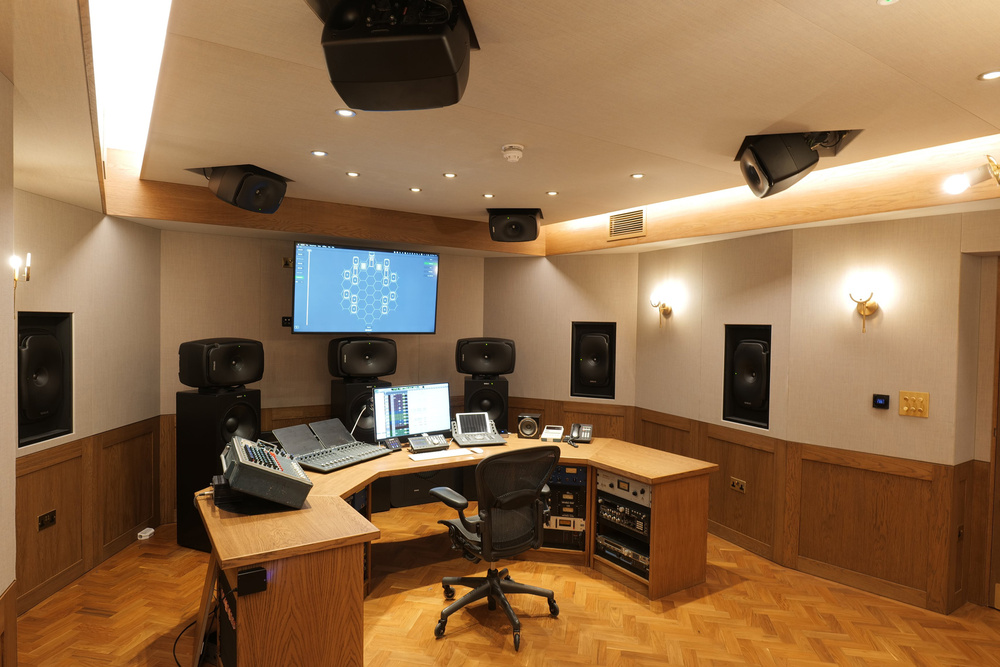 The immersive remix was carried out at RAK Studio 4, newly equipped with a Genelec Atmos monitoring setup.
“I was slightly concerned when Ken mentioned samples and adding stuff,” admits Ramazanoglu. “I’m very very fussy about that kind of thing. Especially with the hi‑hats, which is really not often done sample by sample — but I don’t think you’d tell they were there. It was just part of the drums. If you’d put them up, I wouldn’t have questioned it. I might not even have known.”
“It’s ridiculous!” laughs Scott. “It literally is hit by hit, making sure it’s on there. I use the Massey DRT to get it into MIDI and then trigger from there, and there are always some things that are going to be off, and you have to move it around. Obviously when you’re coming to hi‑hat, especially when it’s very quiet with regard to everything else, it’s going to be off more. So it really was going in and moving around almost every beat to make sure it’s exactly the same as the original. Otherwise, then it starts to sound fake. And also, doing it via MIDI, you do get the builds and the quiet passages, all of that kind of thing, a bit better. So that makes it more human.”
Scott’s painstaking efforts also addressed another respect in which the original sound has dated somewhat. The album’s relatively tight low end made it perfect for cutting to vinyl, but arguably unnecessarily bass‑light on modern playback systems. “The kick drum sample I used the most throughout had a lot more low end than the original, and there were a couple of places I used a third kick drum, which was really sort of low end, just to emphasise a couple of spots.”
Getting Wet
Once the sample augmentation process was complete, Ken Scott bounced stems of important elements and took them into Abbey Road Studio 2. “I can’t remember what it is they use at Abbey Road these days, but we had a pair of their regular monitors down in the studio, and I had them set up Neumann U67s and AKG C12s and U48s all the way along the studio, and played back the stems.
“As luck would have it, there was an engineer came along and it looked as if he was going to be working on this project with me. He came along and he brought this mic called a Core Audio OctoMic, and he said ‘Would you mind if I set this up in the middle?’ I said ‘Fine.’ He set it up, we recorded it, we never listened to it when we were doing all the stems. We just listened to the Neumanns and all of those. And it wasn’t until we came to start mixing that we finally managed to pull up the OctoMic — and that was the one. It was so much better than the rows of mics that I had along Studio 2!”
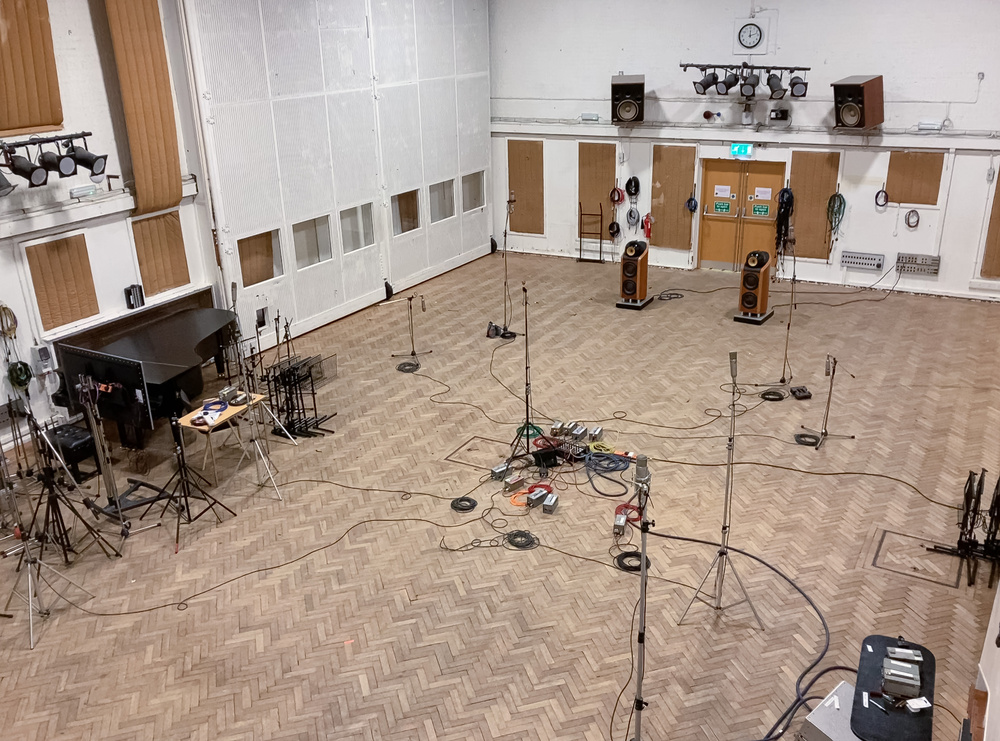 To create ambiences for the immersive remix of Ziggy Stardust, Ken Scott played stems out through a pair of large floor‑standing B&W monitors into Abbey Road Studio 2 and re‑recorded them using a variety of microphones placed around the room. In the event, it was the Core Audio OctoMic in the centre of the room that provided the best results.
“This mix was really interesting,” continues Ramazanoglu, “because when we first talked about it, my very first thought was ‘God, that’s a dry album!’ So when Ken said ‘I printed rooms’, I was like punching the air going ‘Oh my God, yes!’ Because you won’t listen to this and think it’s wet. Not even the stereo mixes. You don’t think ‘It’s a different record. It’s all huge reverbs!’ It’s nothing like that at all.
Emre Ramazanoglu: "We used Altiverb’s plate more than I thought we would. They did an unbelievable job that I think is slightly unsung, taking Altiverb 7 and making it immersive.
What reverb there was in the original mixes came from an EMT stereo plate, and although Scott and Ramazanoglu weren’t trying to recreate those mixes exactly, they did end up leaning on modern equivalents. “We did quite a bit of looking for reverbs,” says Ramazanoglu. “We were making sure it sounded natural in the track. It wasn’t just whip up that plug‑in and it’s done. We had to search a bit for a couple. Actually we used Altiverb’s plate more than I thought we would. They did an unbelievable job that I think is slightly unsung, taking Altiverb 7 and making it immersive. And so they’ve got sort of combinations of all the plates to make a 9.1.6 plate, which is really good. They’ve done a lot of really clever stuff in there that isn’t being shouted about really much, but it’s absolutely brilliant. And otherwise, Liquidsonics’ Lustrous Plates were used quite a bit.
“We didn’t really reference the original mixes that much until quite near the end, where we were having a listen going, ‘I’m not sure these are present enough,’ and then we had a quick listen to the original mixes, and I would sit with headphones and make a small tweak here and there just to get a bit more edge, because I think we were feeling out the room as well. It was some of the first mixing we’d done in RAK 4, which is fabulous. But we were working out, ‘OK, what sort of reference level are we working at? And could it just have a little hair more presence?’ and that’s the first time we really listened to the original mixes. When Ken was saying it was nice working together, it really was, because we’d both go ‘1dB on the vocal!’ at the same time. ‘This word, take the ess down!’”
Third Dimension
Freed from the requirement to match an existing mix, Emre Ramazanoglu found he needed to use much less processing than usual on the Ziggy Stardust remix. “Normally I will be recreating the mix bus or at least the mastering, so I’ll have linked sidechain processing going across. If I have 100 mono objects, it’ll be 100 mono channels of processing all sidechained and all working together and creating 'glue'. Here, we used one compressor on one channel on one track on the entire record, which is testament to the recording I have to say. There were a few EQs — a few — and it was mainly subtractive.
“There was so little done across the whole record, but this is why I was so impressed by this, because you could move things. I did very little of what I would often do to create space. There’s all kinds of ways of making space immersively that feel satisfying and coherent that mean I can spread effectively a mono or stereo source around a bit more, but we didn’t really do that, because of the way it’s put together. It’s slotted into a mix that was in 3D rather than in stereo, and the whole basis was thinking in 3D and thinking about... We found some interesting things with masking. Some things that we hadn’t heard before. Even some melodic stuff I’d never heard before, because it was interacting before with other elements. So there was recreating that feeling of interaction.
Emre Ramazanoglu: "One of the things I hadn’t done before is have the vocal ‘floating’. It’s actually slightly forward and up. It made it all quite spacious-feeling immediately, not having it all just pinned to the back wall."
“One of the things I hadn’t done before which is quite interesting is have the vocal ‘floating’. It’s actually slightly forward and up. It made it all quite spacious-feeling immediately, not having it all just pinned to the back wall. I really don’t use the centre speaker much in Atmos, because of headphone translation issues. But this worked! There’s a sense of belonging, every piece belongs in its new position for a reason, and it’s not just sort of plonked there. It’s like a 3D supported mix.”
Ken Scott: "I wanted it to feel like you were in the club or the theatre with the band, and it’s the way they’re positioned on the stage. The vocalist will always be out front, and the band just around that, not all in one line, because when they’re live they’re not all in one line."
Ken Scott sums up the philosophy behind the immersive mix thus: “I wanted it to feel like you were in the club or the theatre or whatever with the band, and it’s the way they’re positioned on the stage. The vocalist will always be out front, and the band just around that, not all in one line, because when they’re live they’re not all in one line. So it was very much that kind of thing that I was after, more of a live experience.”
“It’s quite immersive in that there’s a lot of sides and rear,” concludes Emre Ramazanoglu, “but unless you turned your head, I don’t know if you’d notice massively — except if you turned it to stereo, you’d go ‘Oh no, put that back.’ If you didn’t even notice it was Atmos, I wouldn’t be sad. As long as you felt enveloped by the music, then I’ll be delighted, personally. In the nicest possible way, it’s not about making a Dolby advert!”
Conceptual Art

The Rise And Fall Of Ziggy Stardust And The Spiders From Mars has sometimes been described as a concept album — a notion with which co‑producer Ken Scott has no truck. “That’s a complete fallacy. If you consider that, the main thing that brings it all together as a ‘concept’ is the track ‘Starman’, and that was never part of the original album. We had a cover of Chuck Berry’s ‘Round And Round’ in there until we gave it to the record company. They came back saying they didn’t hear a single, so we went back into the studio, spent two days recording ‘Starman’, and just put it in place of ‘Round And Round’. So as the main focus of the concept was never in there originally, how can you possibly consider it as being a concept album? There are some songs that link together about Ziggy Stardust, of course, but as a full‑on concept album, no.”
Not that Bowie himself was averse to laying false trails: “You could never tell with him. A track off Hunky Dory called ‘The Bewlay Brothers’ was the last thing we recorded for the album. He came rushing in one day and said ‘I’ve got a new song we’ve got to record!’ And he said ‘But don’t listen to the lyrics.’ I said, ‘OK, why?’ and he said ‘Because they don’t mean anything. I’ve written it specifically for the American market, because they’ll read things into anything.’ And I must have heard five, six, seven different ideas as to what that song’s about — and David would agree with every single one of them. So, yeah, you could never quite tell. David loved to float some porkies every now and again!”