

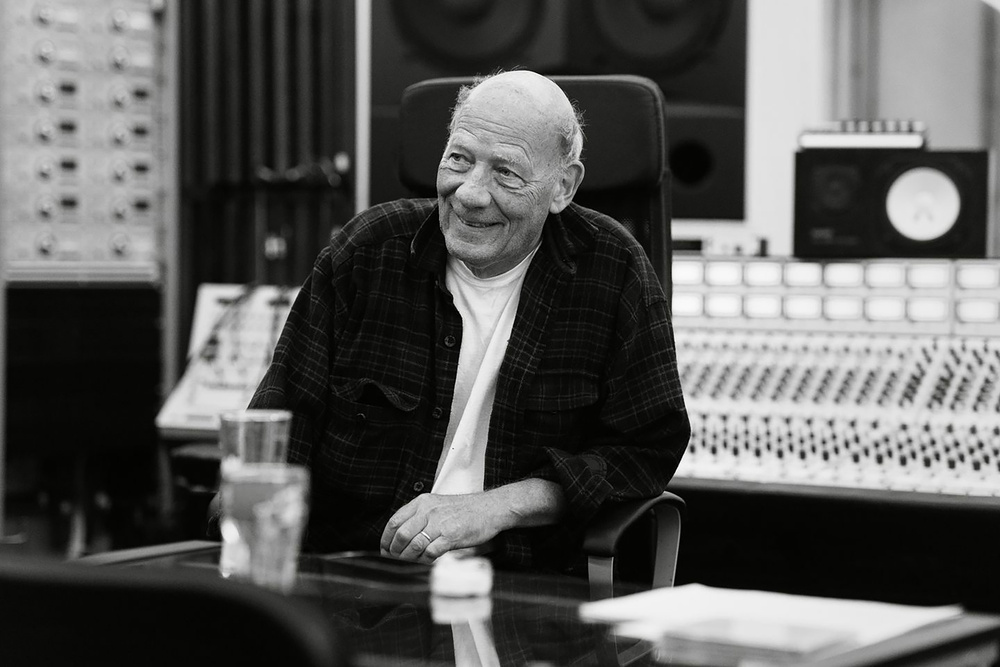
Legendary engineer Phill Brown has worked with the biggest names in music, from Led Zeppelin and David Bowie to Cat Stevens and the Rolling Stones. Asked to choose a favourite sound from his vast catalogue, he nominates the drum sound on ‘After The Flood’, from Talk Talk’s 1991 album Laughing Stock.
“Mark Hollis hated repeating himself and people repeating themselves. When we did the Spirit Of Eden album, it was a completely different setup. We used one of these Neumann three‑dimensional heads and a bass drum mic and snare, and it was in a kind of booth — an old microphone cupboard. So, when we came in to do Laughing Stock and this track, ‘After The Flood’, the first thing Mark said was, ‘I don’t want you to use any of the mics or the setup that you used on the previous album.’ So, we took the drum kit out of the booth and set it up in different places in the live room, just to see how it sounded. And we found a spot where it sounded really good — but the mic was 28 feet away from the drums!
Phill Brown: We closed‑miked all the drums so that we could feed either Lee or other people that were playing with him, but we weren’t actually recording any of those mics.
“Because Wessex was a very dead studio, it didn’t sound like you were in a kind of gymnasium. We put up a Neumann U47, an old valve mic from the ’50s, and neither the producer Tim Friese‑Greene or myself realised that there’d be a delay from what Lee [Harris] was playing on the drums to what we were picking up on the mic. That became apparent very quickly because Lee couldn’t hear the drums in his cans; it was delayed. We then closed‑miked all the drums so that we could feed either Lee or other people that were playing with him, but we weren’t actually recording any of those mics. We just recorded the U47. And then because of the delay, we had to then delay everybody else to be in time with what we were actually recording.”
Check The Weather
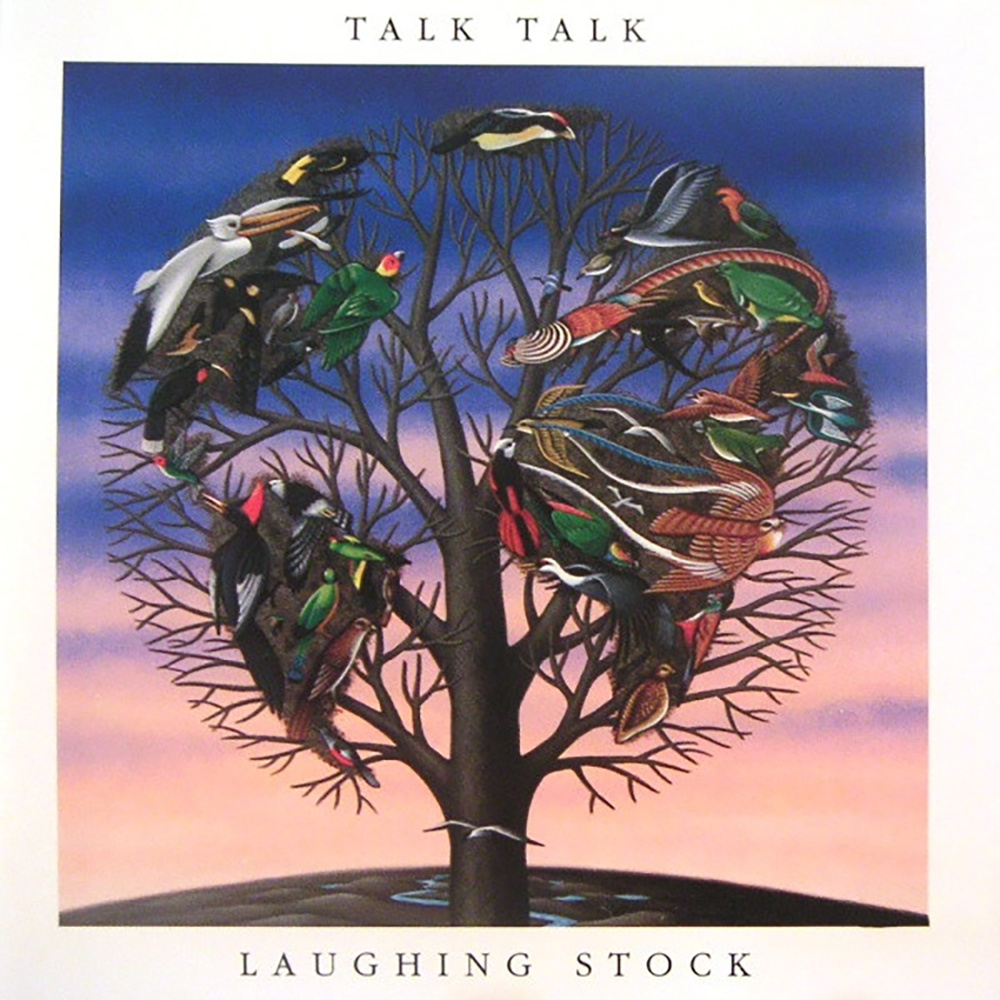
“What turned out to be kind of a simple idea with just one mic actually became quite involved, because the delay changed depending on the temperature of the room, and the humidity. We had to constantly check the temperature of the air. If the air conditioning had been left on all night, the room was cold and dry, so it would be a kind of 26 millisecond delay. But if it had been turned off, the room was very hot and humid, and it would be more like 30 milliseconds. So, we had to check this through the day to make sure that everything was kind of in time. The drums on ‘After The Flood’ are just this one Neumann 47 mic.
“We did in the end use a little bit of the bass drum mic, an AKG D12, because when you have a kit that far away, the bass drum sounds too far away. All the cymbals, all the top end travel faster and are very clear, and the bass drum tends to sound like it’s a long away. So, we had probably 30 percent of the drum sound was the bass drum mic, everything else was just off the U47. There was no EQ. It was just the way that Lee played, as he was very good at balancing internally the volumes and sounds. His drum kit was not just a regular drum kit, too; it was made up of about three or four different drum sets. He made sure that the toms were the right kind of sounding toms, along with the cymbals. When you listen to the drum sound on ‘After The Flood’ it doesn’t sound like it’s 28 feet away and in a dead room.”