

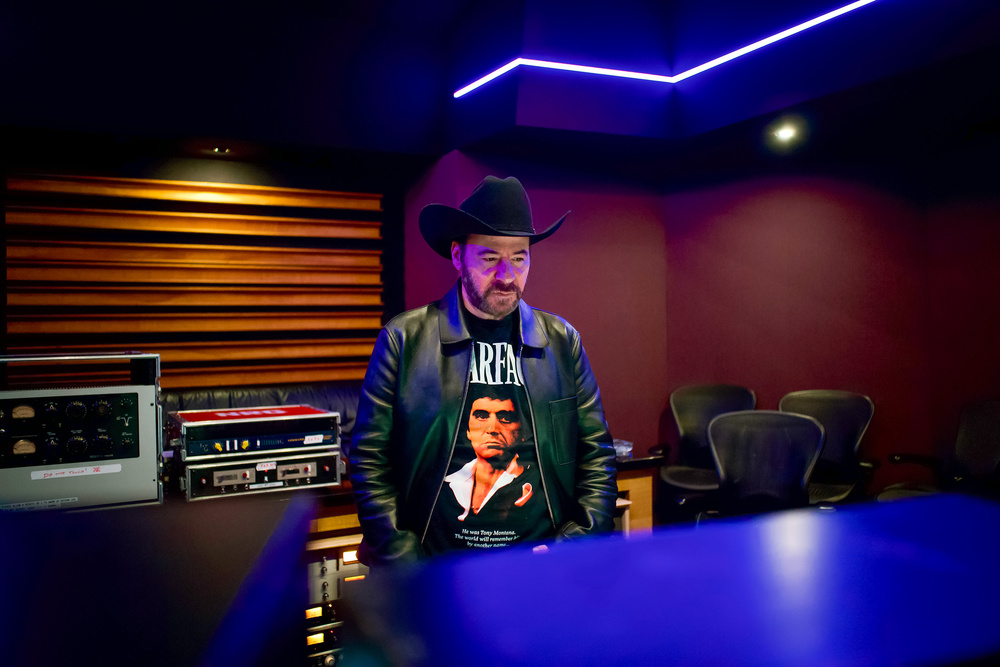
Matt Schwartz at NRG Studios, one of many studios used for the making of One More Time.Photo: Kyle Hoffmann
Yungblud capped a triumphant 2025 with a hit collaboration with Aerosmith. Long‑term producer Matt Schwartz was behind the desk.
Producer Matt Schwartz vividly recalls his first meeting with a teenage Dominic Harrison. “I met Dom in 2016, when he was 19. Labels sometimes send me artists for a chat to see if they’re the real deal or not, because I’m pretty harsh. I dig into someone’s soul. So my manager and friend Tommas [Arnby] asked me to check out this kid he’d found. Dom came in, and played me some songs, and I stopped him, and said, ‘What is this? It sounds like bad Ed Sheeran. We already have Ed Sheeran. And do you think teenagers are stupid? If not, why are you writing stupid lyrics? If you want to work with me, I want another Bowie or Freddie Mercury. If you want to be an artist, figure out what you want to say, and what culture you want to build.’
“Eight months later, Tommas calls me again, and says, ‘You got to meet the kid again.’ I’m like, ‘Why?’ And he says, ‘Because you don’t realise what that meeting has done to him. He locked himself in a bedroom for eight months and figured out who he wants to be as an artist.’ So Dom came in, and had this crazy look in his eyes, and his whole mannerism had changed. The first song he played me was ‘King Charles’, and I was blown away. We recorded that song there and then, in four hours, including mixing and mastering. Yungblud was born. We also did the next five records really quickly. I was thinking to myself, ‘He’s so young, and to write those lyrics with that vocabulary is amazing.’ Over time I also became a much better writer myself through working with him. His ability has pushed me to places I never thought I could go.”
‘King Charles’ was released as Yungblud’s first single in 2017. The artist’s first album, 21st Century Liability, produced by Schwartz, Martin Terefe, Sluggo and Patrick Russel, was released in 2018. Aided by hit singles like ‘11 Minutes’ (2018, with Halsey and Travis Barker), which Schwartz co‑wrote and produced, and ‘I Think I’m Okay’ (2019, with Machine Gun Kelly and Travis Barker), Yungblud’s star continued to rise, culminating in 2025 in the number one album Idols and the EP One More Time (with Aerosmith) and his momentous performance at the Black Sabbath Back To The Beginning concert.
Idol Moments
“Generally, it’s just Dom and I, in an enclosed environment, without outside interference. I’ll usually sit at the computer and record. He plays everything, I play everything, we’re good. We’re not virtuosos, but with the computer we’re the best. We’ll grab guitars, or are on a piano, or sometimes a bass line triggers something, and we’ll sing some ideas. Once we have a rough idea, we’ll jump on a microphone and develop it. Sometimes we start with a concept or a lyric. A melody inspires you to do another melody or another lyric, and suddenly it morphs into a story. It’s an amazing process.
Matt Schwartz: If you’re an artist, never let anyone else start your ideas for you. Ever. If you work with somebody else, you need to start the idea.
“The one thing that is crucial is that I insist that Dom starts the idea, every time. If you’re an artist, never let anyone else start your ideas for you. Ever. If you work with somebody else, you need to start the idea. They need to be inspired by your ideas, not you by their ideas. That’s the rule. That’s what real artists who write their own songs do. You cannot be in the shackles of a record label. You cannot be in the shackles of a producer or another writer, or whatever. The greatest artists always inspire the people around them. Whether it’s in music, whether it’s in style and fashion, whether it’s in ideas of how to promote things and marketing — you have to inspire, you have to get everybody to go with all your crazy ideas. Starting with a backing track limits what you can do with the song.”
Going Slow
The opener of Idols and also the album’s first single, a nine‑minute epic called ‘Hello Heaven, Hello’, was co‑written by the two of them, plus guitarist Adam Warrington, and composer and producer Bob Bradley, known for his work with Jeff Beck. “We went up to Bob’s studio in north England, and Dom had the idea for the first section, which was good. He went to bed and I said to Adam, ‘Let’s try something.’ We came up with the basis for what became the middle section, and I thought, ‘This is effing sick, let’s connect it to the first section. Dom must have heard what we had done while asleep, because when he woke up, he thought it was part of a dream! He said, ‘I have some ideas, let me go on the mic,’ and I was like, ‘Go go go.’ He went in and immediately came up with what’s on the record. It was insane. Dom found a real and natural persona on that track that really inspired the rest of what we were doing.
“Then I was like, ‘You know what? It’s missing a third part.’ Everybody thought I was crazy, but we got this great other idea. I started orchestrating it, and tried to fit the three sections together. However, the problem was that the new section was in a different bpm. How do we go from 83 bpm to 94, or the other way round? I decided to automate the tempo change in Logic, but because of a slip of the mouse, or whatever, the tempo dropped to 5 bpm. It went all the way to 5 bpm and then back up to 94, and it sounded incredible. Everybody on the sofa looked at me with their mouths wide open.
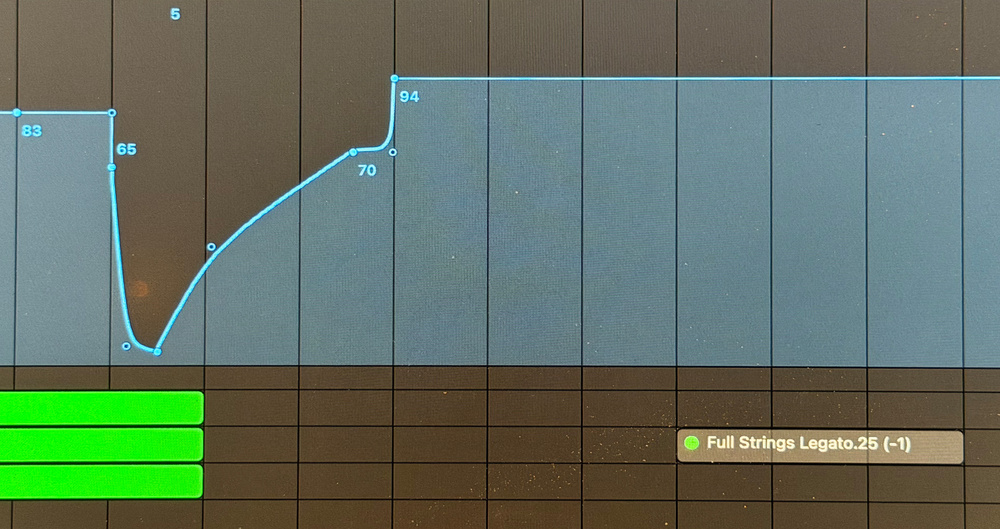
A mousing accident created the wild 94 bpm to 5 bpm tempo swing that became the hallmark of ‘Hello Heaven, Hello’.
“When we went to live performance, the guy who was doing FOH was using Ableton, and I sent him the parts he had to play from his computer, with a MIDI file, so he could do the tempo change. However, it was not working in Ableton, though it worked fine in Pro Tools and Logic. We found that Ableton only goes down to 20 bpm. I contacted Ableton, and told them. They were like ‘What? We’ve never heard anybody go to 5 bpm. Why?’ I’m like, ‘Well, there’s always one, isn’t there?’ I hope they’re sorting it out.”
Time Travel
Although the arrival of One More Time half a year after the release of Idols and Yungblud’s Birmingham performance appears like a natural progression, the collaborative EP was a long time in the making. In September 2023, Aerosmith had been forced to abort their farewell tour because of damage to Steven Tyler’s vocal cords, and in August 2024 the band took the decision to abandon touring altogether. During that year, guitarist Joe Perry, bored at home in Sarasota, Florida, asked his manager Larry Rudolph for projects to work on. Rudolph’s son happened to be friendly with Yungblud and his manager Tommas Arnby, and soon afterwards Schwartz and Yungblud were on their way to Florida.
“We spent four or five days vibing in Joe’s studio, Baysound. It was brilliant, Joe is a legendary guitarist. Much later we ended up going to Johnny Depp’s Sweetzerland Studios in Los Angeles to meet with Steven and Joe. Dom’s energy is engulfing everyone around him, and Steven said that it took them back 50 years to how they used to make records. Everybody was getting in on the energy. It was very inspiring. We pretty much wrote and recorded ‘My Only Angel’ the first day. Nobody knew whether Steven could sing, but Dom walked into the vocal booth, and said to Steven, ‘Come on, let’s do this.’ Steven went in and sang the first verse, and everybody was like, ‘Oh my God, this is incredible!’
“After that we went to NRG, and did the song ‘A Thousand Days’. We were just vibing in the room. Later on Dom and I went to Black Rock Studios in Santorini, a Greek Island, and wrote the basics of ‘Wild Woman’. We finished that later with Steven and Joe at NRG, Johnny’s place, and in Sarasota. It was the same with the song ‘Problems’. All songs fell into place so quickly, within a day the melodies, structures, concepts and lyrics were there. Steven is a great lyricist, as is Dom, and lyrics fell into place line by line. Similar to when I work only with Dom, my role tends to be to round things off. When there are melodies, lyrics, chords, song structures in the room, I finish what needs finishing.
Matt Schwartz (at the console) with Aerosmith and Yungblud at Baysound Studios, Sarasota.
“The collaboration between Dom, Joe and Steven was working so well that the idea emerged of doing an EP, but for this we needed an extra song. Joe suggested a cover of ‘Back In The Saddle’ [a classic Aerosmith song from 1976]. I was like, ‘Oh, wow, that’s sacrilege!’ Then I told him, ‘OK, but I want to get into your headspace back in 1976. I want to feel like I was there when the record was created, so I know where and why everything is there. Then I can maybe start approaching it in the right frame of mind.’ For me, music always starts from the heart, and then it goes to the head. If you have the right feel, the right emotion, the technical stuff just happens naturally. In the end, I got Matt Sorum to add some drums, and I added some bass, to give a more modern feel, Joe added some guitars, and Dom his vocals. Overall we tried to keep it authentic. Joe said that it had a great, dancing feel. Without them giving me the sign of approval, I would not have been able to do it.”
Schwartz travels everywhere with his laptop, loaded with Logic, because he finds it “a lot quicker than Pro Tools for pretty much everything, and I love it for the stability."
In The Desk And In The Box
Schwartz travels everywhere with his laptop, loaded with Logic, because he finds it “a lot quicker than Pro Tools for pretty much everything, and I love it for the stability. I also love PreSonus Studio One, but it takes a long time to learn a new DAW, and I need to get things done quickly. If anything slows me down, I get frustrated really quickly. Just creating a new track in Pro Tools takes longer than in Logic. It takes maybe three or four seconds, but in Logic, it’s instant. I’ve got lots of friends who are wizards in Pro Tools, but for me it has a slower workflow than Logic, especially when creating things, with soft synths and so on. I sometimes mix in Pro Tools, but Logic is an extension of myself for whatever I need to do.
“I work both in the desk and in the box, but when I’m recording it’s important for me to go through analogue stuff. Because the songwriting with Steven, Joe and Dom happened so organically, and really fast, most of the recordings you hear of them on the EP were done during the writing sessions. So I used the analogue gear from the start. I recorded Steven and Dom’s vocals generally with a Neumann U47 valve, and the Telefunken ELA M 251, and at one point I used a Sony G800G on Dom. The 47 can be a little dark sometimes. For mic pres, I used Neves, like the 1081 or the 1073, and then a Tube‑Tech CL‑1B [compressor].
Multi‑instrumentalist Matt Schwartz has played both guitar and bass on Yungblud releases, among other instruments.“The electric guitars on One More Time are played by Joe, with Dom and I on acoustics. We always used amps for the electric guitars, recorded with two mics, usually a Shure SM57 and a Sennheiser MD 421 or a Neumann U67. Joe is adamant he does not want to go through tie lines. He wants to go directly into his pedals and then the amps, and nothing else. On acoustics I used a technique with a Neumann M147 and a 251, one placed on top of the other with the top one upside down, both placed in front of the sound hole, a little bit away. I don’t like recording acoustics too close. If you’re far enough away, you don’t need to roll off bass. I again went through Neve pres and some UA compressor, and it sounded amazing. I played all bass guitars on the new songs on the EP, going in DI going into a Neve 31102 pre, or using The Channel Strip from API or the Pendulum Quartet II. I also played keyboards, including the beautiful C7 Yamaha grand piano at NRG, a Juno‑60, and some soft synths.”
Attaching Strings
For Schwartz, finishing is doing anything necessary to complete a song idea. In addition to playing many instruments, this also involves programming drums and orchestral arrangements. “I often use XLN Audio Addictive Drums, but lately have also used Bogren Digital Drums and sometimes Toontrack Superior Drummer 3. I later normally have a drummer come in to bring the programmed parts to life, and I may strengthen the live drums by adding samples.
“For the strings, I compose the entire arrangements with Spitfire Audio, it could be the Albion or Hans Zimmer libraries, EastWest Sounds, Native Instruments Kontakt libraries, or Logic Studio Strings. Many string libraries don’t have really punchy strings, and when I want more attack, I’ll use a sample, and change the start point. I may have the sample in the timeline, or use the Logic Sampler. We were lucky with Idols, because Capitol Records agreed for us to use the London Philharmonic, which we recorded at AIR Lyndhurst. Sally Herbert transcribed everything, and then conducted. It was the same with the strings on One More Time. They’re all live!”
In fact, almost all parts on One More Time were played live, with Matt Sorum (Guns N’ Roses) “overdubbing drums on three songs at NRG, and Ben Sharp playing drums on ‘Problems’, which we recorded at Angelic Studios in England. Dom played drums on the regular version of ‘Wild Woman’, while Matt’s drums are on the Lainey Wilson version of the song. Adam Warrington also plays one of the guitars on ‘Problems’.
“Later on, when Steven, Joe and Dom did the VMAs performance [September 7th, 2025], we spent a day at The Bakery Studios in Brooklyn, New York, doing an acoustic version of ‘My Only Angel’. We then worked more on this in London and at Canyon Studios in Los Angeles, where the video for ‘Wild Woman’ was shot. I said to Steven, ‘What about adding banjo?’ He goes, ‘Sure, why not try Steve Martin?’ Next thing, Steve Martin was texting me! It was insane. He sent me his banjo part recorded on his iPhone, I put it in the session, stretched and quantised it a little bit, and it was brilliant. Steve told me he wanted to go and record it, but I said, ‘You’re done, Steve, you killed it, it sounds amazing!’”
Improving Outcomes
With this emphasis on live performances, recorded on an iPhone or not, one would be forgiven for thinking that Schwartz is an adherent of the keeping‑it‑loose philosophy common in more traditional rock, championed by the Stones, and also in the past by Aerosmith. Not so, it turns out. “I’m a grid guy. I like to start from that point, and then work outside that if I need to, rather than impose a grid on loose recordings. Maybe it’s my dance mindset, but my brain works a bit better when it’s all in time. But it’s always my mission to keep the feeling, without making it sound too programmed or too sterile. A lot of the feeling of a live performance comes from the dynamics, not only from the timing. If you retain these dynamics, it will feel live regardless.
“Similarly, I’m a tuning guy. I treat vocal and instrument tuning with the same respect as I treat a compressor or an EQ. When people say, ‘Why do you use Auto‑Tune?’ I reply, ‘Why do you use a compressor?’ Some say that Auto‑Tune is used because someone can’t sing. I’m like, ‘I use a compressor because someone can’t handle their dynamics when they sing. What’s the problem?’ Back in the day, we used an Eventide H3000 to do micro‑pitching to address pitch issues. There are no rules. It’s a matter of using all tools at your disposal, so that when you press Play you go: ‘Ah, that feels amazing!’ I don’t really care what goes in. I only care about what comes out. If you want to use AI, use AI — as long as you don’t let it take over the creation. Whatever you use, just give me that amazing thing!”
At The Mix
Whilst Rich Costey mixed ‘Problems’ and the Lainey Wilson version of ‘Wild Woman”, with her vocals recorded in Nashville, Schwartz mixed the rest of One More Time himself. “I mixed some of the project at NRG and most of it at my studio in London, Destined. I used to have an SSL, but got rid of it. I now mix in the box, in a hybrid fashion. I have the Prism ADA‑128, which is the best converter in existence, and lots of analogue gear, which I send through the Prism.
One More Time was mixed at Matt Schwartz’s own Destined Studio.
“Some of my outboard is the Manley Massive Passive EQ, Empirical Labs Distressor, Crane Song STC‑8 and Manley Vari‑Mu compressors, the Thermionic Culture Vulture, and units by API and Chandler. The fact that they all go into the inserts of the Prism, is why that converter is so important for me. My main monitors are the ATC SMC25A Mk2, and I also have NS‑10s with a Chord amp, and ADAM S5Vs, which have an unbelievable bass response. I don’t like subs too much. The ATCs and NS‑10s are great for rock, and the ADAMs for dance. I also have some Auratones, and work with Sennheiser HD 650 headphones, with the Sonarworks SoundID, which helps the HD 650 come to life even more.
“My mixes for One More Time were just a matter of finishing rough mixes. I mixed the songs every day we were recording. I don’t use templates in Logic, but I do have some tracks with plug‑in chains, that I change as is need. On the vocals my plug‑in chain is Waves SSL E‑Channel, then, if needed, going into Auto‑Tune, or Melodyne, then an SPL Vitalizer to open up the top end a bit, and then a delay like Soundtoys EchoBoy, Logic Tape Delay or Repeater. After that there’s a Waves L1 limiter and a de‑esser. Then I send the vocals to a bus, often with the Waves CLA Vocal, and I add another de‑esser if necessary, and cut anything below 90Hz or thereabouts.
“My favourite reverbs are the UAD Lexicon 224 and 480, the TC Electronic 6000, and sometimes the Slate reverbs or the Logic Space Designer. I like to tweak presets. It’s about having a quick workflow. But sometimes I get creative. For example, I’ve experimented with the Valhalla FutureVerb recently. My mastering chain usually has iZotope Ozone 11 or 12, the Plugin Alliance bx_digital V3, and the Sonnox Oxford Limiter. But I really like to have analogue gear on the master bus, usually the Vari‑Mu and the Massive Passive.”
Feel Factor
“When I produce, I’ll mix and master the tracks the way I feel. I’ll usually send them out to mix, like to Rich, or Spike [Stent] or Serban [Ghenea] if it’s a pop record. Sometimes when these mixes come back, the team prefers my mix, and I’m proud. But when Spike or Rich get it right, I’m humbled. They’re truly masters of their craft. You can’t get attached emotionally to those things. If somebody else does a better job, I’ll take it. If I nail it, great. Sometimes when I beat the top, top, top guys, I’m like, ‘Hey, I know what I’m doing!’ But I never take that for granted. Being a producer means that you have to put your ego aside and do what’s best for the artist, record and song. And the artist is always right. They usually have the final say on what’s coming out as it’s their name and career essentially that will take the win or the fall for that record.
“I let go of being a control freak a long time ago. Getting the artist involved in every decision has made my life so much easier. It’s really, really important. Otherwise, you end up being known for your own sound. You can do one thing really well, but as soon as the culture changes, you’re out of work. In London, every Thursday there’s a new style of music. When drill first came out, I was like, ‘What on earth is this?’ So I read up about the people behind it. Once I understand the social or the cultural reasons behind the style, I try to understand the sonics. I make sure that I’m not left behind with any new style of music. I have to learn it. If you don’t let other people affect what you do, it becomes difficult to progress and to move forward and evolve.”
Matt Schwartz
“It’s guitar music that I have always felt strongest about.” says Matt Schwartz. “But in our business, the things that you love doing the most aren’t necessarily what happen. Instead, you go with the flow to keep your head above water. So sometimes I did things that I might initially have been reluctant to do, but that gave me a lot of experience, sonic wisdom, and the ability to work with tons of different people and genres.”
Born in Israel in the early ’70, Schwartz moved to the UK at the end of 1993 to study Sound Engineering, Music, Technology and Music Business at Kingston University. He met James F Reynolds there, who became a good friend, and one of the UK’s top mixers (see SOS August 2018 - read it here). Reynolds taught Schwartz English, and worked with him at Hit‑House Studios. In 1996, Reynolds connected Schwartz with BeatFarm Studios, where the latter worked with Massive Attack, Arthur Baker, Wamdue Project, Tall Paul, and got heavily into DJ’ing and electronic music.
“BeatFarm was a fantastic place, with all the analogue keyboards you’d ever want! It was mainly a studio for dance music. I was there for three years. I got paid per day, to write, mix and produce music. It gave me a lot of experience in making records and in how to run sessions and manoeuvre all the emotional intensity when dealing with different characters. Afterwards I was bitter for a while about rarely being credited as a writer or producer, especially with some songs becoming hits, but eventually I decided, ‘You know what? It helped me along the way. As much as I served a purpose for those people, working with them also served a purpose for my career.’”
In 2000, Schwartz founded Destined Studios and the labels Destined Records and Blackgold Recordings, and enjoyed success as an artist as part of Deepest Blue, and under pseudonyms like M’Black, DADA, the Drill and 4tune500. He also had his music featured in films like The Jackal and The Matrix. As time progressed, he more and more focused his musical career on songwriting and producing, often playing many of the instruments on the tracks he produced. This led to credits like Kylie Minogue, Madison Beer, Cheryl Cole, Selah Sue, Pitbull and, eventually, Yungblud. With the latter he has had three UK number one albums: Weird! (2020), Yungblud (2022) and Idols (2025).
