

With their debut speakers, South Korean company AsciLab have raised the bar for nearfield monitoring.
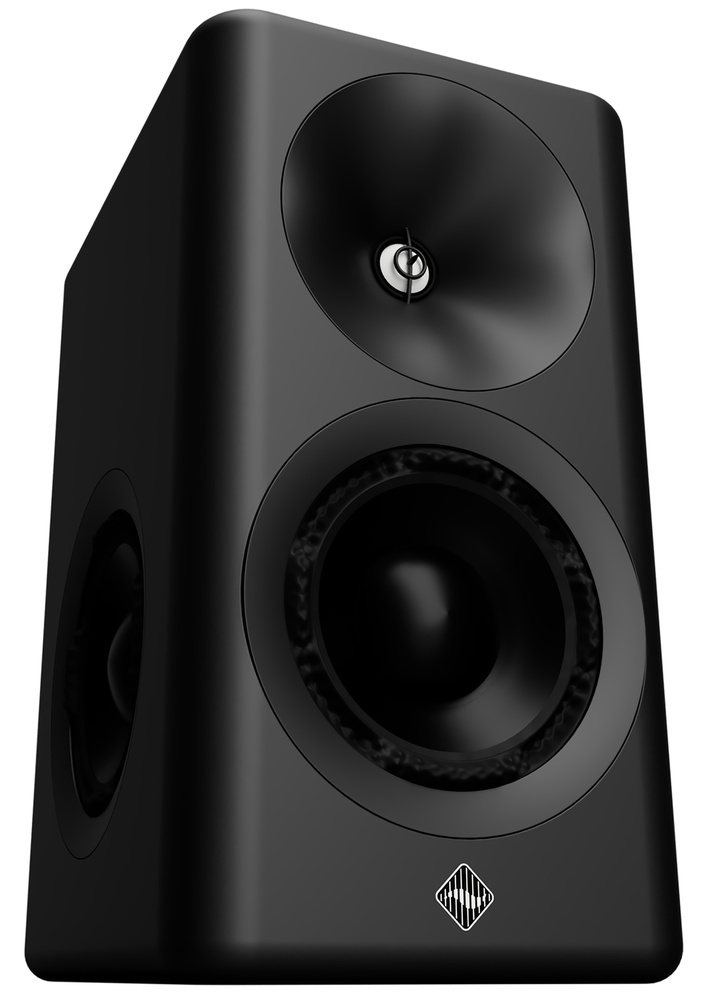 Located in South Korea, AsciLab are relatively new entrants to the high‑performance loudspeaker sector. The company have their roots in two decades of architectural acoustic consultancy, and while one might justifiably argue that the world needs no more speaker manufacturers, AsciLab arrived with an unusually focused approach to design and engineering — one that’s rooted very firmly in high‑end speaker technology and a commitment to rational, science‑based electro‑ and psychoacoustics. Although AsciLab’s initial offerings are aimed at domestic hi‑fi applications as well as professional monitoring, there’s a complete absence of the imaginary engineering and snake‑oil that infests the hi‑fi business and this, to my mind, is to be enthusiastically applauded.
There are currently three products in the AsciLab range: the F6B, the C6B and the A6B. All are relatively compact, two‑way, passive monitors. For this review I was loaned a pair of A6Bs, the largest and most ambitious model in the current range. I say ‘current’ because AsciLab say there are more products on the way, including an active version of the A6B.
While the A6B is presently the largest product in the AsciLab range, its 40.5 x 22 x 30cm dimensions still fall into the ‘nearfield’ category (only just, though; much larger and I might be deploying the ‘midfield’ term). The cabinet is a braced MDF construction, which on my review sample was finished with a fine‑textured black paint. One white and two grey options are also available. The cabinet edges are generously rounded, which both softens the aesthetic appearance and helps suppress edge‑diffraction effects. An aluminium panel let into the back of the cabinet carries the connection sockets externally and the passive crossover board internally. The sockets can handle 4mm plugs, bare wires or spade connectors.
The front panel is populated by a nominally 165mm bass/mid driver and a 25mm waveguide‑loaded tweeter, and its side panels are each home to a 165mm auxiliary bass radiator (ABR). The bass/mid and tweeter drivers are integrated by the passive crossover at an unusually low 1kHz. The crossover combines third‑ and fourth‑order filters and is implemented using air‑cored inductors and predominantly plastic‑film capacitors. If you read my recent review of the Amphion One18X monitor, you might be struck by its conceptual similarity to the A6B, and you’d not be wrong. Amphion and AsciLab both seem to have concluded that the combination of a waveguide tweeter with a low crossover frequency and an ABR‑based low‑frequency system is the way to go for a passive nearfield monitor (for the record, it’s probably what I’d do too). However, the A6B takes the concept a step further in its waveguide dimensions, its crossover frequency and its driver technology. It also goes even further in attempting to minimise non‑linearities and the various distortion phenomena that result.
Purification Ritual
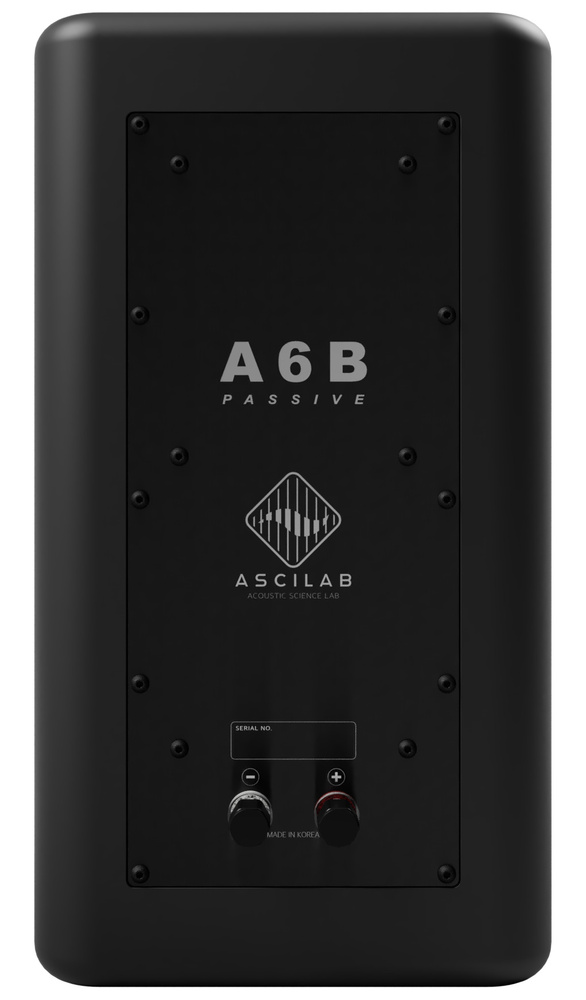 Being a passive monitor, there’s not much happening on the back panel. However, AsciLab plan to release an active version of the A6B in the future.
I’ll begin with the drivers. Firstly, AsciLab, like a great many other monitor manufacturers, don’t make their own drivers but buy OEM units. Apart from eliminating the need to develop drivers from scratch, thereby massively reducing the time (and cost) to market, using OEM drivers enables monitor manufacturers to pick and choose from a huge range of options. AsciLab have chosen Purifi units for the bass/mid and ABR roles and an SB Acoustics unit for high‑frequency duties. The Purifi drivers have aluminium diaphragms, while the SB Acoustics tweeter has an aluminium/ceramic dome.
We’ve come across Purifi drivers before, in my reviews of the Jones‑Scanlon Baby Red and PresentDayProduction’s MUM‑8 monitors. Purifi is the brainchild of electro‑acoustic engineers Lars Risbo and Bruno Putzeys, and if the second of those names rings a bell, that’s because it is also attached to the brains behind the the Kii Three and Kii Seven monitors (and numerous commercial Class‑D amplification products). Lars and Bruno’s guiding principle with their Purifi drivers is, in one word, distortion. They argue that driver design over the decades has tended to put too little emphasis on the various mechanisms within the motor system (the magnet, metal parts and voice coil) and diaphragm restraint (surround and suspension) that inherently generate distortion. And they’re not wrong, I think. The driver design emphasis on diaphragm material that’s continued ever since BBC research engineers Shorter and Hughes happened upon Bextrene (a type of polystyrene) rather than paper in the early 1970s has, I think, been something of a distraction from more significant problems with moving coil drivers. And it’s those more significant problems that Bruno and Lars set out to fix.
The most visually obvious result of their efforts to eradicate distortion from drivers is the characteristic (and crazy‑looking) surround. While perhaps appearing as though it might have been drawn by a visually challenged chimpanzee, the surround is actually of a very cleverly conceived 3D geometry that offers effective wide‑band diaphragm energy termination, while also remaining consistent in terms of its radiating area regardless of whether it’s moving inwards or outwards (something that conventional roll surrounds tend not to do). This is important because, especially in the case of relatively small diaphragms that are required to move significantly, the surround constitutes a significant portion of the overall radiating area, and if that varies on in and out stroke, distortion will result.
While the Purifi surround grabs the headlines, the engineering complexity hidden down in the driver motor system is, I think, more significant. The basic electro‑mechanics of a conventional driver motor system — the voice coil, magnet and pole piece/top plate metalwork — are hamstrung by numerous non‑linear phenomena that, if left unattended, result in distortion the instant a signal at the terminals demands that the voice coil moves. I don’t have space to explain all the non‑linearities here, or Purifi’s approach to suppressing them (try this if you’re interested: https://purifi-audio.com/blog), but if there’s another driver manufacturer out there that takes a more deliberate and innovative approach to fixing non‑linearity and distortion, I’m not aware of them.
The High End
The Purifi project is a product of Northern European audio engineering and so, despite its Indonesian manufacture, is the A6B’s SB Acoustics tweeter. Although SB (Sinar Baja Electric) are an Indonesian company, their design office is in Denmark, a country with an unparalleled tradition of driver design (mostly fathered by a well‑known radio company founded in 1925 by Peter Bang and Svend Olufsen). The A6B tweeter is a 25mm dome device with an aluminium/ceramic (fundamentally, anodised aluminium) diaphragm and an under‑hung motor system, which means its voice coil is shorter than its top plate is thick, so it never leaves the magnetic flux field. Having said that, AsciLab select tweeters for optimal excursion linearity by rejecting those in which the voice coil rest position is not exactly at the midpoint of the top plate. This is important because a significant respect in which the A6B differs from almost every other two‑way high‑performance speaker is that its crossover frequency is extremely low: 1kHz to be precise (the idea of a 1kHz crossover on a dome‑tweeter two‑way system would have many a traditional speaker designer quivering with anxiety). This means its tweeter diaphragm is required to move rather more than it would if the crossover frequency was at a more traditional, say, 3kHz.
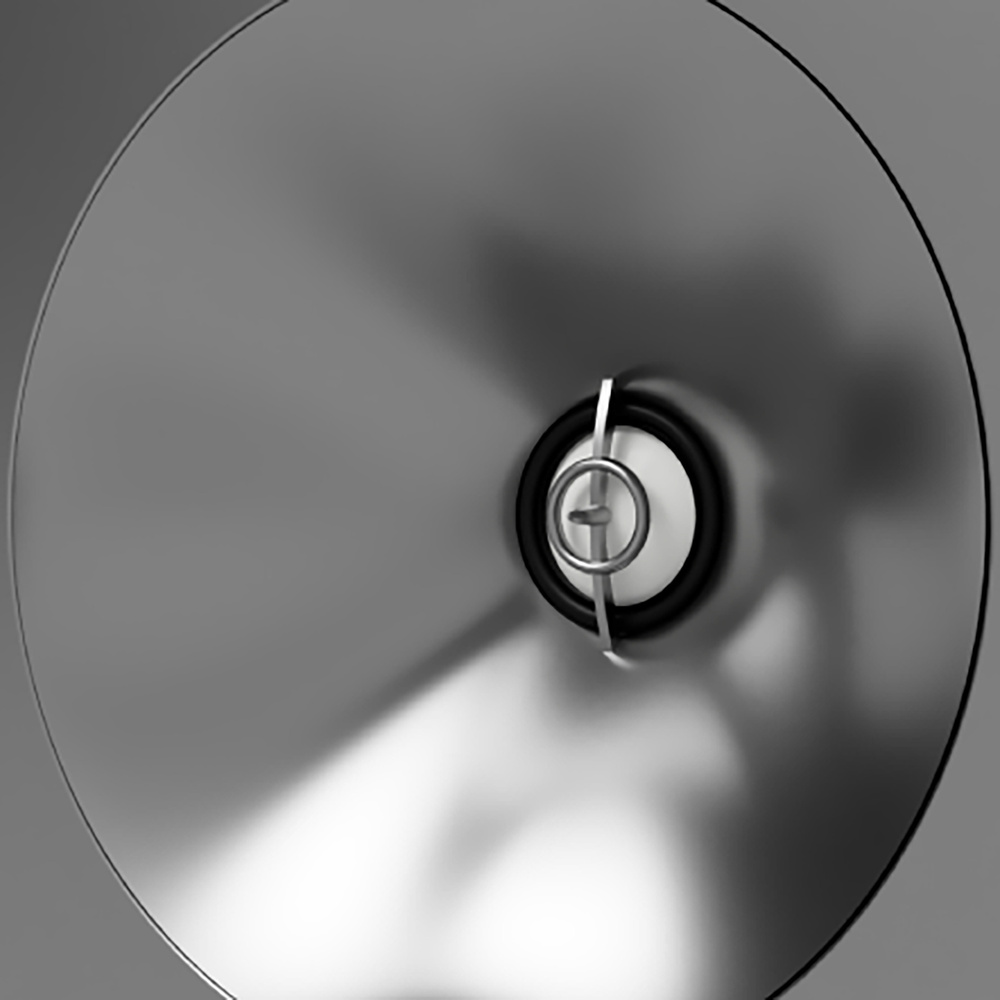 The A6B’s waveguide is unusual in that, as well as affecting the tweeter’s sensitivity and dispersion, it has been designed to mitigate cabinet‑edge diffraction.The very low crossover frequency arises as a result of AsciLab’s twin aims to control system dispersion as the bass/mid driver integrates with the tweeter, and to minimise the Doppler distortion that inevitably arises in a driver asked to reproduce low and high frequencies simultaneously. Imagine a driver working hard, pumping backwards and forwards, at say 40Hz while simultaneously reproducing 3kHz. The 3kHz signal will be modulated by the 40Hz as its source (the diaphragm) moves. So pulling the crossover frequency down to 1kHz ameliorates that distortion source somewhat. And that’s also where the A6B’s highly complex waveguide comes in. Adding a waveguide to a traditional dome tweeter very significantly increases its sensitivity (and therefore its effective power handling) while simultaneously matching its dispersion at the low frequency end of its range to that of a similarly dimensioned bass/midrange driver. The Amphion One18X leverages this concept, as does the A6B, but to a more extreme degree. Not only is the A6B waveguide larger, both in diameter and depth; it employs both an extremely complex variable surface profile and, down at its mouth, a ‘phase plug’ device placed close to the dome diaphragm surface that helps keep the very high‑frequency output of the dome ‘coupled’ to the waveguide.
The A6B’s complex waveguide profile reminds me of the PMC6.2 I reviewed back in April 2022. The 6.2 employs a hybrid hyperbolic/exponential midrange waveguide that PMC say helps simultaneously optimise the driver’s lower‑frequency sensitivity and high‑frequency dispersion. AsciLab say that the A6B waveguide profile is not particularly aimed at managing the balance between sensitivity and dispersion, but I think it’s clear that waveguide profiles generally offer a rich vein of speaker‑development potential. However, if the A6B’s complex waveguide profile is not aimed at massaging dispersion and sensitivity, what does it do? AsciLab say its development followed an intensive FEA (Finite Element Analysis) and 3D printing development programme aimed at employing the waveguide not only to make possible the low crossover frequency and match the bass/midrange driver dispersion, but also to manage the cabinet‑edge diffraction, which, despite the softened cabinet edges, apparently still has a significant and negative effect. The waveguide effectively steers the tweeter radiation away from the cabinet edges.
Having A Graph
To investigate whether all this engineering is apparent, I subjected the review samples to a little electro‑acoustic tyre‑kicking in my usual measuring space. The data in Diagram 1 shows the A6B axial frequency response at 90dB SPL, overlaid with its second‑ and third‑harmonic distortion. The frequency response is one of the flattest I’ve ever measured (and notably lacks the oft‑seen waveguide discontinuity above 15kHz) and the distortion, especially the more troubling third harmonic, is better than 60dB down above 100Hz. That’s less than 0.1%, over the vast majority of the audible band, and a truly remarkable achievement.
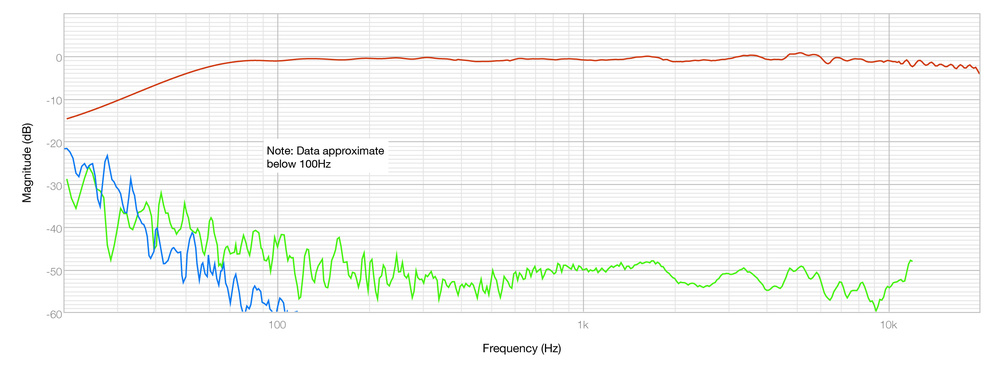 Diagram 1: The A6B’s on‑axis frequency response (red trace), and its second and third harmonic distortion products (green and blue, respectively). The distortion performance in particular is remarkable.
Diagram 2 shows the A6B horizontal dispersion at 20 and 40 degrees compared to the axial response, and again it’s pretty much faultless, exhibiting just a gentle, increasing wide‑band roll‑off as the off‑axis angle increases. There’s no sign of any crossover discontinuity or misbehaviour at the top end of the tweeter band.
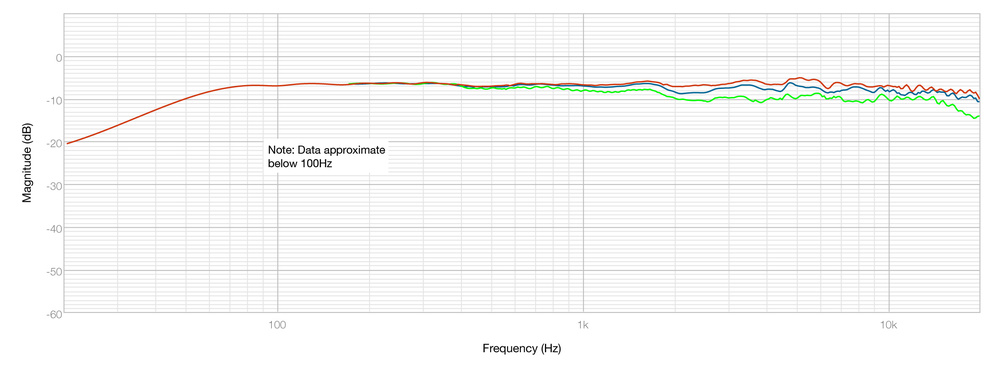 Diagram 2: Comparing the on‑axis response (red) with measurements taken 20 and 40 degrees off‑axis horizontally (blue and green, respectively).
Diagram 3 shows another dispersion check but this time for ±15 degrees vertically. A slight crossover region dip at ‑15 degrees reveals the A6B to at least be subject to the usual rules of acoustics rather than somehow immune. The crossover dip is caused by the path lengths from the drivers to the measuring mic changing vertically off‑axis, which shifts their relative phase and causes some destructive interference. I’d aim to listen to the A6B on or above axis, rather than below, as a result.
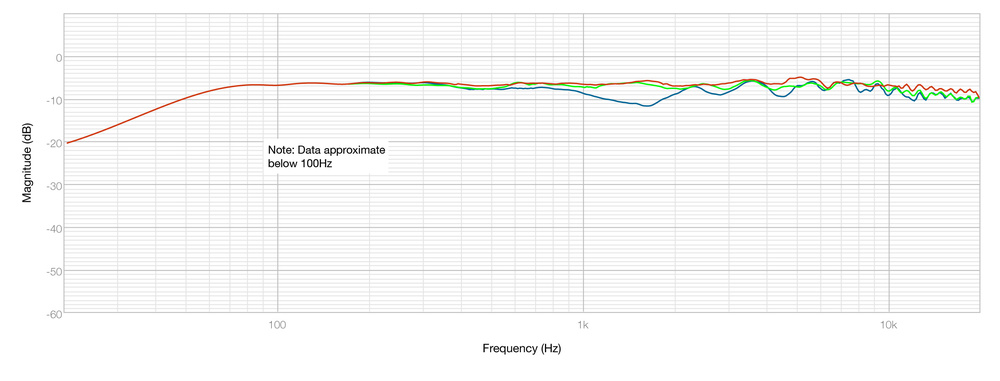 Diagram 3: The A6B’s on‑axis response (red), and measurements taken 15 degrees above (green) and below (blue).
Finally, Diagram 4 shows the A6B input impedance, electrical phase and Equivalent Peak Dissipation Resistance (EPDR for short). EPDR displays the effective resistive load the amplifier ‘sees’ from the combination of magnitude and phase. The A6B offers a pretty typical passive loudspeaker load to an amplifier but its EPDR drops to pretty low levels, and its overall sensitivity is low also (82dB for 2.83V at 1m), so it would definitely best be driven by a generously rated amplifier that is happy to deliver significant output current. The impedance curve also reveals that the A6B ABRs are tuned to 35Hz, which ties in well with the specified ‑3dB low‑frequency bandwidth of 37Hz.
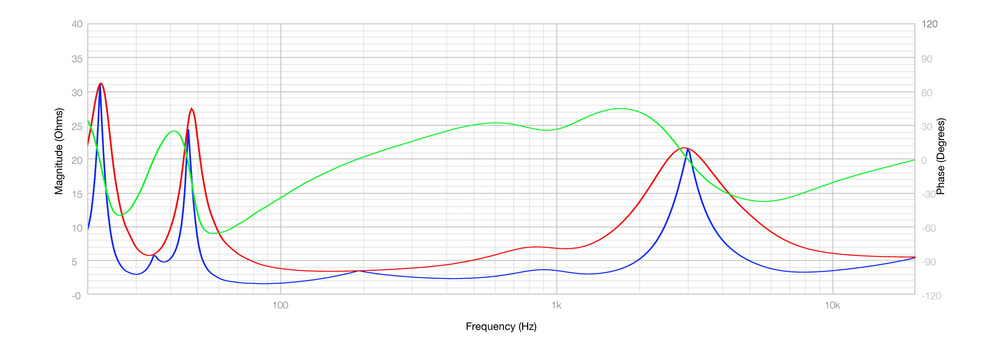 Diagram 4: The A6B’s input impedance (red trace), electrical phase (green) and EDPR (blue).
Asci Art
So how does the A6B’s impressive set of measurements sound? I’m actually going to be relatively restrained in describing my subjective experience, because I was somewhat knocked sideways by it. Wearing my loudspeaker engineer hat, I’d really like the takeaway from this review not to be my grasping for inadequate descriptive adjectives, but to be that serious, rational, science‑ and engineering‑based electro‑acoustic engineering really delivers the goods. And then some. The A6B sounds extraordinary, and in monitoring terms can play the role of an incredibly effective mix tool like very few alternatives.
The A6B sounds extraordinary, and in monitoring terms can play the role of an incredibly effective mix tool like very few alternatives.
I can’t entirely help myself indulging in subjective description, though, because the A6B is one of those ‘recalibrate your expectations’ products. I’ve not heard a compact loudspeaker much, or perhaps anything, like it before. The sense of realism in voices through the tonal accuracy, image focus, lack of distortion and depth of detail is truly uncanny. I wondered initially, for the first few minutes of listening, if perhaps the A6B was missing a bit of vocal warmth in the lower midrange voice band, but I then began to realise the missing element wasn’t warmth, it was the distortion and coloration I’ve come to expect, and almost take for granted, from traditional moving‑coil drivers. It was not dissimilar at high frequencies: the usual subjective trade‑off between balance and detail we all sort of expect (for example, “it has fabulous high‑frequency detail but maybe the balance is a little bright”) just didn’t seem to apply. The A6B simply sounds right. To my mind this is a result of the vanishingly low distortion from the tweeter and the control of dispersion and diffraction provided by the waveguide. At the opposite end of the audio band the A6B offers a good compromise between bandwidth extension and dynamics, but as with the rest of the audio band, it’s the lack of distortion artefacts that dominate. Bass sounds clean, communicative, properly timed and accurately pitched.
To some extent, the performance of the A6B is a direct consequence of the groundbreaking work invested in the Purifi drivers by Lars Risbo and Bruno Putzeys. But by no means is the A6B simply a competent application of a Purifi driver, because Jinsung Ko and his AsciLab colleagues have taken the Purifi foundation and run with it by developing a tweeter waveguide and overall system design of equal capability and engineering quality. I’ll personally be fascinated to hear what AsciLab do next, and there’s some major monitor and hi‑fi speaker brands out there who also, I think, ought to be pretty interested.
Alternatives
Including the price of a suitable power amplifier (I used an Amphion Amp700 during the review) a pair of A6Bs lives in the same cost territory as monitors such as the Amphion One18, Genelec 8341A, PSI A17M, ATC SCM12 and Barefoot Footprint01 Gen 2.
Pros
- Near‑faultless measured performance.
- It sounds as good as it measures.
Cons
- Demands significant power amplifier muscle.
- Otherwise, none.
Summary
The A6B is a remarkable product that’s arrived from nowhere. It gives monitor design and performance a significant nudge down the road, and it proves that you don’t need snake oil to build brilliant loudspeakers.
Information
£3000 per pair including VAT.
Purité Audio +44 (0)7739 407129.
$3300 per pair.