

Add a touch of magic with Bastl’s mini modular effects box.
Behold the magical mystical box of delights that is the Bastl Instruments Kastle 2 FX Wizard. It’s a bit of a mouthful to say, although, unlike the other Kastle boxes, it doesn’t quite fit in your mouth if that’s a helpful measure of size. I’m not sure a wizard would want to use something quite this fiddly, but it’s undoubtedly overflowing with mischief and spellbinding effects.
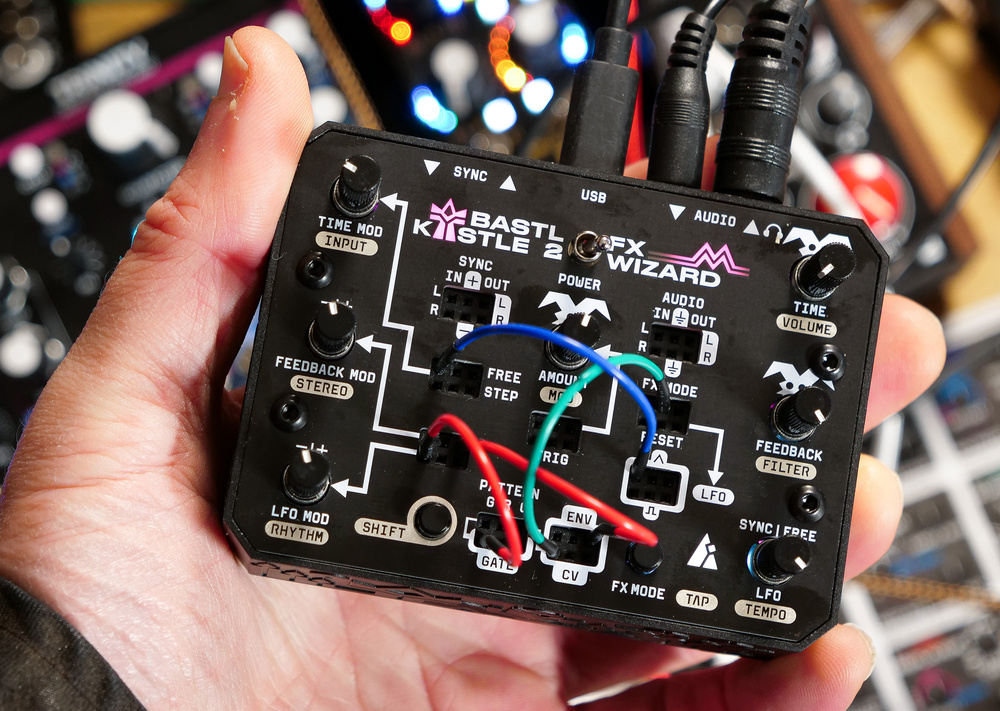
The FX Wizard is a small but mighty multi‑effects box. It’s made from plastic but feels solid; it has an air of brutal functionality rather than anything approaching beauty or elegance. Although It’s about half as big again as the other Kastles (ARP, DRUM and Kastle 1.5), it has the same layout of seven knobs; three on either side and one in the middle. The additional space has allowed Bastl the room to plough in a bunch more patch points. It retains the patch‑wire modular approach of its companions, which is both fun and frustrating, fiddly and fabulous.
Its size will inevitably be a factor, but assuming the compact form does not put you off then let’s dig in.
Nine Modes To Rule Them All
Within the FX Wizard are nine effects modes. These include Delay, Flanger, Freezer, Panner, Crusher, Slicer, Pitcher, Replayer and Shifter. Most are self‑explanatory and some are less so, but they all make sense very quickly once you start to fiddle with them.
There are only actually three parameters involved in the effect itself; the other four knobs, and the majority of the patching, are to do with modulation. If you look closely at the front panel, you might see the floppy ears of a white rabbit biting hold of three of the knobs; these are the ones that will, presumably, take us down the rabbit hole. The middle knob is usually the dry/wet mix or amount, but this does vary depending on the effect. The top‑right knob is usually time or rate, but again there’s some variation, and the right‑side Feedback knob is nearly always feedback and plenty of it.
The effects are great. On the whole they are fun, responsive and capable of some really wizard things. Some of them do exactly what you’d expect, like the Delay, Flanger, Panner and Crusher, whereas others invite you in for a bit more of a play. The Freezer is like a sync’ed delay wired into a ratchet machine with granular vibrations. The rate knob goes one way to smear timbral components and the other to rhythmically regurgitate frozen slices of your audio. It’s enormous fun. As is the Pitcher, which will shift your melodies through some tonal stretching before finding some nonsensical loops of juddering Arcadian bubbles. The Shifter is a much calmer and more deliberate pitch‑shifter that can give you everything from subtle detuning to octaves and FM‑style ultrasonic modulations. The Replayer is also very cool, where you can grab a chunk of audio and then play it back at different speeds or directions in a fitful emulation of some form of tape.
The Slicer endeavoured to patternise my audio in line with a bunch of preset rhythms, and was the least interesting for me. I was probably not using the right sort of source material, but it seemed to lack the playfulness of the other options.
Wired For Sound
So, as an effects box, it’s a fun little machine that will keep you amused for hours. But that’s not the half of it. If you want to move on from being the sorcerer’s apprentice into something approaching Gandalf, Dumbledore or even Rincewind, then you’ll need to embrace the tiny weeny world of jumper‑wire modulation.
Modular patching with jumper‑wires is not unique to Kastle boxes; you’ll also find it on AE Modular systems, the Korg Volca Modular and the NS1 Nanosynth. And all of them share a nagging sense that your fingers are simply too fat for this sort of nonsense. However, with patience, compromise and the knowledge that the compact size is convenient, affordable and even adorable, we will persevere.
The FX Wizard has 54 patch points broken up into nine blocks of six. Many of the blocks have two rows of functionality so you have to keep your wits about you and follow the screen‑printed labels and signal routing very carefully. In terms of modulators, we have an LFO, an envelope follower and a pattern generator that can output CV and gates.
The LFO patch block is split into three for the triangle wave and three for the square wave. A dedicated LFO knob lets you turn from sync’ed tempo divisions to free‑flowing frequencies. The envelope follower has three outputs and drags some CV shapes off the incoming audio. Alongside the envelope is an interesting little pattern generator. It generates eight steps of both CV and gate in 16 different patterns. The CV either runs up all eight steps like a flight of stairs, bounces up and down again or randomly blips about depending on how you patch it.
All of this modulation can be fed into numerous places. The Time and Feedback parameters have dedicated attenuverters over on the left. The Amount knob in the middle has its own block for modulation or triggering. You can mess with the LFO rate on another knob or put some CV to work selecting the effect mode in a wonderful cascade of glitch‑riven sound mangling. The more you play with it, the more extraordinary it becomes until you feel you could be casting some sort of modular enchantment.
As a final flourish, Bastl have snuck in a DJ‑style filter that goes from high‑pass to low‑pass on a turn and a stereo widener for pushing those sounds apart. The FX Wizard is resolutely stereo and loves nothing better than moving about in that field. Still, it’s worth noting that it prefers a stereo input by default, and you’ll have to dig into the advanced settings to switch it to mono mode.
The effects are very capable when used as intended, and the box can quickly morph into a weird wizardly instrument of its own once you apply a bit of modulation.
Conclusion
After spending a good amount of time conjuring up effects with the Kastle 2 FX Wizard, I find two things to be true: one, it’s very fiddly, and two, it’s a heck of a lot of fun. When you get right down to it, there’s enough space around the controls for uncomplicated grab‑and‑twist interaction, and its playfulness does a good job of soothing away the jumper‑wire eye strain and fudgy‑finger syndrome. The effects are very capable when used as intended, and the box can quickly morph into a weird wizardly instrument of its own once you apply a bit of modulation. So grab your pointy hat, flourish your patch wires, and let the FX Wizard cook up something potent.
Pros
- Some really fun effects.
- Very playable.
- Modulation brings it to life.
- Capable of wonderfully zany combinations.
- I can’t stop fiddling with it.
Cons
- Fiddly mini modular patching.
- No bypass and no pass‑through when off.
- No battery cover.
Summary
The Bastl Instruments Kastle 2 FX Wizard is terrifically entertaining, casting explosions of effects and epic spells of modulation in an almost but not quite too fiddly little box.