

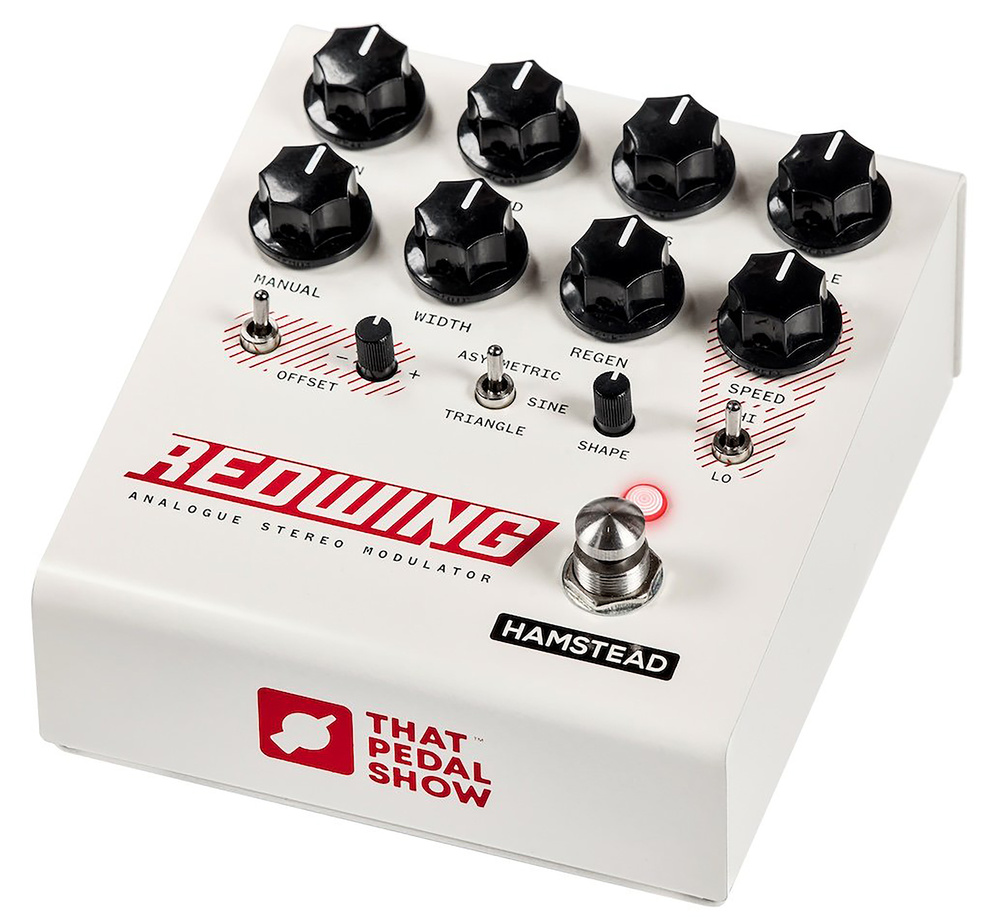
This all‑analogue affair takes modulation well beyond the bread‑and‑butter chorus and flanger effects.
With a background in aviation electronics, Pete Hamstead came to the guitar world with different ideas from most designers, but arguably his most important was to design analogue amps that boast much better noise performance than the classics, and his recipe works: I’ve played through a couple of their amps and as well as kicking out a great tone, they’re whisper‑quiet in terms of noise — to the extent that when not playing through it, you really wouldn’t know the amp was on!
Red Lines
This is all achieved through component choice and skilled circuit design (as opposed, for example, to any noise‑supression processing such as expansion). Naturally, Hamstead soon went on to bring his expertise to bear on analogue stompbox design, and we’ve already been impressed by a couple of his designs: the Signature Analogue Tremolo (reviewed in SOS July 2016) and the Odyssey multi‑mode analogue overdrive (SOS August 2018).
Now, in collaboration with the team behind That Pedal Show, Hamstead have returned with a larger, more ambitious pedal called the Redwing. But although billed as an analogue ‘stereo modulation pedal’, that description doesn’t really convey its full scope. It features two bucket‑brigade delay (BBD) lines that are used in various ways to bring us a whole smörgåsbord of tasty effects, ranging from chorus, vibrato and flanging, to a sort of rotary‑speaker emulation and even ring‑mod‑like textures.
As you might expect of Hamstead, they’ve taken an analogue purist’s approach: the signal path and the controls are entirely analogue, and that’s a decision that has pros and cons. In the pros column, the sound is great, the technical performance is superb, with vanishingly low noise levels, and the controls are every bit as immediate and intuitive as you’d expect of a decent analogue pedal. As for the cons, there’s no MIDI, no tempo sync, and no preset switching system. For some, that last one could well prove a deal‑breaker, simply because this pedal is capable of performing so many different duties, and for playing a set on stage I’d tend to view it as a single‑purpose pedal, even if that purpose might vary from show to show. The sound and versatility definitely appeal, though, and at home and in the studio, you obviously have more time to dial in your settings and experiment.
Form & Function
The Speed control has a switch to change its range, allowing you to access more aggressive, out‑there effects than on a typical chorus/flange pedal.The build quality is solid and weighty; it inspires confidence. On/bypass switching is handled using GigRig’s ‘silent’ OptoKick optical footswitch, which should prove reliable and, as long as you’re gentle, can be operated quietly, with no click. The main knobs on the top panel are Gain (which appears to be a post‑effect master volume, and doesn’t apply when the effect’s bypassed), Speed, Width and delay time (labelled Manual), pretty much as you’d expect. There’s also a Blend knob for mixing the wet and dry signals, and Regen, which sets the feedback intensity. An active EQ section comprises separate Bass and Treble knobs that can cut or boost, but apply only to the wet signal — so, in conjunction with the Blend control, you can use them to rein in any effects that you like but which nonetheless tend to leap out a bit too much.
Some switches, though, allow you to take things a little further. There are three LFO modulation waveform options (Triangle, Sine, and Asymmetric, which is essentially a sine wave that’s flattened out on the top part of the wave, to cause a ‘lurchier’ sort of feel), along with a smaller knurled knob to adjust the Shape. With the latter you can move the centre point of the waveform back/forwards, so you can, for example, dial in a classic sawtooth shape. The LFO is Hamstead’s own design by the way, not an off‑the‑shelf chip.
The Speed knob has an associated switch for Hi/Lo speed ranges. This increases the range of effects possible without the pot seeming too sensitive and finicky to the user, and the Hi setting is what allows this pedal to be taken all the way into Leslie and ring‑mod sort of territory. Finally, an Offset switch and another small knob allow you to offset the right‑side delay line, making it possible to achieve something like the classic through‑zero open‑reel tape flanging. Obviously, you can’t move either delay line earlier in time than the dry signal!
You have the choice of fully mono operation and not only a stereo output, but separate wet and dry mono outputs.On the rear, the Redwing has a single mono jack input, but the dual jack outputs can be used in a couple of ways. A switch determines whether they’re used in tandem for left‑right stereo, or one for the dry signal and the other for the wet. There’s also a Control input for an expression pedal that acts on the Speed parameter. A Hold jack supports an external footswitch, and this can be used to drive the feedback loop into oscillation. A Phase In/Out toggle inverts the polarity of one of the two delay lines, for more complex, spacious‑sounding effects. Finally, a DC power inlet accepts 9‑24 V, and requires a 365mA supply (not provided).
Impressions
Plugging into the Redwing, the first thing I noticed was a joyful sonic richness, and in general it sounds every bit as good as I’d hoped. Obviously, you do need to spend a little time dialling in the actual effect you want, and there are some recall sheet‑style examples in the manual to help get started. The dual BBD lines open up possibilities far beyond what a standard mono modulation pedal can deliver and since, in stereo mode, you can offset one channel and polarity‑invert the modulating LFO for one line, you’re able to produce all sorts of luscious textures.
The sense of width and motion was impressive: a constantly shifting, luxurious image that feels warm and immersive, but simultaneously clear...
The Redwing really shines when used in fully stereo setups. I don’t tend to run dual amps or cabs myself, but when testing it over my studio monitors with modelling amps, the sense of width and motion was impressive: a constantly shifting, luxurious image that feels warm and immersive, but simultaneously clear — never noisy or muddy. It has serious potential, then, for keyboards, synths or, perhaps, even vocals, not just guitar. But for all this glorious stereo sophistication, the Redwing is perfectly happy being used as a mono‑in, mono‑out stompbox on your guitar pedalboard.
I can’t claim to be a frequent user of chorus effects either, but I admired and enjoyed what I found here; even subtle settings seem to have a sense of depth and vitality. Flanging is much more ‘me’ territory, and when it comes to that effect this pedal is oh‑so satisfying. The Redwing is capable of restraint or wildness, and pretty much everything in between. You can dial in familiar effects — the gentle ‘whoosh’ of an Electric Mistress, say — or something far more distinctive. That includes, with the Offset control engaged, what I reckon is a convincing approximation of tape‑style flanging. What’s more, since the Gain control only applies when the effect’s engaged, you can compensate for any sense that a flanging effect is sucking your part out of the mix when you engage the pedal — an occupational hazard with modulation effects that can render otherwise brilliant effects unusable!
I found the vibratos equally impressive. And if you push Regen into higher values and set the Speed switch to Hi, the pedal begins to veer into much more experimental territory: those metallic, ring‑mod‑like sounds I mentioned above, and self‑oscillation — the latter can be really engaging.
Verdict
So, do I love the Redwing? Absolutely! Should you get one? That depends on what you require of it. If you need a Swiss Army knife of a modulation pedal to experiment and record with, and the sound and range of effects is all important, it’d be a superb choice; it may not be inexpensive, but I really can’t think of a better option, and I’d heartily recommend it. If, on the other hand, you need a stompbox that you can quickly configure differently for each song in a live set, then, gorgeous as the Redwing sounds, you should probably look elsewhere.
Summary
An immaculately designed and built all‑analogue pedal, the Redwing is capable of a surprising range of modulation effects, from classic choruses, through whooshing flangers, to swirling rotary speakers and metallic ringing. As long as you don’t require instant preset recall or MIDI control, it’s a joy to hear and use.

