Twenty years since the launch of the original POG, the concept has been brought up to date, with features for guitarists and modular enthusiasts alike.
It seems like Electro‑Harmonix’s famous POG pedal has been around forever in one form or another. But in reality, it dates back only 20 years — the original POG was launched back in 2005, and was soon followed by the Micro POG and POG2. There is now even a Nano POG! I recently got my hands on the current full‑fat version, the POG3, which came out last year, and I have to say that, with its host of new features, it takes the POG concept to the next level.
Pretty Poly
The acronym POG stands for Polyphonic Octave Generator, and that pretty much sums up the core ethos of the original POG. On that pedal, sliders are used to add octaves both above and below the original sound. The additional voices are created by pitch‑shifting, and there are controls to shape them, so they allow for the creation of many effects, from bass‑heavy riffs and pseudo 12‑string sounds to organs and synth pads.
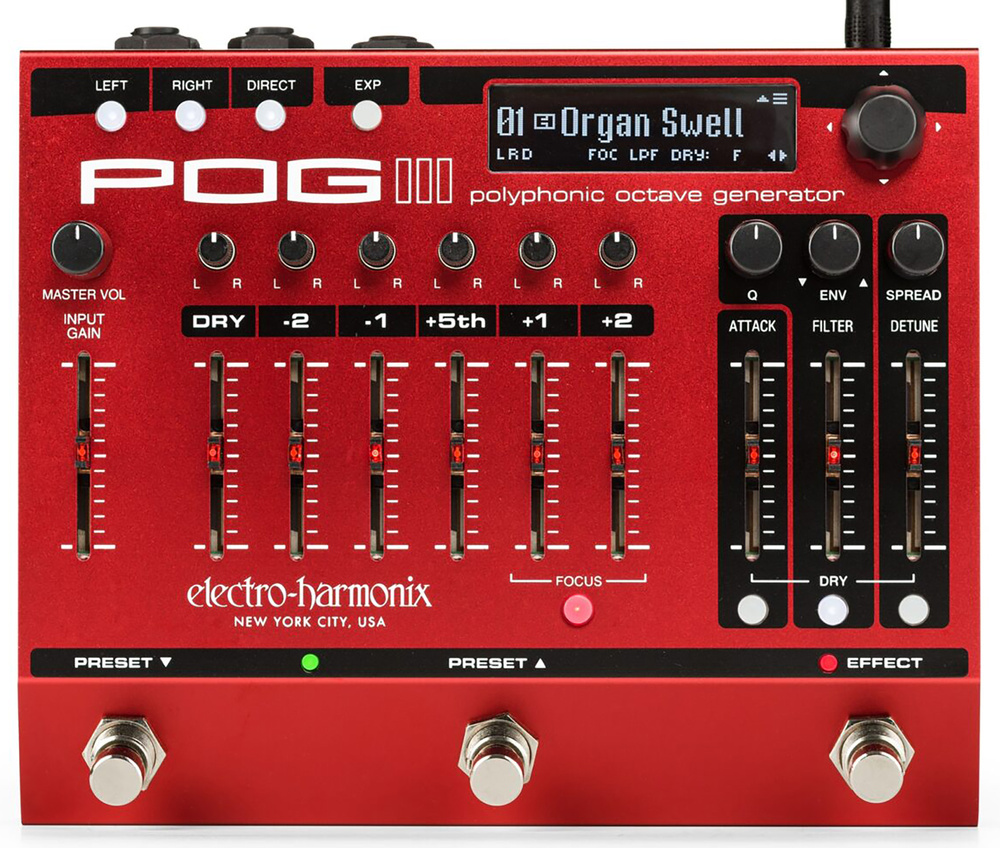
This latest versions adds a fifth‑interval slider and has an expanded filter section with adjustable parameters, including Q for the multi‑mode envelope filter and tweaked detune settings, as well as the existing envelope attack control. The POG3, which features a small OLED display for patch and editing information, can store 100 presets and also benefits from the free EHXport Mac/Windows software editor. EHXport supports preset transfer and backup to and from a computer, preset reordering, global settings and firmware updates. Its GUI mirrors the front panel of the POG3 with a parameter section running down the right‑hand side of the screen.
Housed in an aluminium case that has a more contemporary feel than that of the POG2, the controls are all located on the top panel, while the rear panel sports jack connections for the left and right outputs, direct out and Exp/CV in. The Exp/CV jack can be used not only with a conventional expression pedal as you’d expect, but also with control voltages from a modular synth system in the range 0V to 5V, which opens up all sorts of possibilities! MIDI in and out are provided too, on five‑pin DINs, and a USB‑C port facilitates connection to a computer running the aforementioned EHXport software. A suitable power supply is included in the price.
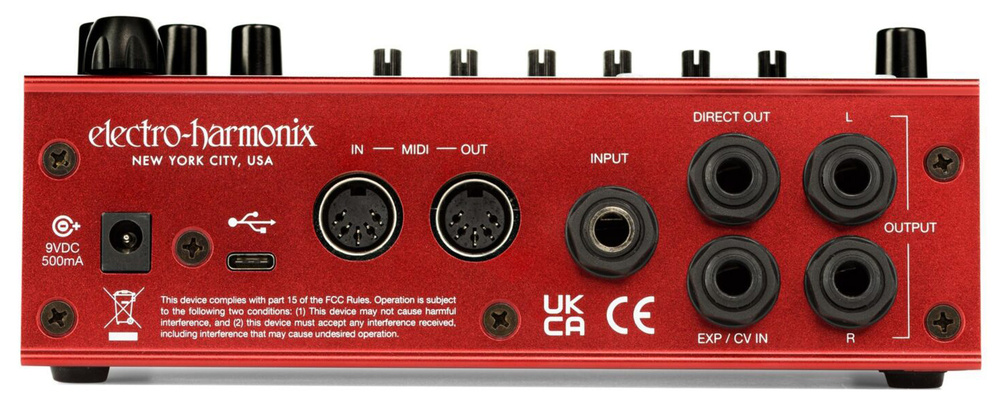 The expression pedal input can also accept CV, so there’s the possibility of integrating it into a modular synth rig.
The pedal’s 10 sliders have LED‑illuminated caps that offer useful at‑a‑glance feedback: they blink if moved or when a preset is loaded, and they get brighter the higher the value. Each of the five shifted voices, as well as the dry sound, have individual pan pots for when using the pedal in stereo. At the top right is a stepped rotary control, known as a NavCoder: it has an integral push switch, and can also be rocked in four axes to act as direction buttons. This single control accesses multiple menu items, including those to save presets. At the top left of the case are illuminated switches to activate the left, right, direct and Exp/CV jacks, and these settings are saved with a preset. A row of controls below the display hosts the master volume, small knobs for the pan controls, and three closely‑spaced knobs for Q, Envelope and Spread. Q and Envelope relate to the filter, while the Attack control sits below, along with the Filter (frequency) and Detune sliders. The Attack control works polyphonically, by the way.
Detune adds a chorus‑like texture to the overall sound by modulating the upwardly shifted voices, while leaving the sub‑octaves unprocessed. Buttons below these sliders determine whether or not the dry sound is affected. Spread introduces small timing differences between the upper shifted voices, and this can deliver a richer‑sounding effect. The filter, which responds to the input signal envelope and the attack control, works much like that of a synth, with adjustable resonance and cutoff frequency, and an Envelope control whose sweep can be negative or positive. By default, the filter is a low‑pass type, but you can switch it to be a band‑pass or high‑pass.
The voice faders cover Dry, ‑2 (octaves), ‑1, +5th, +1 and +2, and there’s an additional Focus button below the +1 and +2 sliders. When active, Focus uses the algorithm from EHX’s Pitch Fork pedal for shifting, instead of the usual POG algorithm — this allows for pitch glides when using an expression pedal (of which more below), which can be an enticing effect.
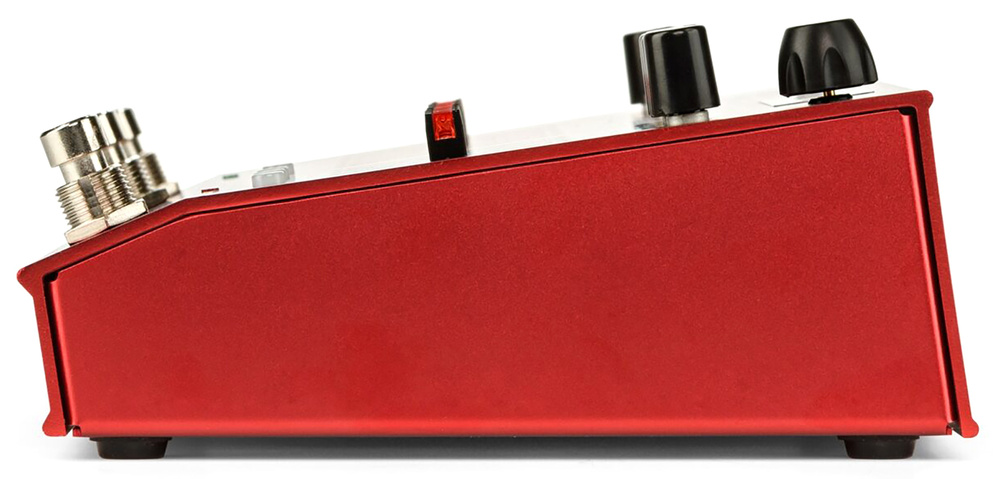 The top panel is dual‑angled, to put the footswitches, screen and controls where you need them.Two of the three built‑in footswitches can be used to navigate up or down through the presets, with the rightmost Effects switch being a bypass. The pedal also offers a Live mode for using the pedal without loading any of the saved presets, so that the slider positions always reflect the current parameter settings, allowing for parameter tweaking during a performance. The green Preset LED turns off when Live mode is in use.
But while the built in controls access plenty of functionality, I’d personally consider an expression pedal an essential add‑on for those who want to get the most out of this pedal. By default, the expression pedal controls volume, but other options are available in the setup menu — it can provide real‑time control over nearly every relevant parameter, including the filter section, preset warping and pitch glides. A Freeze function can also be invoked via an expression pedal, and there are options: Freeze+Gliss adds a pitch glissando between freezes when a new sound is held, while Freeze+Volume mode offers dynamic control over the frozen sound. The POG3’s MIDI system also supports extensive parameter control, in addition to the expected preset changes, and it can also respond to standard MIDI note messages, while the MIDI out port can provide a thru connection.
More Than Guitar
The original POG was always an interesting pedal that gave access to a range of unusual sounds, but this new POG3 has evolved nicely to give you even more options and control, without losing all that made the original special in the first place. The extensive support for CV and MIDI control mean it could have appeal beyond the guitar world, and the software‑based preset management and backup facility is also very welcome.
The envelope filter really is easy to use and adds a great deal of character to the sound.
For the most part, the pitch‑shifted voices created by the POG sound very stable, whether it’s used monophonically or polyphonically. Some complex chords can cause the odd grumble, as you’d expect, but I didn’t notice anything serious during my tests. The envelope filter really is easy to use and adds a great deal of character to the sound, while with the filter fully open the added voices can sound quite bright, giving you a lot of frequencies to work with.
Without the filter, the faders allow for the creation of organ like tones, faux 12‑string guitars and the illusion that a bass player is doubling the dry riff. Bring in the filter, and use the envelope to modulate it, and the sound becomes rather more synth‑like. It all works well and the sound is impressive. Add in some additional effects, such as delay or other modulation pedals, and your humble electric guitar can be transformed into something truly otherworldly, without you having to resort to a dedicated guitar synth.
Pros
- Huge creative potential.
- Lots of useful new features.
- CV and MIDI support.
- Free Mac/Windows editing software.
Cons
- Only the price!
Summary
The POG3 updates EHX’s poly octave generator concept, with new features such as the fifth‑interval voice, filter options and a Freeze mode. Its combination of pitch‑shifting and envelope‑filtering thus offers a lot of creative scope.
Information
£599 including VAT.
$645
When you purchase via links on our site, SOS may earn an affiliate commission. More info...

When you purchase via links on our site, SOS may earn an affiliate commission. More info...