

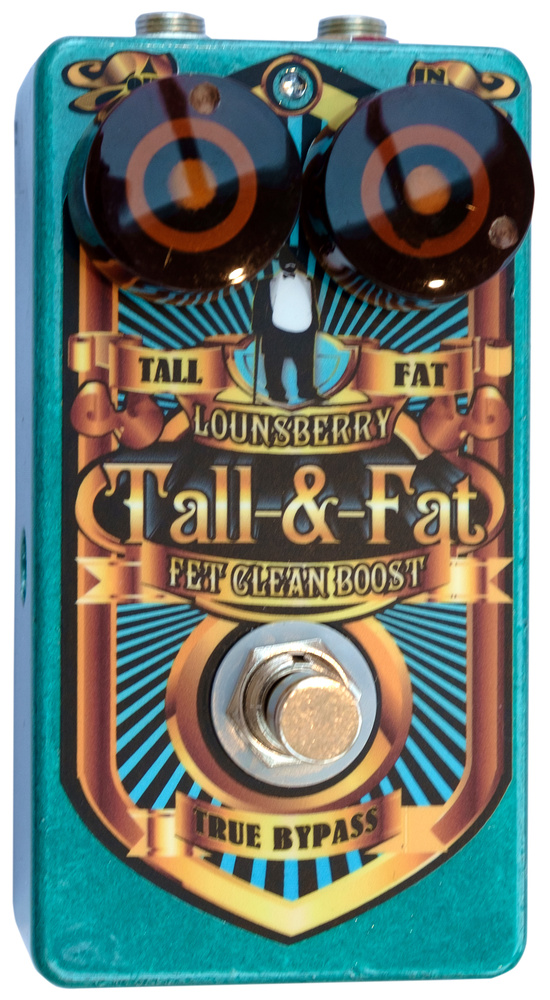
‘Clonewheel’ organs have come a very long way since the ’80s, but for many they still lack the appealing character of original behemoth Hammond consoles. So, it was with considerable personal interest that I recently discovered Lounsberry Pedals. Named after Greg Lounsberry, the designer and owner, this American manufacturer specialises in pedals that reintroduce the analogue character associated with vintage instruments and amps. Their Organ Grinder and Wurly Grinder pedals have already acquired a great reputation for classically overdriven vintage keyboard sounds, but the model that piqued my interest is the TFP‑1 Tall & Fat, designed specifically to emulate the dynamic behaviour and tonal character of the Hammond AO28 amplifier found at the heart of revered B3, C3 and A100 console organs. The Tall & Fat is built around three FET gain stages with germanium diodes, to introduce the desired character in an impressively effective way and, like the Grinder pedals, it’s available in both mono and stereo formats.
The standard‑sized, aqua‑coloured, die‑cast metal box sports steampunk‑style graphics, and aside from the true‑bypass footswitch, hosts only two controls. The left knob varies the output level while the right adjusts the amount of drive, ranging from essentially clean (though still with a warm, valve‑like character) through to a thoroughly overdriven sound. It’s not as heavy an overdrive as the Grinder delivers, but there’s still plenty of grit and grunge if needed. Greater Drive control settings require a compensatory reduction in output level, and vice versa, so I’d recommend starting with both controls turned down until you’ve optimised the gain structure from keyboard through the pedal and out to your speakers!
A standard 9V coaxial power socket (tip negative) is provided on the left‑hand side panel, but the unit ships with a PP3 battery installed. Unbalanced input and output sockets are at the top end of the box (input on the right as viewed from above), and the whole unit feels robust and reliable. Internally, the circuitry is housed on a high‑quality PCB with the pots, connectors and switch all wired onto it to reduce the risk of physical stress damage.
The Tall & Fat brings a pleasingly rich, organic quality to the sound, with a slightly compressed nature.
For organ setups using an internal Leslie emulation, the stereo version of the pedal would be a more appropriate solution. But my particular clonewheel rig comprises a Hammond SKX with the 11‑pin Leslie socket feeding a Neo Ventilator 2 Leslie pedal, so I connected the (mono) Tall & Fat pedal between the Hammond and the Leslie emulator. It takes a little experimentation to find the optimum control settings but, once optimised, the Tall & Fat brings a pleasingly rich, organic quality to the sound, with a slightly compressed nature and strong even‑harmonic character, which add a subtle depth and warmth quite reminiscent of a classic console organ. With the Drive sweet spot dialled in, pulling more drawbars and/or opening the expression pedal brings on a beautifully controllable and emotive overdrive which, to my ears, sounds far more realistic and musical than the digital drive features built into either my SKX or the Neo pedal.
Vintage Character
The Lounsberry Tall & Fat isn’t the most inexpensive boost pedal out there, and if you’re importing from the US to another country the cost rises further (UK customs duties and VAT added another £50 to the bill for mine). But it does a remarkably good job in bringing a very pleasing vintage character and realistic overdrive quality to digital clonewheel organs — it is easily the best solution I’ve heard to date, and I highly recommend it!
Measurement
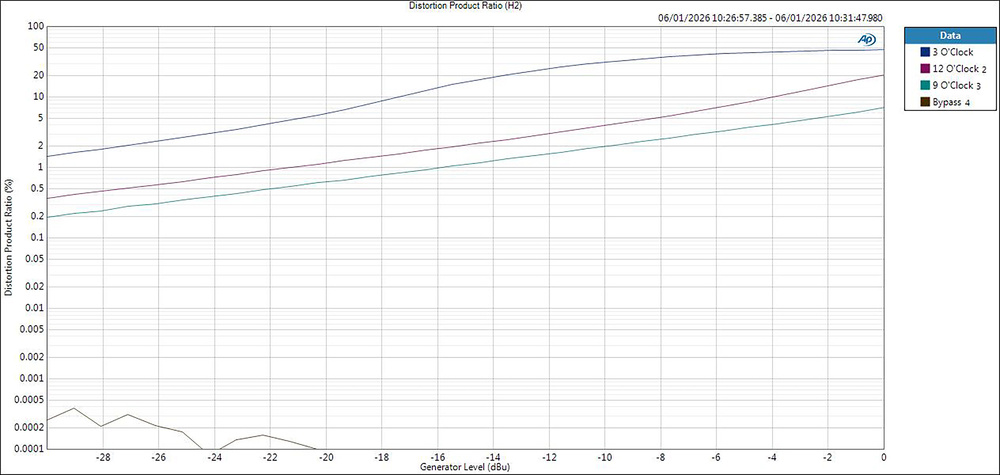
This Audio Precision measurement shows the Tall & Fat’s second harmonic distortion ratios for three different drive settings as the input signal level rises from ‑30dBu to 0dBu — a fairly typical working range for a clone‑wheel organ. The harmonic distortion in bypass mode is shown by the bottom trace which is below 0.0005%.
Setting the drive control low (around 9O’clock), distortion rises linearly with increasing input level from a barely perceptible 0.2% up to a rich 7%. Raising the drive control to 12 O’Clock shifts the entire trace upwards, starting at 4% and ending around 7%, again in a very linear build‑up.
The top trace was measured with drive set to 3 O’clock. The second harmonic distortion starts around 1.5% and plateaus at a very raunchy 50%, with a significant amount of compression too.