

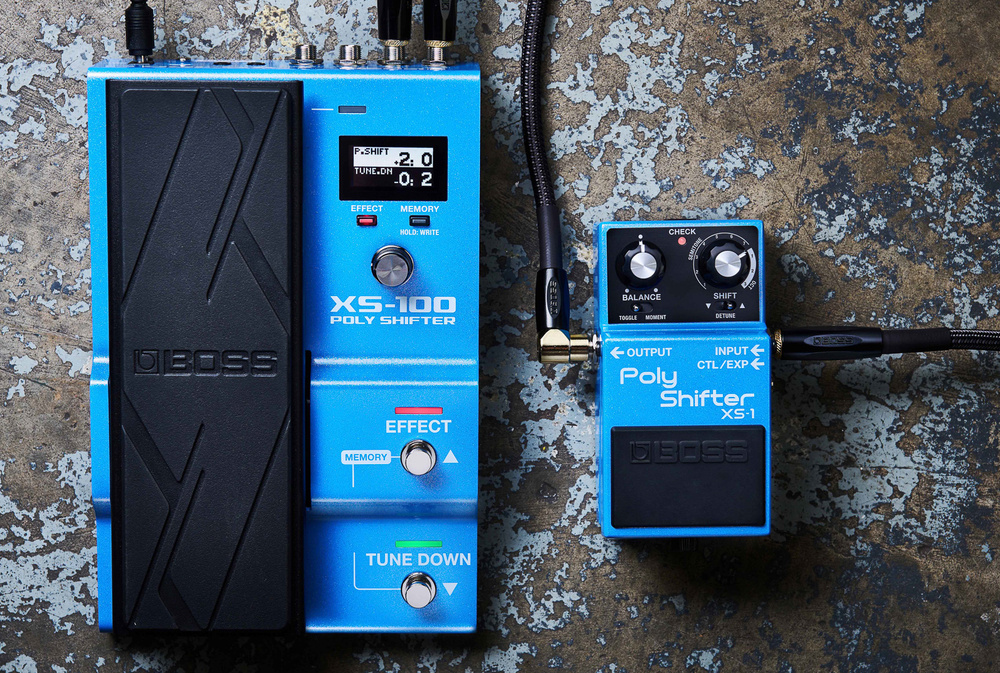
Smooth, real‑time polyphonic pitch‑shifting remains a real technical challenge, and with most pitch‑shift pedals processing artefacts are generally audible when shifting chords. Boss’ latest attempts to rise to this challenge are the compact XS‑1 and the larger, more controllable XS‑100, both based on the same underlying pitch‑shifting technology.
XS-1
Adopting the familiar Boss compact pedal format, the XS‑1 Poly Shifter is the more straightforward of the two new Boss pitch pedals, furnished with a Balance knob to blend between the dry and shifted signal, and a Shift Value rotary switch that determines how far the pitch is moved up or down. The first seven positions are semitones and the last three are octaves, with the choice of one‑, two‑ or three‑octave shifts. I found the numbers around the Shift Value control to be quite difficult to read, even when holding the pedal in front of me in daylight, so that could pose a challenge under subdued stage lighting.
A small three‑way switch sets the direction of the shift or adds detuning if left in its middle position, and the main footswitch can be set either to toggle on and off in the usual way or to operate only when the switch is held down. In detuning mode, the Shift Value knob adjusts the amount of detuning up to ±20 cents, and with the Balance control set around a quarter of the way up, this produces a very natural‑sounding chorus effect. External footswitches can be connected to switch tunings.
With just a couple of knobs and a toggle switch, what’s on offer? Set the Balance control fully clockwise and you hear only the shifted sound as set on the Shift Value dial. The first thing you notice on selecting a shifted sound is the lack of grainy artefacts. The sound is almost as smooth as using a capo, even on fancy chords, but there’s no formant correction included in the processing, so the apparent guitar body resonance will change along with the pitch‑shift. If only moving two or three semitones up/down you won’t really notice, but if you shift up by an octave the guitar body will sound smaller, almost mandolin‑like; conversely, if you shift down the body will sound larger. The harmonic content of the string is also shifted, so when shifted upwards the sound will be brighter and harmonically different from the same note played unshifted. That being...
You are reading one of the locked Subscribers-only articles from our latest 5 issues.
You've read 30% of this article for FREE, so to continue reading...
- ✅ Log in - if you have a Digital Subscription you bought from SoundOnSound.com
- ⬇️ Buy & Download this Single Article in PDF format £0.83 GBP$1.49 USD
For less than the price of a coffee, buy now and immediately download to your computer, tablet or mobile. - ⬇️ ⬇️ ⬇️ Buy & Download the FULL ISSUE PDF
Our 'full SOS magazine' for smartphone/tablet/computer. More info... - 📲 Buy a DIGITAL subscription (or 📖 📲 Print + Digital sub)
Instantly unlock ALL Premium web articles! We often release online-only content.
Visit our ShopStore.