

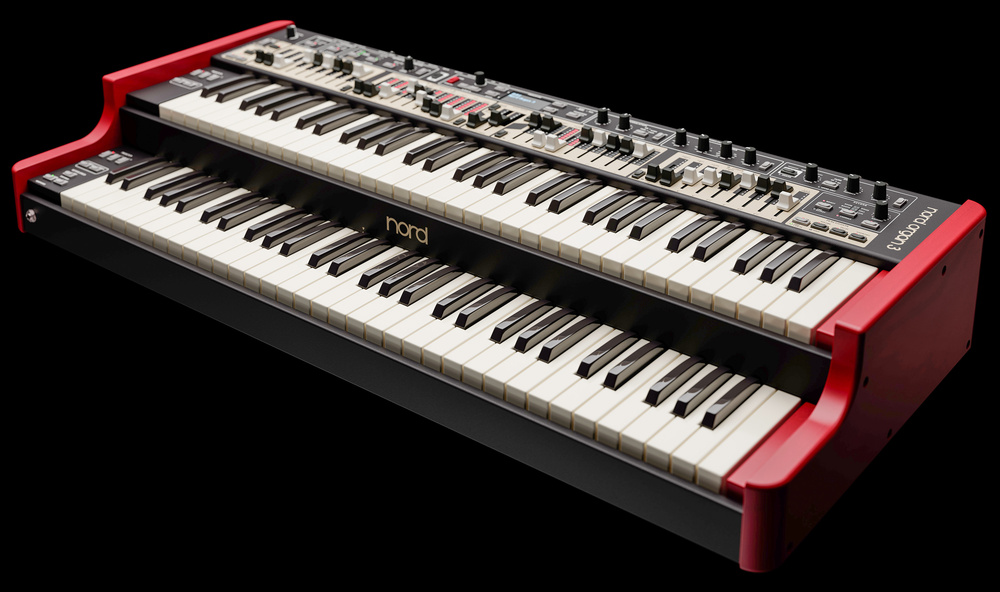
The latest generation of Clavia’s organ series introduces some pretty big changes.
Some years ago, Hammond tonewheel organ emulators — often called ‘clonewheels’ — achieved such a degree of realism that (by and large) only those who played them could hear any significant difference between the original instruments and the emulations. Nowadays, you can stick the likes of a Nord C2D or Hammond SKX Pro in a fake wooden case, and nobody in the audience will be able to tell whether you’re playing a fistful of zeros and ones or a menagerie of rotating thru’penny bits. But as players, we always want something new, something improved, something that woos us to hand over large wodges of cash for the promise of sounding better than ever before, and it’s this as much as anything that forces manufacturers to carry on developing existing product lines. If they didn’t, they would fall by the wayside and some other bunch of Herberts would then get their hands on your money. Consequently, and notwithstanding component obsolescence, I have no doubt Clavia would have loved to keep selling us C2s and C2Ds ad infinitum and avoid the costs of further development and tooling up for manufacturing a new instrument. But today we have the Organ 3, which replaces the previous models and promises numerous updates and improvements over them.
The Organ Models & Effects
The underlying Hammond emulation in the Organ 3 sounds to me to be very similar to, if not the same as, that in the latest C2 organs but with some useful enhancements to the surrounding technology. For example, the panel promises three overdrive types compared with the single type of the C2s (although the third isn’t yet implemented so we’ll have to wait to see what that offers). The existing two are less aggressive than before and, for me, are an improvement, offering a more organic growl when dialled in appropriately. There’s also a new ‘Deep’ mode within the Hammond chorus effect. This sounds similar to the chorus on my C2, so perhaps it’s the shallow mode that Clavia added. Either way, there are now more chorus/vibrato options, which can’t be a bad thing. The next enhancement is a Soft B3 option, which, at the touch of a button, removes the percussion, key click and leakage to produce the unsullied sound of the virtual tonewheels. If you’re looking for the cleanest representation of a tonewheel generator, this is a quick and easy way to obtain it.
Unlike its Hammond model, Clavia’s Vox and Farfisa emulations have not yet reached the point of convincing me that I’m listening to the original instruments. Indeed, I long ago stopped liberating my large, heavy and fragile Vox Continental II and Farfisa Compact Duo from storage to make detailed comparisons with modern instruments because the result was always that the emulations were Vox‑ish or Farfisa‑ish. But Clavia have promised an “updated Vox emulation” in the Organ 3, and a “fully revised Farfisa emulation, with improvements to the tone generators, filters and dynamic behaviours such as compression and key click”.
When testing the Vox model, I was surprised to find that the method for mixing the sine and triangle tones (which, traditionally, is achieved by pulling out two drawbars by the desired amounts) has been changed on the Organ 3. This offers a single drawbar with the pure sine wave at one extreme and the triangle at the other, which means that you can’t control the volume by pulling the waveform drawbars out by the desired amount; you can only control the waveform mix. I’m not sure that I like this. When compared with the C2D, there are also changes in the way that octaves ‘fold’ at the upper and lower extremes of the keyboard. (Mind you, the Continental II only had four‑octave keybeds and a more limited range of footages, so folding wasn’t an issue.) Ultimately, the Nord’s drawbars don’t reflect those of the original precisely but provide additional voicing options, which is good. Happily, the V3 chorus/vibrato setting does a pretty good job of emulating the original vibrato so, if you add some overdrive and use suitable EQ, you can approach the sound of the Conti. Nevertheless, I doubt that you’ll ever feel that you’ve perfectly imitated ‘I’m A Believer’ or ‘The House Of The Rising Sun’.
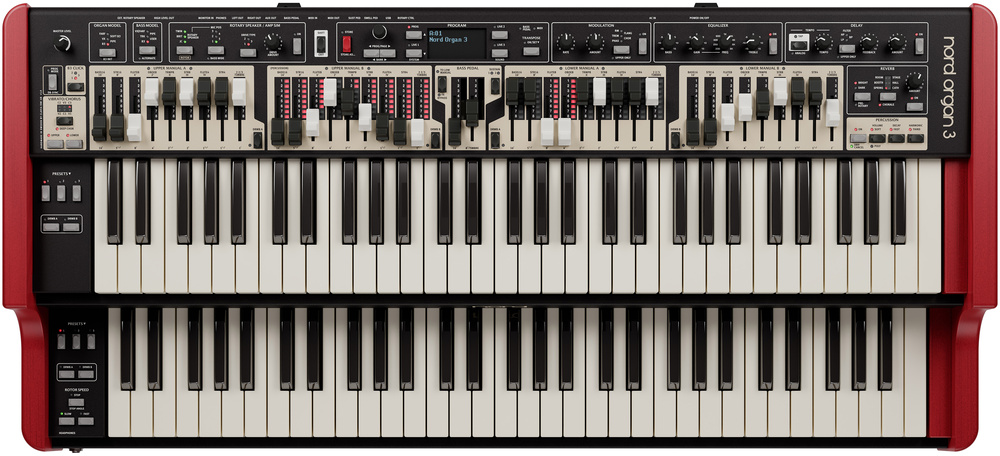 How strong are you feeling? The Nord Organ 3 measures 985 x 165 x 446mm and weighs a reassuringly hefty 17kg.
While the control mechanism remains the same as before — using the halfway point of a drawbar as a simulacrum of flicking a tab up or down — there are differences in the Farfisa model when comparing the C2D with the Organ 3. Most noticeably, the 16’ sounds fold on the C2 but don’t on the Organ 3, which means that you can now obtain greater bass extension. Unfortunately, as with previous Nords, the Organ 3 lacks the Multi Tone Booster tabs that generated the Farfisa’s most aggressive and instantly recognisable sounds. To be fair, the underlying tone can be subtly brighter on the new model, which is a good thing, but the Organ 3 remains too polite to be completely convincing. Sixty‑year‑old Farfisa Compacts tend to be brash lumps of noisy, distort‑y...
You are reading one of the locked Subscribers-only articles from our latest 5 issues.
You've read 30% of this article for FREE, so to continue reading...
- ✅ Log in - if you have a Digital Subscription you bought from SoundOnSound.com
- ⬇️ Buy & Download this Single Article in PDF format £0.83 GBP$1.49 USD
For less than the price of a coffee, buy now and immediately download to your computer, tablet or mobile. - ⬇️ ⬇️ ⬇️ Buy & Download the FULL ISSUE PDF
Our 'full SOS magazine' for smartphone/tablet/computer. More info... - 📲 Buy a DIGITAL subscription (or 📖 📲 Print + Digital sub)
Instantly unlock ALL Premium web articles! We often release online-only content.
Visit our ShopStore.