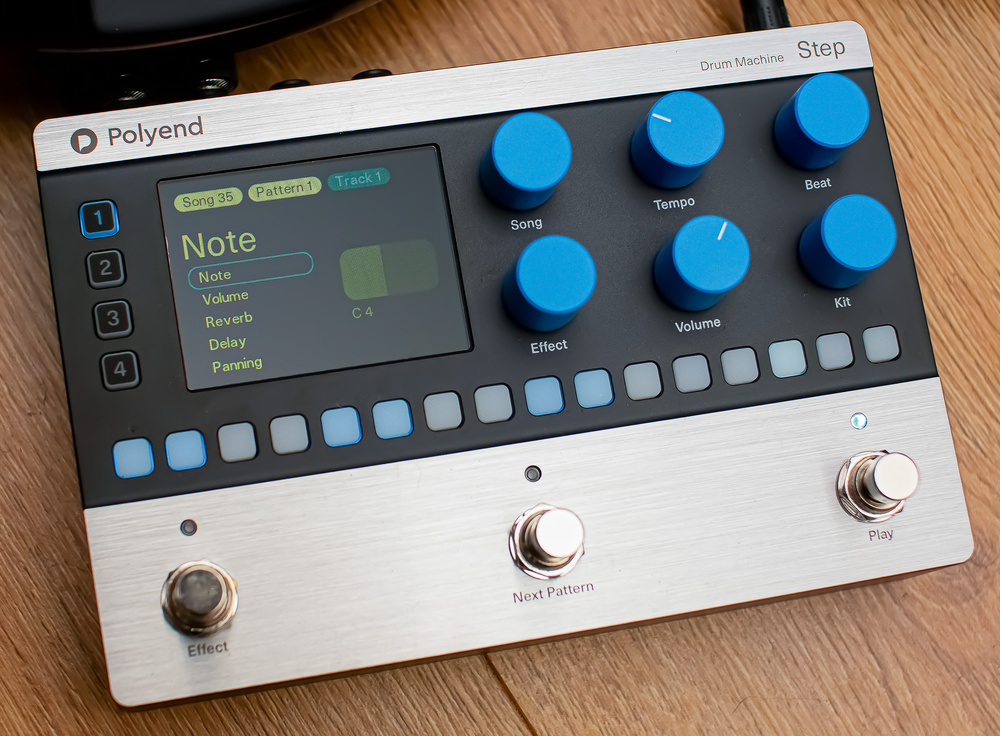
Polyend take it to the floor with a new pedal‑based drum machine.
Based in Poland, Polyend have undoubtedly carved their own path over the last few years with their intriguing line‑up of music production hardware. This now includes synths, grooveboxes, trackers and, more recently, Press, a rather impressive studio‑grade stereo analogue compressor in a guitar pedal format. Whether live or in the studio, Polyend’s target audience is undoubtedly those who like to make their music by putting their hands (or feet) on actual hardware, rather than via a software/mouse combination.
All of which is worth bearing in mind when you consider what their latest release has to offer. The Step is a four‑track drum machine/sequencer in a guitar pedal format. The pedal form‑factor obviously implies a design intention with live use in mind but, equally, Polyend are keen to promote the Step’s potential within a broader creative workflow, including the studio. Of course, the world is not short of hardware drum machines, including a few that come in a pedalboard‑friendly format for solo gigging applications. However, this is Polyend... so, what’s the twist that puts the Step out of step (in a good way) with the existing crowd?
Hardware Heaven
You might already have noted the Step’s fairly serious price. Well, let me confirm that, when handled in person, you soon realise that the price is matched by the seriously impressive quality of the hardware. Not only does it feel very robust, the controls all work smoothly, and it also looks fantastic.
The top panel features with an array of large rotary knobs (some of which also operate as push buttons), a very nice display that provides plenty of graphical feedback in use, two rows of smaller buttons (with colour‑coded lighting used to identify different functions or operating modes) that are used when sequencing patterns, and three high‑quality footswitches. As shown in the images, the back panel features an impressive array of audio, MIDI and USB connectivity, alongside a microSD card slot (used, for example, for firmware updates) and a 9V power jack designed for use with standard pedalboard power supplies.
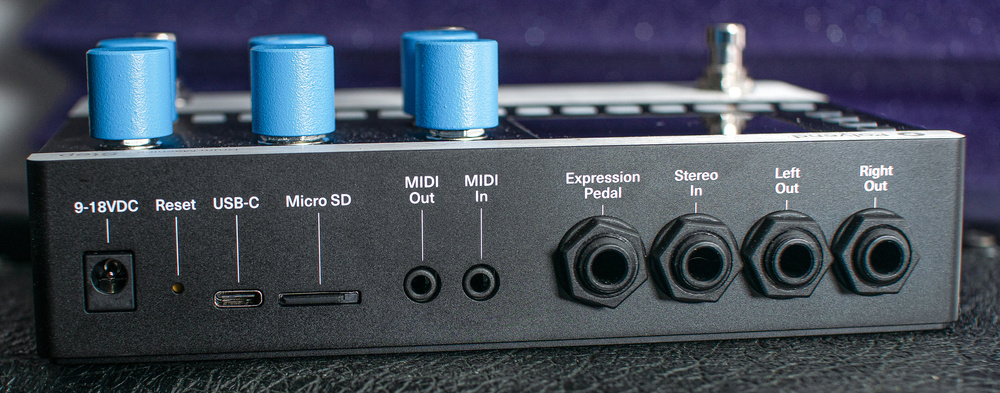 Things are pretty busy round the back, with a USB‑C port, microSD card slot, 3.5mm MIDI in and out sockets, and quarter‑inch connections for an expression pedal and stereo audio inputs and outputs.
Four On The Floor
When I started browsing the Step’s feature list, I have to admit that my first thought was ‘only four tracks?’ Essentially, the Step provides a four‑lane, 16‑step, pattern‑based sequencing environment, with a ‘song’ structure allowing you to chain up to 16 patterns into a longer performance. Would a ‘kit’ containing a maximum of four sounds not feel a little limiting?
In practice, any doubts were very quickly and comprehensively dispelled. In part, this is because the collection of included sounds — some 2000 samples spanning classic analogue drum/synth sounds and acoustic drums — are excellent but, equally, your ability to tweak them, and to process them with a range of included effects (with per‑step control of many parameters within a track’s step sequence) makes it possible to conjure all sorts of variations, both sonically and rhythmically, from what’s available. This is ably demonstrated by the included 200 preset kits (built from those 2000 available sounds) and the 350 pattern presets, and you can, of course, assemble your own kit and create your own patterns.
Pushing the Beat or Kit knobs opens preset browsing options, with genre‑based categories that you can scroll through using the rotary action of the same knobs. From 2‑step, breakbeat, drum & bass, electro, garage rock, glitch, hip‑hop, house, jazz, various flavours of rock and into weird, the Step manages to cover a lot of musical ground, and those four‑part patterns never sound limited. Many of the Kit presets feature kick, snare (or clap) and hi‑hat on lanes 1 to 3. Lane 4 can be a further percussive sound but, equally, in many of the presets it is a melodic sound such as a bass sample. And, as one of the many per‑step parameters you can sequence is note (pitch), if you want to add a bass line (or other melodic element) to your sequences, that’s perfectly possible; the Step can therefore provide more than just your drum accompaniment.
Pressing any of the four numbered buttons on the left selects one of the four tracks within the current pattern for editing, and the row of 16 buttons can then be used to create a pattern for that track. This will all function while the Step is in playback, so you can experiment in real time as you develop a rhythm. There are some very impressive elements to the pattern creation feature set, though. For example, you can change the number of steps on a per‑track basis; set your hi‑hat to cycle on 15 steps while your kick and snare cycle on 16, and all sorts of interesting rhythmic options can open up. In addition, over and above note pitch, there is a long list of parameters that you can vary on a per‑step basis including volume, reverb, delay, panning, filter cutoff, filter resonance, bit depth, overdrive, sample start/end, microtuning, sample fade‑in/out, repeat type/grid, and chance (probability an active step will play each time the pattern cycles). Volume, speed and swing can also be adjusted for each track. Master effects options, including delay, reverb, a limiter and saturation, are also available.
Yes, all this programming has to be done using the hardware controls and the (high‑quality) display, so it is perhaps not quite as efficient a process as you might have when pattern sequencing on a large computer screen. However, even with a little use, it soon becomes a fairly familiar process. And, if you are already comfortable with the kinds of hardware‑based musical tools that Polyend obviously focus on, the Step’s workflow will feel very intuitive.
Once you have crafted some patterns, and chained them into a song, the Step’s footswitches then provide you with hands‑free control. This includes the obvious options to start/stop playback and to trigger pattern changes (you can also do that via MIDI) and, while patterns can have a preset tempo, when the unit is not in playback, the Step’s Effect button supplies a tap‑tempo function (tempo sync via MIDI is also possible). However, while in playback, this same button then lets you trigger your choice of spot effects from reverbs, delays, filters, pitch‑shift, various sequence glitching options, pattern looping and multi‑effects. This is very cool and adds additional performance interest on the fly. For further options, you can also use the expression pedal input for parameter modulation.
Take The Step?
Polyend’s Step is impressive, so who might take the appropriate steps to purchase one? Well, if you are simply looking for some conventional drum sounds and patterns to support your solo function or pub gigs, there are probably more obvious (and less expensive) options, including a few that will provide drum sounds from your pedalboard. However, if you are seeking something with a more obviously creative slant — for electronic music making built around a MIDI rig, or more abstract guitar‑based improvisation, for example, I think the Step could really shine.
The quality of the build, sound and feature set fully justify the price tag.
The quality of the build, sound and feature set fully justify the price tag. For those that love the creative process provided by hardware instruments, Polyend’s Step is a mouthwatering proposition and well worth getting your hands — and feet — on for a test drive.
Summary
Polyend make high‑end hardware instruments aimed firmly at the more creative and experimental musician. As a powerful drum/step sequencer with a pedalboard footprint, the Step looks, feels and sounds great.
When you purchase via links on our site, SOS may earn an affiliate commission. More info...