

Expressive E’s trademark physical modelling paired with MPE control delivers an extremely playable instrument.
With the French company Expressive E, the clue is most definitely in the name. These days they may be best known for the Osmose, their groundbreaking MPE (MIDI Polyphonic Expression) synth and controller keyboard, but they develop virtual instruments too and Soliste is the latest. It’s a suite of modelled solo string instruments — violin, viola, cello and double bass — that run in recent versions of macOS or Windows as VST2, VST3 or Audio Unit plug‑ins, with three activations possible via a virtual or hardware iLok. And it’s definitely built with real‑time expressivity in mind.
Acoustically modelled instruments typically promise greater versatility and a more involved playing experience than their sample‑based counterparts, and are often magnitudes smaller in installation size. It’s an especially attractive concept for a virtual bowed string instrument; in a solo guise they’ve always been notoriously difficult to deliver in sampled form. On top of that Soliste has enhanced compatibility with specialised MIDI controllers: the Osmose first and foremost, and also Expressive E’s standalone gesture controller, Touché. But it will work with other MPE controllers and even quite basic non‑MPE keyboards too.
Fired up in your computer, all the separate Soliste instruments present with identical controls in clean, modern‑looking, three‑way resizeable windows. They’re designed to give musical results straight off the bat, but there’s some considerable sound‑design depth available should you want to explore it.
Open Strings
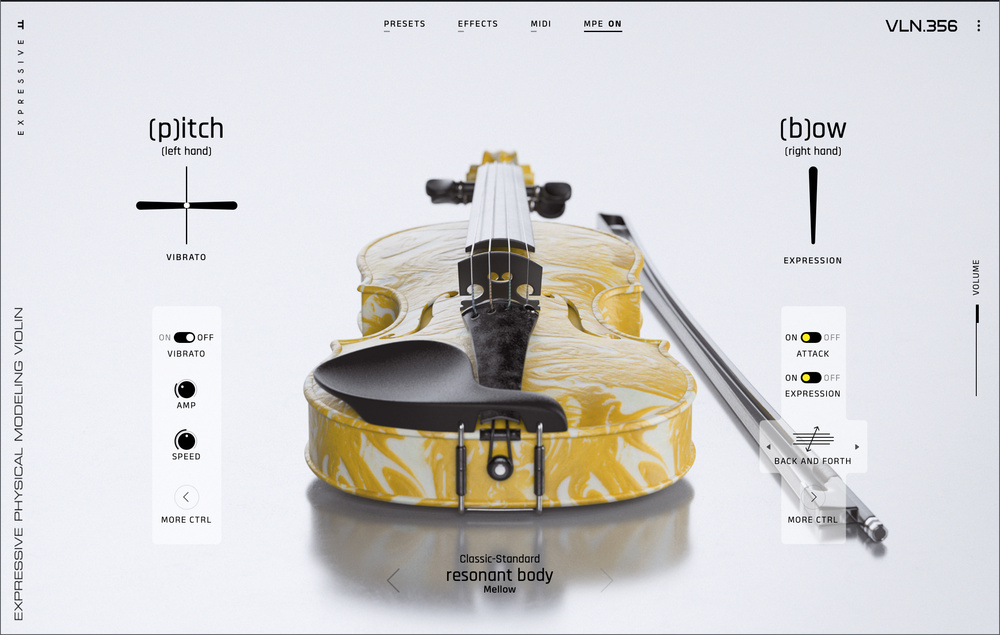
A Soliste plug‑in window presents three main control areas. In the middle, below the big graphic depiction of the instrument, you get to choose a timbre characteristic based on a notional ‘resonant body’ material. VLN.356, Soliste’s violin, offers a choice of six: Spark, Hollow, Sleek, Antique, Lyric and Mellow. As you step through them the large instrument graphic changes colour and texture, so if you fancy trying a Mellow yellow and white violin, or a Hollow one made of cork, it’s there. The other instruments offer either four or five materials, incidentally.
To the left are a few controls relating to pitch, and particularly vibrato. Assisted vibrato will do a pitch wobble for you, with variable amplitude, frequency and fade‑in time. If you use your pitch‑bend wheel, or a key‑generated bend from an MPE controller, that’s taken into account too, adding to the effect. You can also turn the whole thing off, for completely manual control and sleek non‑vibrato tones.
Then, to the right, appropriately, are controls relating to the bow, and thus the actuation and excitement of the virtual strings. To dig in with this aspect of the plug‑in you’ll want to click the ‘more’ button, which opens up a page‑full of parameters. Pitch also gets a ‘more’ page, offering deeper, more finessed control of the auto‑vibrato (especially in its sensitivity to MPE pressure, aftertouch, and configurable MIDI CC messages). There’s also a portamento section there, that’s compatible with the Osmose’s see‑saw Pressure Glide feature, or can introduce inter‑note swoops based on key velocity thresholds.
The musical effect often tends towards sweet and impassioned, and it’s easy to create lines that surge and recede in much the same way that a real violinist achieves.
Jumping straight in, using an Osmose as the MIDI controller, and using the default Classic Mode preset, a freshly instantiated Soliste instrument delivers impressive expressivity with essentially zero effort. Typical MPE behaviour is to the fore: sounds can creep in, triggered by slow and shallow key‑touches, but then swell and intensify radically as you press deep into the aftertouch. Play legato and the melodic line is sewn together with brief but complex transitions; in particular, wide jumps down to a lower note sometimes take a moment to settle, and for the fundamental harmonic to fully emerge. Key‑actuated vibrato and bends also sound complex and natural. Strike faster, or play with a detached touch, and attacks become crisper. The musical effect often tends towards sweet and impassioned, and it’s easy to create lines that surge and recede in much the same way that a real violinist achieves. Happily, not a great deal is given away when using a basic non‑MPE MIDI controller. With those, by default, key‑presses are responsible for a velocity‑controlled attack phase and the mod‑wheel dials in the intensity of the sustained part, and it can sound really good.
One thing Soliste doesn’t support is double stopping: playing two notes at once. Attempt it and Soliste just plumps for one note or another, monosynth style. I can see there could be challenges in implementing it while also supporting overlapping legato note inputs, and it’s probably impossible alongside the Osmose pressure glide feature. But to have no way of achieving it at all is an unfortunate omission.
So, an impressive range of control is available by varying keyboard touch, but additional playing styles — articulations, in normal sample library parlance — are very much available, accessed via a Presets sidebar. Spiccato, martelé, tremolo, pizzicato and others can be selected with the mouse, and many have a secondary Character option. They include general adjectival descriptions — light, intense, and so on — or something more technical, such as a ‘harmonics’ option for the already glassy‑sounding sul ponticello, or a gloriously ghostly ‘flautando’ for sul tasto. These variations all derive from settings in the bow page, including a normally hidden set of five advanced parameters that go deep into the underlying physical model, affecting bow position (relative to the bridge), pressure and noise. Explore extremes in those and Soliste can produce some quite striking, novel sounds, which can be saved as user presets. A preset, by the way, recalls just the entirety of these bow page parameters, not any other settings.
Further sound‑shaping flexibility can come from real‑time MIDI control: nearly all parameters (including the effects) can be mapped to up to six incoming MIDI CCs, pitch‑bend or aftertouch, in the MIDI sidebar. A nifty combo of MIDI Learn for the message type, and click‑to‑assign for the destination, makes this a breeze to set up.
 A Soliste preset is comparable to a sample library’s ‘articulation’, but currently there’s no way to select them on the fly with a key‑press or other MIDI message.
Performance Practice
I’ve mentioned some aspects of the playing experience already. But what of the sound and character of Soliste? Well, because there’s no functional demo version of the plug‑ins available, I would encourage prospective buyers to first listen carefully to Expressive E’s YouTube showcases. They’ll let you form an opinion much more rapidly than me waxing lyrical for paragraphs on end. However, I will offer a few insights.
I personally don’t think many listeners would mistake Soliste, in an exposed solo say, for a recording of a real instrument. Actually I ought to nuance that: you might, for individual notes or some simple accompaniment figures, probably more so for the bass and cello than the upper strings, and certainly some of the specialist ‘extended’ techniques are surprisingly convincing. But to my ear straightforward expressive melodic playing exhibits a certain quite strong synthetic quality: not unpleasant at all, but not naturalistic either. Attempt the main theme from Mendelssohn’s violin concerto or perhaps John Williams’ Schindler’s List on the Soliste violin and quite honestly you’re not fooling anyone. The reasons are hard to pinpoint, but it’s partly tone quality (which to my ear becomes actually quite flute‑ or tube‑like in some tessitura) and also the quality of legato pitch transitions (which can have a little whiff of synth‑y portamento even when the main portamento feature is turned off).
But here’s the question: is Soliste supposed to be a true‑to‑life replacement for real string instruments?
But here’s the question: is Soliste supposed to be a true‑to‑life replacement for real string instruments? Expressive E don’t claim so, and in the plug‑ins themselves the funky instrument depictions also suggest not. If that’s the case, we can judge these instruments on different terms. You might say they form a class of instruments all their own: not synths, and not sample libraries either. In that I was continually reminded of the Osmose’s onboard synth, which has its own sophisticated physical modelling abilities. It too is capable of a (different) range of quasi‑acoustic sounds with remarkable harmonic complexity and expressive nuance, but which almost always remain outside the realm of naturalistic reality: to great effect. I was also reminded of Yamaha’s 1990s VL‑series synths, which offered their own brand of fascinating natural/synthetic hybrids, with expressive control inputs.
For me the proof of the pudding was that the Soliste sounds opened up new possibilities all their own. I absolutely loved playing them, especially with an Osmose. The experience is absorbing and addictive, the sound beguiling and often ravishingly beautiful, and lovely things keep happening that open up creative pathways. These instruments feel alive, and I started dreaming up ways of incorporating them into song arrangements, even alongside traditional sampled strings.
Comparing Soliste to the best solo strings sample libraries is instructive. Yes, with painstaking work those can generate something that actually might fool most of the people most of the time: they’re using recordings of real instruments after all. But none I’m aware of are remotely as musically involving under the fingers, and they require much more learning and forward planning to achieve good results. This broadly corresponds to the way I’ve known other samples versus modelling contests play out: sample libraries often triumph in sheer naturalistic accuracy, but acoustic modellers offer a more immersive musical experience. Samplers are work, modellers are play, maybe?
 The busy bowing parameters page, a click away from the main interface. There is a lot of flexibility here, to change both the fixed behaviour of the physical model and the way it responds to control inputs from your controller.
Conclusion
 A flexible MIDI control scheme lets you extend the scope of Soliste’s response beyond what’s possible to generate from your keys alone.
Looking at the broader implementation of the Soliste plug‑ins there are few things to be aware of. The elephant in the room, for me, is the lack of sample library‑like keyswitchable articulations. Soliste presets offer a range of articulations, but you can only select them with the mouse. So if you want to perform a string part that has a sustained phrase then a spiccato section, and a couple of pizzicato notes to finish, your best option would probably be to create three instances of the plug‑in set up accordingly, and do it in bits, or get painstakingly creative with your DAW’s parameter automation. MIDI CC control can take charge of bowing mode, and that counts for a lot, but it’s far from a full solution. I find this omission a great shame, and even if it doesn’t pop the expressive balloon it definitely deflates it a bit. There would be room for a bank of keyswitches too, as the lower pitch limit for each instrument corresponds exactly to its real‑life counterpart: the violin, for example, bottoms out at G2.
Other things I was less keen on include the strange partial nature of the preset system, only recalling a subset of bowing‑related parameter values. I’d have much preferred presets to include vibrato, portamento, effect and other settings. Oh, and at the time of writing there is still no manual of any kind: not a PDF, nor even a web page. Some website walkthrough videos are useful, covering some features in depth, but specific information relating to setup in different DAWs, non‑MPE use, or incorporating a Touché, is currently almost non‑existent.
Still, there’s a heck of a lot to like in Soliste, and way beyond a formal review phase I find myself continually drawn back to it. The asking price — €299$299 for the whole suite, or €99$99 for each instrument — is not inconsiderable, but it’s possible to make striking solo performances and arrangements with it that have a sound quality and expressivity like little else.
Back & Forth
I expect the vast majority of users will end up using (whether they know it or not) Soliste’s Sustain bowing mode, most of the time. That simply means that while you hold a note, sound continues indefinitely, subject to real‑time control of other parameters, as if your virtual string player was keeping the bow in constant motion. But there are other modes including a potentially very convincing held tremolo, and two ‘back and forth’ options which, on an Osmose (for example), can give rise to virtual bowstrokes on both the press and release of a key, with optional sustain on the downstroke phase.
With no sustain an Osmose key effectively becomes a bow about 2cm long, which isn’t of much use other than for very fast passages or rapid repeated notes. However, movement of your modulation wheel can be brought into play to simulate longer bow movement. And it should be here that Expressive E’s Touché controller really comes into its own. I wasn’t able to test this combo, but everything suggests that stroking Touché’s larger surface will simulate yet longer individual bow strokes.
Effects
 Lurking in another side panel in the interface is a trio of effects processors. The three‑band parametric EQ offers boosts and cuts up to 10dB. It works just fine, but the labelling isn’t quite finished: the frequency range of all bands show as 40‑4000 Hz.
A Timbre knob adds a sort of edgy brightness, defaulting to differing low values across the different instruments. And there’s a very good, simple but smooth‑sounding convolution reverb with impulse responses named seemingly after various UK venues in York, Elveden and St Albans, amongst a few others.
Pros
- Engaging, complex sound quality, broad timbral range and first‑class playability.
- Bespoke handling of MPE MIDI controllers like the Osmose, but usable with almost all.
- Comparatively small installation size of about 400MB per instrument.
Cons
- Not notably naturalistic‑sounding... but that’s arguably not what Soliste is ultimately about.
- Lack of keyswitched articulations hampers real‑world use, for some jobs.
- Double (let alone triple) stops are not supported.
Summary
A physically modelled quartet of orchestral string instruments, with great expressive potential for both MPE and conventional MIDI controllers. The sound strongly channels acoustic behaviour but offers a specific, attractive quality all its own.