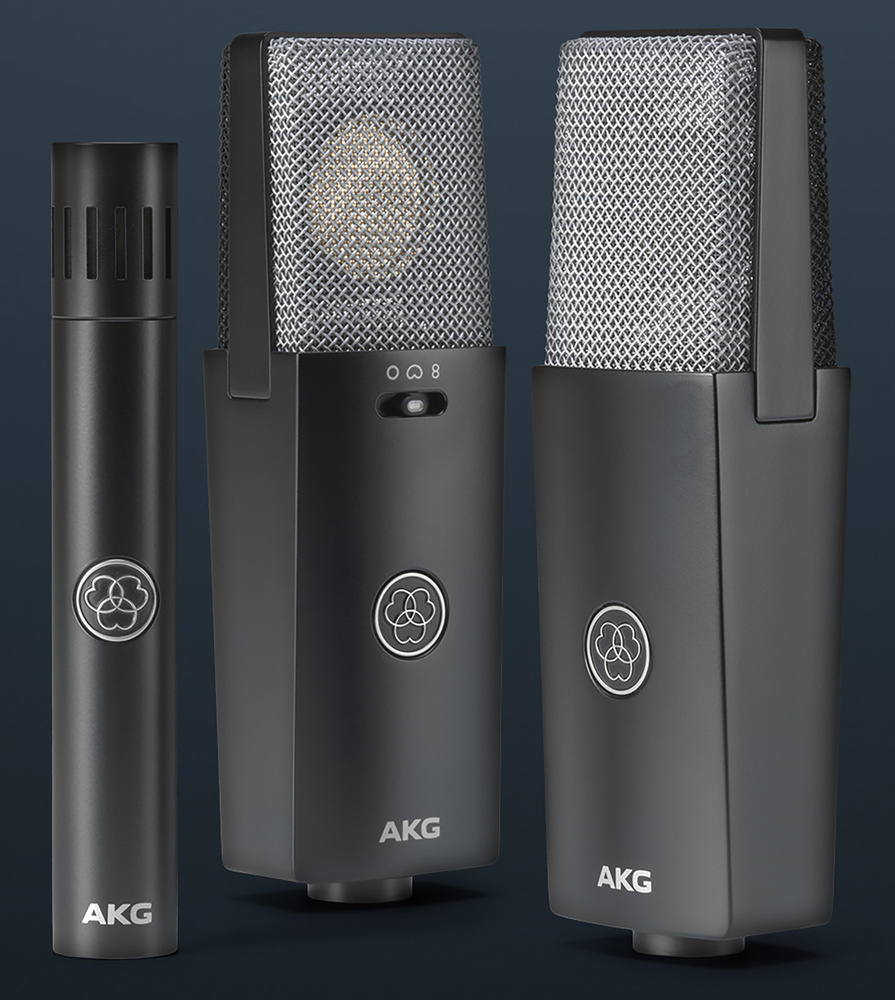
AKG’s trio of affordable studio mics have more in common than just the letter C.
For many years now, AKG’s line‑up of capacitor microphones has been divided into two ranges. Mics targeted at professional applications have a model designation beginning with the letter C, whilst the company’s more wallet‑friendly designs have appeared under the Perception brand. But the gulf between the two has been eroded by the appearance of more affordable mics in the C‑series range, where classics like the C414 and C12 VR are now joined by the much more accessible C214 and C314. That trend continues with the release of three new C‑series mics that are aggressively priced, and which explicitly replace models from the Perception line.
The multi‑pattern C114 is an externally polarised large‑diaphragm capacitor mic that supersedes the older Perception P420, while the C151 is a fixed‑cardioid, small‑diaphragm ‘pencil’ mic with an electret capsule. Once again, this displaces a Perception model, in this case the P170. Finally, the fixed‑cardioid C104 is an interesting half‑way house. Although it’s described as a large‑diaphragm mic, and shares the same shell as the C114, it actually uses a 22mm electret capsule intermediate in size between those of the 114 and 151. The C104 is the successor model to the P120.
In each case, AKG have done much more than simply repackage existing designs and, consequently, the specs of the new models are significantly different. For example, the C151 is actually a little noisier than the P170, at 21dBA against 19dBA, and is also slightly less sensitive. However, the C151 can handle sound pressure levels of up to 145dB without the need for the P170’s switchable pad. By contrast, the C114 is 3dB quieter than the P420, and some 6dB less hot. It offers the same three standard polar patterns, but without the P420’s switchable low‑cut filter. Likewise, the C104 is quieter in both senses than the P120, and also omits the filter. One improvement that everyone should welcome concerns the way in which these new models are manufactured and delivered. The bodies are made from recycled metal, and the packaging is fully recyclable.
The shell of the C104 and C114 bears an obvious visual resemblance to current C414 models, which slightly round off the brutalist square lines of the earlier 414s. However, in place of the ‘stalk’ that houses the XLR connector, these new C‑series mics have a much longer body. At its base, the connector is surrounded by a recessed thread. This is the same on both models, so if you own both, you can freely swap the C114’s supplied shockmount for the C104’s simple standmount. The C151 comes with a fitted clip. Despite the extremely competitive pricing, build quality for both mics and fixtures appears top‑notch.
Family Resemblances
My first impression on testing these mics was that AKG’s designers have put a lot of effort into giving them a ‘family sound’. Having put all three up together as close as possible, my initial reaction to a speech test was to wonder whether I had somehow recorded the same mic to three different tracks. Not only are they almost perfectly matched for sensitivity (assuming the C114 is in cardioid), but the on‑axis tone is remarkably similar, given that they use three entirely different capsule designs. This is reflected in the published frequency‑response charts, which in each case show a broadly flat response through the midrange, rising above 5kHz to dual peaks that top out perhaps 5dB above the nominal zero. The charts also make the mics look a little lean in the bass department, but on the C104 and C114 this is probably a function of measurement distance, as the latter mic boasts a very healthy low end in omni. However, the C151 does seem to roll off to a noticeable extent below 100Hz.
As is usually the case with small‑diaphragm mics, the C151 is susceptible to popping from plosives when used as a vocal mic. This reflects typical polar pattern behaviour for mics of these types. Pencil cardioid mics like the C151 tend towards figure‑8 at low frequencies, so in a close‑miking scenario, its low‑frequency roll‑off is compensated for by proximity effect, and it is naturally vulnerable to air blasts, since it’s predominantly measuring air velocity rather than pressure. By contrast, the C114 becomes somewhat omnidirectional at low frequencies, making it a more benign choice for close‑miked vocals and allowing its low‑frequency response to be more consistent with distance. In this respect, the C104 seems to behave in much the same way as the C114.
Axis Powers
The ideal cardioid mic doesn’t exist, but if it did, you wouldn’t notice a timbral change as the source moved off‑axis, just a change in the amplitude of the recorded signal. Small‑diaphragm models usually approach this ideal rather more closely than their large‑diaphragm brethren, but that isn’t quite the case with the C151. Off‑axis capture is rather dark and, as you move towards the rear of the mic, becomes noticeably hollow‑sounding. In real‑world situations where sound is incident from all directions, I think this probably goes some way towards offsetting the on‑axis high‑frequency emphasis that’s displayed in the frequency plot. Or to put it another way, although it measures bright, it often doesn’t sound particularly bright, because there’s quite a lot of high‑frequency attenuation for sound arriving from the sides and the rear. In this respect at least, the C151 doesn’t really challenge more high‑end models like AKG’s own C451B, but at the price, you’d hardly expect it to. And although I was initially concerned by its rather high self‑noise measurement, in practice this was not an issue.
The C114’s on‑axis tonality varies quite a bit with polar pattern, as is typical of large‑diaphragm capacitor mics. In omni mode, the high‑frequency emphasis gets greater, but also shifts up the frequency spectrum. It’s bright, but good bright. In figure‑8 mode, the major presence peak is in the 3‑5 kHz region, and it all begins to sound a bit like a mic voiced for stage use: plenty of ‘cut’, but not a particularly natural sound. Finally, the C104’s published polar pattern suggests a noticeable narrowing at 4kHz, becoming fully hypercardioid at 8kHz. This was borne out by my tests, but unless you accidentally put the mic back to front, doesn’t cause issues in normal use.
My first impression on testing these mics was that AKG’s designers have put a lot of effort into giving them a ‘family sound’.
Triple C
Despite these differences, my first impression of the new C‑series mics turned out to be a lasting one. For on‑axis, close‑miked sources, I think you could happily drop in with the C104 on a track recorded with the C114 in cardioid, or vice versa, without anyone noticing. Differences are slightly more apparent with the C151, but there remains more similarity than I’d have expected. These mics don’t just belong to the same family in name: they really do share a sonic DNA. They’re the sort of mics that largely stay out of the way, offering a clear and detailed window on the source with a hint of high‑frequency emphasis; unless you switch the C114 to figure‑8, there’s no obvious push in the midrange or other characterful quality. If you want your mics to deliver magic, you’ll have to spend more money, but the ratio of utility to price on offer here is compelling, especially with the C114.
Alternatives
This is a highly competitive market, and the new C‑series mics face off against models from Rode, Lewitt, sE Electronics, Sontronics, Shure, Audio‑Technica and more.
Pros
- Excellent build quality and sustainable manufacturing.
- Remarkable tonal similarity between different models.
- Very good value for money.
Cons
- At the price, I have no real criticisms.
Summary
Versatile, well made and impressively consistent, AKG’s new C‑series models will make a considerable impact in the market for affordable capacitor mics.
Information
C104 & C151 £119 each, C114 £209. Prices include VAT.
Sound Technology +44 (0)20 8962 5080.
C104 & C151 $129; C114 $229
When you purchase via links on our site, SOS may earn an affiliate commission. More info...

When you purchase via links on our site, SOS may earn an affiliate commission. More info...