

You are here

RAI Stereo Array

A near-coincident stereo microphone array conceived by the Italian broadcaster Radio Audizioni Italiane (RAI) in the early 1960s. It comprises a pair of cardioid microphones with capsules spaced 21cm apart at a mutual angle of 100°. The resulting SRA is 93 degrees. This technique captures both time and level differences between channels, and is comparable to similar techniques such as NOS, ORTF, DIN, EBS, and others.
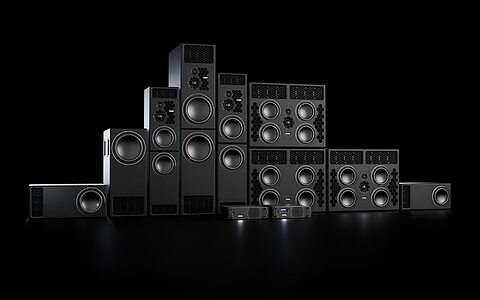
PMC Main Monitors PMC10 PMC12 PMC15 PMC10-4
link

PMC unveil Main Monitor series

PMC's NAMM 2026 launch represents the first complete reinvention of PMC’s main monitoring systems in more than three decades, and promises to deliver the most substantial advancement since the range was last updated ten years ago.

Velocity Operation

A capsule design in which the diaphragm is suspended in open air to detect the difference in relative air pressure on each side of the diaphragm. This design is most sensitive to sound waves arriving directly in front or from behind (the latter with opposite polarity). If the sound source moves above or below the diaphragm the difference in air pressure on each side reduces so the capsule becomes progressively less sensitive, giving a figure-8 polar pattern. The diaphragm mounting is designed to be very compliant at low frequencies to maximise the sensitivity to very small pressure differences. This creates a very strong proximity effect.

Pressure Operation

The simplest form of microphone capsule in which a diaphragm encloses a chamber of atmospheric air. A passing sound wave causes the diaphragm to move in and out as compressions and rarefactions pass, effectively comparing the air pressure variations of the sound wave with the static ambient air pressure held within the chamber. The diaphragm’s movement is not dependent on the direction of sound waves, merely their passing, so the polar pattern is omni-directional. There is also no proximity effect, and the system remains sensitive to very low frequencies.

Phase Correlation Meter

An audio meter designed to indicate the phase relationships (correlation) between left and right stereo audio signals. Various meter formats are used, but most are scaled from +1 to -1, with zero at the centre. Full correlation (ie. dual-mono) is shown as +1, while opposite polarity is shown as -1. Fully-wide stereo material (decorrelated) would register around 0. Signals indicated anywhere between +1 and 0 are considered mono-compatible. Dips below 0 towards -1 suggest a listener of the summed mono signal will hear coloured or severely attenuated audio.

M3/M6

M3 is a reference to the attenuation applied to a summed-mono signal, particularly in application to audio metering systems, to maintain electrical headroom and to give a perceived acoustic volume consistent with the stereo source. M3 uses a 3dB attenuation ((A+B) – 3dB ) and is most appropriate where the stereo source comprises largely decorrelated signals (ie. normal stereo). 

M6 is a reference to the attenuation applied to a summed-mono signal to maintain electrical headroom and to give equivalent metering levels with the stereo source. M6 uses a 6dB attenuation ((A+B) – 6dB ) and is most appropriate where the stereo source has largely correlated signals (ie. dual-mono). 

Lissajous Figure

A two-dimensional visual pattern produced by the interaction of two independent signals, each controlling the amplitude of one display axis. Used in the Stereo Goniometer and Stereo Vectorscope

Pages

Subscribe to Sound On Sound RSS