

You are here

ILD

The difference in loudness or intensity of a sound wave reaching the left and right ears. In real life this is caused by diffraction of sound around the head at high-frequencies (above about 700Hz), causing a 'sound shadow' for the more distant ear.  The brain uses the inter-aural level difference as a means of identifying the location of a sound source which will be louder on the side of the closer ear. See also ITD
ITD

The difference in the arrival time of a sound wave reaching the left and right ears. In real life this is caused by the extra distance the sound wave has to travel around the head, resulting in a detectable phase shift for frequencies below about 700Hz. The brain uses the inter-aural time difference as a means of identifying the location of a sound source which will be earlier on the side of the closer ear. See also ILD

Schneider Disc

A stereo microphone device used primarily for capturing binaural stereo and a variation on the OSS technique. Similar to the Jecklin disc, the Schneider disc comprises a circular baffle of 30cm diameter with acoustic absorption material on both surfaces supplemented with a 12cm foam-covered sphere at the centre of the disc to better approximate the acoustic characteristics of the human head. Omni-directional microphones are placed on either side with a roughly 16.5cm spacing and angled outwards at 20 degrees.

Intensity Stereo

The name given by Alan Blumlein to a stereo signal comprising only amplitude differences between the two channels. It can be created by using a pan–pot in a mixing console, or with a coincident (X-Y) microphones.

Hybrid Stereo Array

A stereo microphone array designed to extract the most attractive qualities associated with both spaced-omni (A-B) and coincident (X-Y) arrays. Inter-channel level differences are captured by angling directional microphones outwards, and inter-channel time differences are obtained by spacing the microphone capsules apart. In practice, some of the imaging accuracy associated with coincident techniques is sacrificed for the much greater sense of spaciousness associated with spaced-omni techniques. Popular hybrid arrays include ORTF, NOS, DIN, EBS, RAI and Gerzon.

Source Elements Source-Connect 4 remote collaboration mixing recording Dolby Atmos
link

Source-Connect 4 gains Dolby Atmos certification

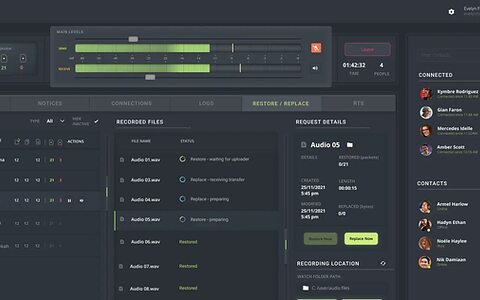
The software now boasts 128 audio streaming channels and supports any combination of beds and objects, along with full metadata integration, allowing directors and stakeholders to attend Dolby Atmos playback and mixing sessions from their preferred location or setup.

Head Related Transfer Functions

(HRTFs) Parameters which describe a unique set of acoustic filters created by sound reflections from an individual’s head, shoulders, and pinnae which modify the sound waves entering the ear canal. These unique characteristics are learned to allow the brain to locate sound sources in the 3D space around the listener. Perceiving accurate sound placement from a binaural audio source relies very heavily on the material being processed accurately with an individual’s personal HRTFs. 

Goniometer

A stereo audio vectorscope which displays the stereo sound image as a Lissajous Figure to assess the correlation and stereo width between channels, as revealed by the phase and amplitude relationships between the two channels.

The two audio channels are plotted on diagonal axes such that a left-only signal is shown as a diagonal line from top-left to bottom-right, while a right-only signal runs from top-right to bottom-left. An identical signal on both channels (dual-mono) results in a thin vertical line, while identical signals in opposite polarity create a thin horizontal line. Normal stereo creates the appearance of a circular tangled ‘ball of string’.

Pages

Subscribe to Sound On Sound RSS