

Rating: ★ ★ ★ ★ 4/5 Stars
Busy media composers looking for a source of sounds off the mainstream beaten track could do a lot worse than checking out the catalogue of Kontakt‑based instruments from Edu Prado Sounds. We reviewed their excellent Extended Electric Guitar library in the SOS August 2025 issue; it’s niche, compact, accessibly priced and full of character. Their latest release is Dark Mandolin, a collaboration between Edu Prado and Jan Pfitzer, and the product blurb suggests it might tick a number of the same sorts of boxes. If you have an affinity for the conventional made unconventional, then read on.
Dark Mandolin is a Kontakt‑based instrument (including the free Kontakt Player) and features a finger‑played mandolin recorded in parallel paths to both pristine digital and analogue tape recorders. Samples from both pathways are available to the user and presented within Kontakt as five main instrument categories — Natural, Tape, Room, Duo and Swarm — with velocity layers and round robins included to ensure realistic performance dynamics. The first two instrument categories are self‑explanatory. Room places the sounds within a small warm space, while Duo provides a wide doubling effect with different samples placed left/right of the stereo image. Swarm is a little more experimental with what seem like rapidly played repeating notes.
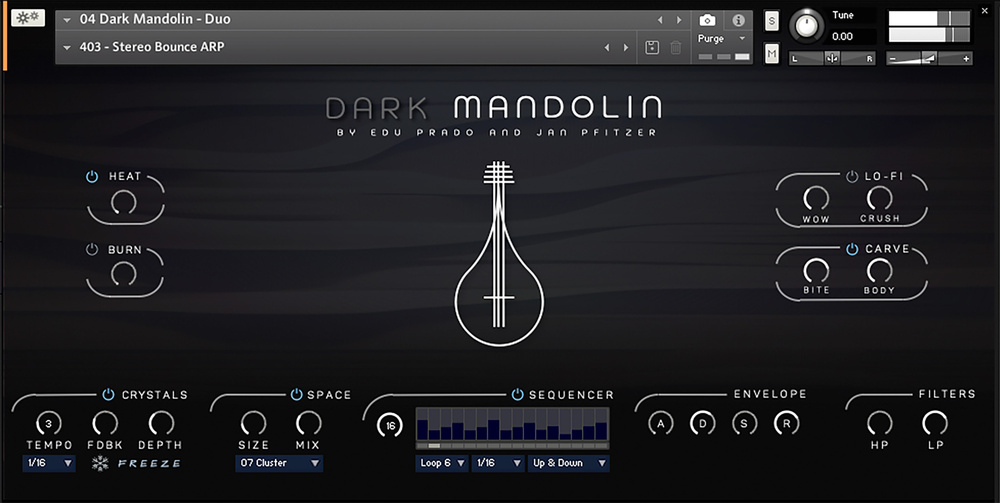
All these instrument categories offer a selection of presets within them and, while the Natural and Tape presets include conventional mandolin sounds suitable for conventional performance styles, as the screenshot here suggests, the UI provides a selection of sound‑design options that let you take the underlying sounds of the mandolin in a somewhat less conventional direction, and many of the presets demonstrate what’s possible here.
The Envelope, Filters and Space (with various convolution reverb options) sections do exactly what you might expect. However, you also get a compact step sequencer with variable step count (up to a maximum of 16 steps), a selection of arpeggiation options, preset velocity patterns and the option to adjust the step length. The Heat and Burn sections provide gentle saturation and distortion respectively. The Lo‑Fi effect can add wow/flutter and bit reduction, while the Carve effect seems to provide emphasis to the attack or sustain portions of the sound via a combination of EQ and/or transient processing. Finally, the Crystal effect lets you dial in a sort of dreamy, ethereal element to the sound. It’s a cool effect and can take the mandolin starting point into soundscape territory.
It is full of character and surprisingly flexible and modestly priced.
The end results can be intimate and realistic or beautiful and otherworldly, going from simple plucks through to enchanting pads. Yes, it is a library with a very particular sonic signature, but it is full of character and surprisingly flexible and modestly priced. If you like the unique flavour that boutique sample libraries can bring to your compositional palette, then Dark Mandolin is well worth auditioning via the Edu Prado Sounds website.