

Rating: ★ ★ ★ ★ ★ 5/5 Stars
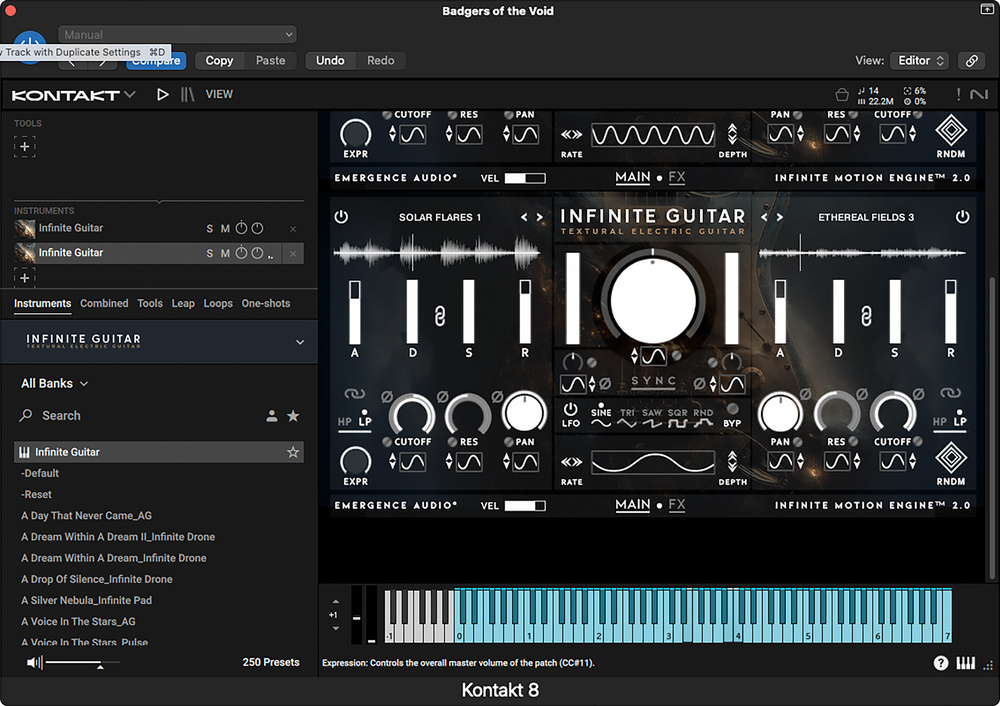
Emergence Audio have a reputation for creating filmic instruments for NI’s Kontakt, and the latest addition is Infinite Guitar. The source material is mainly electric‑guitar‑based but these are configured as layered, modulating textures best described as pads, ambient swells, granular‑like beds, harmonic drones and hybrid tones that would fit in very well with film (especially sci‑fi), TV or ambient music mixes. Underpinning the instrument is Emergence Audio’s Infinite Motion Engine, which is responsible for producing a sense of continuous and non‑repeating motion within each note. The majority of the individual samples are very long, which is why the library takes up almost 47GB when installed, and each of them evolves tonally — some smoothly, others pulsing or incorporating seemingly random delays and granular shimmers.
The Infinite Motion Engine allows for two samples to be layered, with modulation options to continuously change the balance between the two layers. The LFO section can also be used to modulate other parameters with independent depths of modulation: Pitch, Pan, Resonance, Effect Send amount and Filter Cutoff can all be modulated, and all the usual modulation waveshapes are available. The filters can be set to low‑pass or high‑pass, and the individual samples can be freely retuned up to two octaves in either direction. There’s also a so‑called intelligent randomisation function that switches out the samples and changes the pan and filter settings, and this often comes up with very usable patches. Each sample layer has full ADSR control, and there’s a dedicated effects section that includes a convolution engine for lifelike reverb and other effects.
I came away very impressed by the way these carefully crafted sounds evolve in an almost hypnotic way.
Working through the generous set of factory samples gives a good idea of what Infinite Guitar can do, though creating your own patches — even if just by switching out samples in an existing patch (or pressing the Random button) — can be very rewarding. Many of the sounds work well with just a single note or perhaps very simple chords, and the sense of movement means you can hold them for as long as you like without the user experiencing that sense of repetition that you get with straightforward looping. I found that some of the preset sounds seemed a little low in level (which is apparently intentional to preserve dynamics), but these are easily tweaked, and for some of the sounds I found that following the instrument with a compressor plug‑in worked really well. There are deep, ominous drones, haunting meditations, glittering ear candy and soothing ambient backdrops that literally go on forever (or at least until the next power cut). I came away very impressed by the way these carefully crafted sounds evolve in an almost hypnotic way, and I can definitely see a role for them in my own ambient creations.