

Rating: ★ ★ ★ ★ ★ 5/5 Stars
Heavyocity have a well‑established user base amongst media composers and, while said media composers undoubtedly have plenty of choice when it comes to sample‑based virtual instruments that specialise in dark, unsettling or downright scary sounds, a new offering from this developer is bound to arouse their interest. Enter, soundstage left, Heavyocity’s Dystropia. With 9GB of sample data drawn from nearly 400 sound sources, Dystropia’s abundant collection of presets sit within two different Kontakt front ends. Oh, and Heavyocity do deserve a nomination for best tagline to a sample library name ever, as they describe it as a “dread designer”. I put my brave pants on and did the install...
Given the musical target, the broad categories of source sounds are very much what you might expect. There are collections of rhythmical options that can provide suitable pulses to a cue, various tonal and atonal sustained sounds that might provide elements for pads or textures, noise elements, soundscapes, various stings, swelling sounds and a large collection of transition elements such as risers, downers and reverses. In short, it’s an impressive collection of high‑quality source material to underpin the sound design possibilities.
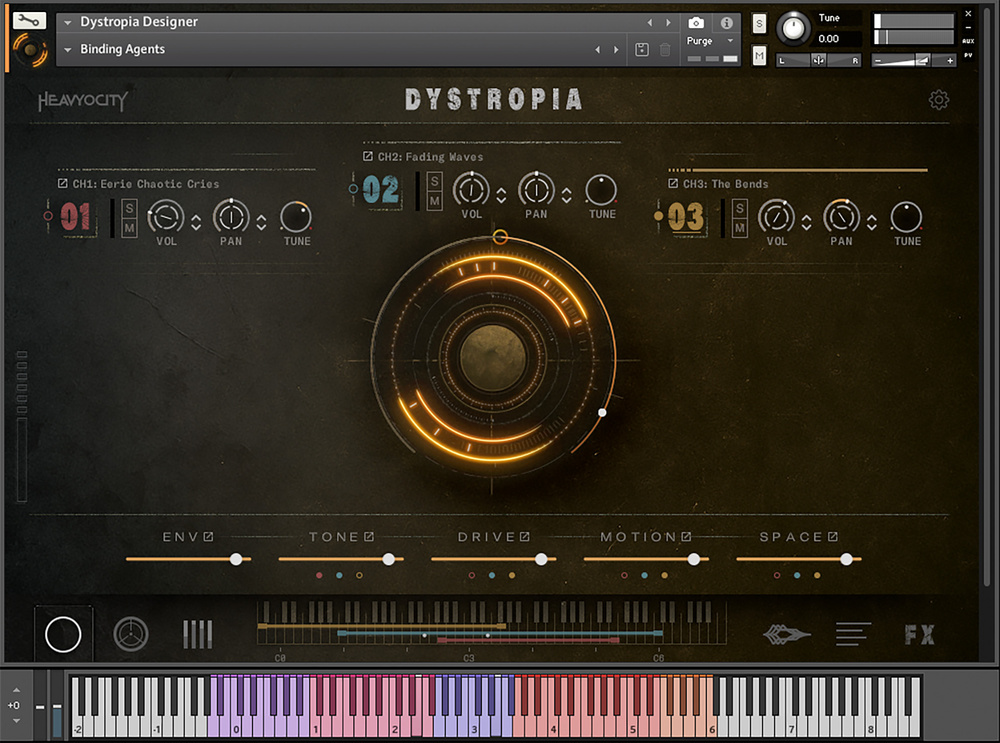
Conceptually, the library’s two Kontakt engines that let you exploit that source material are straightforward enough. In the Designer engine, up to three sound sources can be blended to create a final sound. In contrast, the Menu engine presets map multiple sounds of a particular type (soundscape, stings, swells, etc) across different MIDI keys but, rather cleverly, with the additional option of being able to remap the single sound from any key (the last one you triggered) across the full key range to get a playable instrument from that sound.
Those simple concepts blossom once you dig in as both engines provide a multitude of sound‑design options. For example, under the Designer engine’s hood, you get access to filter, EQ, ADSR, saturation, distortion, both gate and pitch step sequencers, delay and reverb, with independent options for each of the (up to) three sound layers. There is also a comprehensive global effects section. However, sitting on top of all this is the very impressive Macro Sequencer that allows you to manually modulate or automate changes in multiple parameters with a single control. Its power is ably demonstrated by many of the presets and, if you ever get beyond tweaking these supplied sounds, its DIY sound‑design potential is obvious.
Dystropia sounds great and offers almost endless ways to make the sounds your own.
When it comes to creating dark, tension‑filled, music‑meets‑sound‑design for modern sci‑fi, drama or horror set in a dystopian world (you know, a bit like current daytime TV news), Dystropia is right on the money, and the sounds undoubtedly live up to that catchy tagline. Perhaps the price takes it beyond the casual purchase range for some, but Dystropia sounds great and offers almost endless ways to make the sounds your own. It might be the only library you require for all the dread your music needs to evoke.