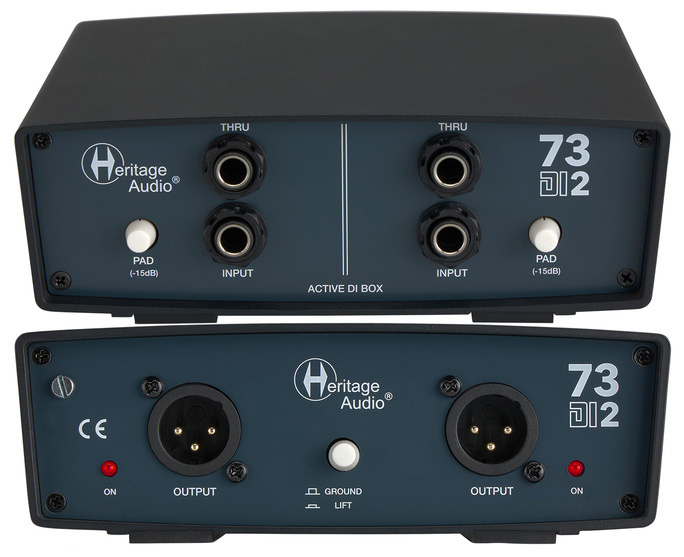
Back in the day, the input channels on large‑format consoles were pressed into service not only for miked signals but also for basses, keyboards and other instruments plugged directly into them. Heritage Audio’s 73 DI is an active DI box that aims to deliver that sort of character in a more portable format. Launched alongside the passive P DI, both are available in single‑ and dual‑channel versions.
Conceptually and electrically, the P DI is probably not so different from the very first DI boxes that were made for studios like Motown. At its heart is an audio transformer that presents a high impedance to the quarter‑inch jack input, and a low‑impedance, balanced XLR output to your mic preamp. Unlike the DI boxes of yore, it has mod cons such as a 15dB pad, a thru socket and a ground‑lift button. On the two‑channel version, the ground lift is global, but there are pad switches for each input. The two 73 DI models use the same housing and panel layout as their passive counterparts, and exactly the same I/O and control sets. The only functional difference is that each channel has a red LED next to its XLR output, to indicate when phantom power is being received. (On the dual‑channel model, each channel needs powering separately.)
A transformer‑based DI box is simple and effective, and provides galvanic isolation to eliminate ground loops, but audio transformers that maintain a flat frequency response across the entire spectrum are quite expensive. Historically, one of the main reasons for developing active DI boxes was to dispense with the transformers. While conventional active DIs thus don’t provide the same immunity to ground loops, they can be more transparent and are better able to drive long cable runs, as well as often being cheaper to make. The 73 DI is anything but conventional, though! It’s an active DI box, but it retains the transformer and isn’t designed to be transparent. Whereas transformers in mic preamps are often found on the input side, the 73 DI has a JFET input stage and a transformer‑balanced output stage. This chimes with what several wise techs have told me over the years, namely that the character of Neve‑style preamps derives more from the output transformer than the input transformer. The 73 DI, say Heritage Audio, will imbue your signals with “a sparkling high end, a solid bottom end and low midrange saturation the 73 is famous for”.
Heritage Audio supplied the two‑channel versions of both DIs for review. Nearly twice the size of my Radial Pro D2 but about the same weight, they don’t have quite the same tank‑like construction but do have solid‑steel cases and look to be built to last. Each has a pair of thick rubber strips on the bottom to stop them sliding on stages and studio floors. The buttons have a nice confident action and enough travel that you can tell at a glance when they’re engaged, and the sockets, mounted to the case rather than directly to the PCBs, seem to be of decent quality.

Comparisons
In a direct comparison, the first thing you notice is that the 73 DI’s output is way hotter than that of the P DI. For the same input, the P DI and the active Radial unit put out more or less the same level, but the 73 DI is around 12dB stronger. Gain‑match the two, and the sonic differences are relatively subtle. Both the 73 and the P DI seem slightly rounded off at the very high end compared with the Radial box, but it’s not a huge contrast, amounting to perhaps a couple of dB above 10kHz or so. Other differences are quite source‑dependent, as you’d expect, and most apparent at the low end. With a bass guitar or an analogue synth bass, the 73 DI does indeed display a pleasing fullness in the 100‑200 Hz region, whilst the P DI seems to focus the sound ever so slightly towards the midrange — in a way that I also rather like! But both qualities are subtle, and you’d have to be a highly consistent bass player to isolate any effect due to the DI box from variations caused by slight variations in hand position or finger pressure.
I don’t have a bass with active pickups, but both DI boxes had sufficient headroom to handle all the synths I fed through them. Conversely, they were happy to accept quiet signals, such as the output from a Hohner Pianet, without any noise or interference becoming apparent. The thru sockets, pads and ground lift all worked as advertised, and the P DI also did an excellent job used in reverse as a re‑amp box, placed between DAW output and amplifier input.
The temptation to spend too little on boring studio accessories is one that should be resisted if at all possible!
These DI boxes sit in the same price bracket as widely used models from Radial and BSS, which is some way above the cheapest tier, but the temptation to spend too little on boring studio accessories is one that should be resisted if at all possible! There are good reasons why you won’t see £20 $25 no‑name DI boxes on big stages. My own Radial units have been with me for at least a decade, and despite being second‑hand when I bought them, they’ve never given me a moment’s trouble. In construction terms, the 73 DI and P DI are not as over‑engineered as the Radial and BSS devices, but I’d still back them to enjoy a long career.
In sonic terms, the 73 DI offers exactly the right degree of character; the coloration it imparts is not pronounced enough to limit its usefulness, but it has just enough influence on the sound to make a difference, if that’s what you want. Meanwhile, the P DI does exactly what you’d hope a passive DI box would, cutting out hums and buzzes, putting out a comfortable level for any mic preamp, and displaying just a hint of ‘roundness’ on sources with a lot of top or bottom end. These may not be the cheapest DI boxes in the world, but they represent good value and an investment you’re unlikely to regret.
Information
P DI One €119, P DI 2 €189, 73 DI One €229, 73 DI 2 €349. Prices include VAT.
P DI One $109. P DI 2 $179. 73 DI One $199. 73 DI 2 $299.
When you purchase via links on our site, SOS may earn an affiliate commission. More info...