

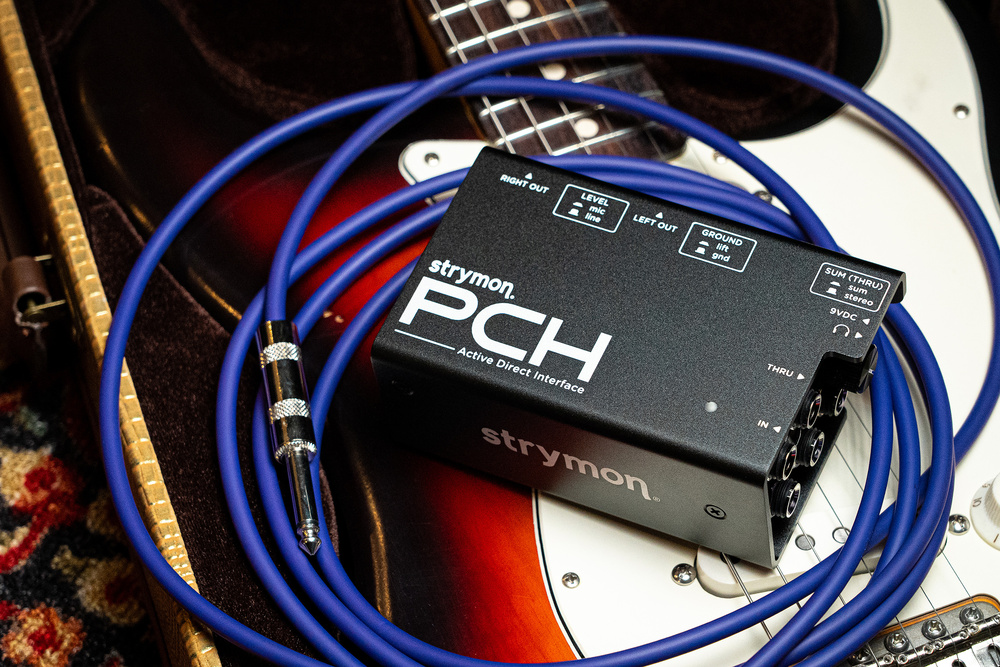
This pedalboard‑friendly DI interface has been designed specifically for interfacing amp modellers and electronic instruments with PA and recording systems.
Even in today’s ever more high‑tech live‑sound world, a guitar player arriving at any gig with a ‘provided PA’ is most likely to find that the engineer’s default option will be a single line to front‑of‑house and an SM57 to place in front of the speaker. All well and good if you’ve turned up with a conventional guitar amp — you’ll be a mono source arriving at the console at the expected ‘mic level’. Not so good, however, if you’ve brought a digital amp modeller and pedalboard loaded with your lovingly crafted stereo effects. What usually happens then is that the 57 gets somewhat reluctantly swapped for a single‑channel DI box and the engineer departs without answering your questions about what kind of level you should be sending...
Amp modellers are usually capable of outputting a very wide range of levels, from a hot ‘pro’ line level down to mic‑ or passive instrument level, and may have anything from balanced XLR or TRS sockets to unbalanced TS jacks. You might imagine that you’d always be pretty safe with a nice, strong line‑level signal on balanced XLRs that you can connect directly to any stagebox, but there’s still plenty that can go wrong in that scenario. The chances are that the stagebox will connect to the mic inputs on the console, with line‑level signals expected to be handled either with a separate TRS input, or maybe just a pad switch to drop the sensitivity of the mic inputs. It’s also sadly true that not all XLR‑equipped modellers can deal with being sent phantom power, and not all PA consoles have phantom power switchable per channel.
On the whole, you are often better off just playing safe and using a DI box that will drop your modeller’s signal down to mic level... except not all DI boxes are created equal! You could be clipping the DI box before your signal even gets to the console, and if you’ve taken a split to a local monitor from before the DI, you won’t even know that your FOH sound is compromised.
Who Needs A ‘Specialised’ DI Box?
The widespread and ever‑increasing use of virtual amps in live sound and recording over the last few years has led to the development of a few dedicated ‘pedalboard amp’ interfaces, notably Pinstripe Pedals’ DISO and Walrus Audio’s Canvas, and they are joined now by the PCH from premium pedal‑makers Strymon. About the size of a standard Boss pedal, the PCH is an active, high‑headroom, stereo DI interface with a pair of balanced, low‑impedance XLR outputs, a pedalboard‑PSU‑friendly 9V DC input (internally converted to 24V), and, unusually, an onboard headphone amp. I say ‘pedalboard‑PSU‑friendly’ because it’s 9V, but with the one caveat that it requires a fairly hefty 500mA current supply.
Not many DI boxes include a headphone output! This allows you to audition the signal after all your pedals, before it goes to the FOH mixer.
Left and right inputs are high‑impedance, unbalanced, quarter‑inch jacks, described by Strymon as ‘virtually unclippable’, and indeed proving to be so in testing — these inputs will handle full line level from a modeller with further gain from downstream effects as well, although I wouldn’t advise running a rig that way! A second pair of unbalanced jacks provide a buffered ‘thru’ output, which might be used to feed the input signal to any on‑stage amplification as well.
Connecting to just one of the inputs sends the same signal to both thru outputs, and both sides of the headphones, too. If you are going into the PCH in stereo with a connection to both sides, you can sum the thru outputs to mono while the main outputs remain stereo. If you have a modeller that can output a speaker‑simulated signal on one channel and a ‘no‑cab’ signal on another, you can connect to the PCH in double‑mono, sending the speaker‑sim channel to the PA via the appropriate XLR output, whilst picking off the ‘dry’ signal for on‑stage amplification with a conventional guitar cabinet by using the matching thru output.
The XLRs benefit from both a ground‑lift switch, for combating potential earth‑loop hum, and mic/line level switching, giving you back control over optimising your front‑of‑house feed without having to change your local monitor feed levels, which may be set just right for your personal monitoring already.
The main XLR outputs can be set to deliver a mic or line signal.
At £259$279, the PCH is not a trivial purchase, so why not just get a stereo DI box that you have verified as having enough headroom and attach that to your pedalboard instead? Most passive boxes will give you earth‑lift isolation and thru outputs, and active boxes may give you input level matching as well, but the latter will need powering, which means you are at the mercy of the console providing phantom, or using batteries. What you may not have, however, is any summing facility, and you certainly won’t have a very nice headphone amp included. Being able to listen to the signal right at the end of your pedal chain gives you certainty as to what you are sending to the PA and is also useful for silent practice using your modeller and subsequent effects. Even if your modeller itself has its own headphone output, you won’t be able to hear pedals patched in further downstream. The absence of an aux input on the PCH for some kind of playback device to play along with will be a disappointment to some — although you can sort of get around that by using one input for your guitar signal in mono and the other for a playback source. It sounds odd for about five seconds and then you simply get used to it. But if playing along to stereo tracks with your full rig in stereo is a big part of your practice routine, it’s probably worth getting a small mixer and doing the job properly.
Strymon’s PCH... out‑specs most of what will go into it or receive its output.
Just One Thing...
I like units that are specified and configured to do a specific job really well, and I think Strymon’s PCH fits that brief perfectly. With a rugged, compact shell (with a nice flat base for securely attaching to a board) and high‑quality connectors and components, it out‑specs most of what will go into it or receive its output. If I could change just one thing about it, it would be to add a summing facility to the main outputs. Even when FOH can spare you a second channel, I am dubious about the value of running primary signals (as opposed to effects) in stereo into a PA where a large part of the audience will be hearing mostly one side or the other. Stereo on stage, however, with a pair of full‑range monitors enveloping the player with a supportive ambience, is a performance‑enhancing delight. And stereo is almost an ‘essential’ for optimising in‑ear monitoring, I find. With the PCH, I can ‘mono’ the local thru feed that I usually want to be stereo, but can’t ‘un‑stereo’ the PA feed that I want to be mono. The designers at Strymon know what they are doing, however, and I have no doubt that the PCH will hit the mark for the vast majority of potential users, so maybe that’s just an issue for me.
Overall, this is a great solution to have available for users of all electronic sources, from virtual amps to drum machines and keyboard rigs, and I guess you could always use it ‘backwards’, sending the stereo XLRs to stage monitors and using one of the mono‑summed thru outputs for the PA!
Great Spec!
Input
- Impedance: 1 MΩ
- Max Input Level: +20dBu
Thru Outputs
- Impedance: 100Ω
- SNR: +135dB (A‑Weighted)
- Gain Relative to Inputs: +0dB
- Frequency Response: 10Hz to 80kHz (± 0.25dB)
- Headphone Output
- Impedance: 2Ω
- Frequency Response: 10Hz to 80kHz (±0.25dB)
XLR Outputs (Line Setting)
- Impedance: 275Ω
- SNR: +130dB (A‑Weighted)
- Maximum Output Level: +20dBu
- Frequency Response: 10Hz to 80kHz (±0.25dB)
XLR Outputs (Mic Setting)
- Impedance: 100Ω
- Gain Relative to Inputs: ‑20dB
- Maximum Output Level: +0.0dBu
- Frequency response: 10Hz to 80kHz (±0.25dB)
Pros
- Excellent signal integrity.
- Flexible routing and connections.
- Great‑sounding headphone amp.
- Bullet‑proof build quality.
Cons
- An aux input would have been nice.
Summary
Strymon’s PCH is more than ‘just another DI box’. When you’ve spent serious time and money crafting a great‑sounding modelling rig that you hope will be feeding into a great‑sounding PA system or recording rig, the ‘bit in the middle’ really matters: a signal chain, like any other chain, is only as strong as its weakest link!
Information
When you purchase via links on our site, SOS may earn an affiliate commission. More info...

