

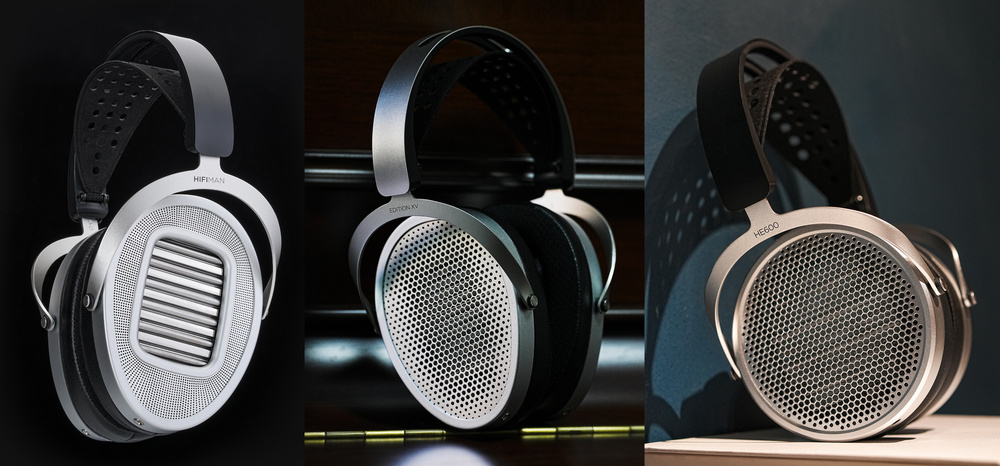
The Ananda Unveiled, Edition XV and HE600 are all open‑backed designs.
Hifiman’s assault on the studio market continues with no fewer than four new headphone models: the Edition XV, Audivina LE, Ananda Unveiled and HE600.
Hifiman sounds like one of Marvel’s less well known superheroes, but they are actually a headphone manufacturer with a huge portfolio of products. The fast pace of innovation and rapid turnover of models reflects the progress being made by founder Dr Fang Bian, who is constantly striving to improve his designs. Although they make other types of headphone, Hifiman specialise in planar magnetic models, and have claimed numerous breakthroughs in driver technology.
It can be a little hard to keep up with the development of the Hifiman product range, which usually includes numerous B‑stock offers, limited editions and variations on a theme. At the time of writing, the collection available in the UK comprises no fewer than 60 different headphones, including all four of the models that were sent for this review. What these all have in common is very aggressive pricing. Historically, headphones that use alternative technologies such as planar magnetic drivers have tended to occupy premium price brackets, but the Edition XV, Audivina LE, Ananda Unveiled and HE600 are all relatively affordable. The first two retail at around the £360$400 mark, with the HE600 coming in at about double that, and the Ananda Unveiled somewhere in the middle.
In The Frame
When I first tested Hifiman headphones in 2022, there was often very little in common between different models. Since then, Dr Bian seems to have been working to standardise some aspects of his designs, and the four models under review share quite a few construction features. The frames appear identical in each case, with a perforated fabric strap sitting inside a separate structural headband and cushioning the load on top of the head. The yokes from which the earcups are suspended are likewise very similar in all four models. They permit the cups to rotate freely up and down, and a little fore and aft. In practice, this means it’s relatively easy to adjust any of the four headphones to fit your personal head shape.
A final point of similarity between all of the review models is that the signal from your headphone amp enters through separate mini‑jack sockets at the base of each earcup. In all four cases, alas, it’s needlessly difficult to identify which earcup and which side of the Y‑shaped cable is left and which is right. If I were planning to pack them away on a regular basis, I’d be making coloured labels, especially for the cables. And talking of packing these headphones away, all four of these models arrived at SOS Towers in smart and practical semi‑rigid cases, which I haven’t seen on previous Hifiman models. The Audivina LEs also come with multiple cables, including a so‑called ‘balanced’ cable terminating in a four‑pin XLR.
Once you get to the earcups themselves, clear differences are apparent between the four models. Those of the HE600 are circular, whilst the Edition XV, Audivina LE and Ananda Unveiled all employ the elongated, asymmetrical egg‑shaped geometry used on the HE1000 Unveiled and Arya Unveiled models I reviewed earlier this year. The ‘Unveiled’ tag refers to the complete omission of any grille or louvre on the outside of the earcup, a design philosophy intended to prevent sound from the rear of the diaphragm being reflected back into the earcup. Hence the Ananda Unveiled’s magnet structure is clearly visible, and they also ship with cloth bags and magnetic shields that can be placed over the earcups to protect them from small particles. By contrast, the Edition XV and HE600 both look more or less conventional from the outside, with the magnet structure covered by an attractive hexagonal mesh. The Audivina LEs are very much the odd ones out, being a closed‑back model. Their rigid black plastic case gives them a very ’70s appearance.
Theme & Variations
All four models under review are passive, planar magnetic designs with relatively similar specifications. Nominal impedance is between 12Ω and 30Ω, with sensivity measuring between 92 and 96 dB. The stated frequency response is, as ever, vast, but no tolerances are given. In practice, they won’t be as loud as a typical pair of moving‑coil headphones for a given signal level, but they’re perfectly capable of being driven well by a fairly mundane headphone amp.
The closed‑back Audivina LE.I’ve heard a lot of very impressive open‑backed planar magnetic headphones, but the intrinsically dipolar nature of this type of driver makes it tricky to develop a good‑sounding closed‑back planar design. When the driver is pushing the same amount of air both ways, something has to be done with the sound emerging from the ‘wrong’ side; and if it can’t be allowed to escape into free air, some other means needs to be found of stopping it bouncing around and interfering with the wanted sound from the ‘right’ side of the driver. I’m not sure what approach Hifiman have taken with the Audivina LE, but the outer cases are about an inch deep, and presumably house some sort of damping material.
One of Dr Fang Bian’s long‑term design goals has been to improve the treble response of planar magnetic drivers, which historically were rather lacking in high‑frequency extension. He reached the broad goal of designing a bright‑sounding planar headphone some years ago, but in some of the older open‑backed Hifiman models, this brightness could be a little uneven or peaky. That same phenomenon is apparent in the closed‑back Audivina LEs, which to my ears exhibit a sharpness somewhere in the 5kHz region. Shakers, hi‑hats, vocal sibilants and the like can be uncomfortably prominent, with a slight ‘whistling’ quality apparent in some case.
This peak sits on top of a basic tonality that is already on the bright side of neutral, and to my ears, the bass and low midrange seemed a little subdued. Having said that, the Audivina LEs do manifest many of the good qualities that we associate with planar designs: they’re clean, with a punchy dynamic response that puts across transients in a very lifelike way, and they present a broad and coherent stereo picture. I probably wouldn’t want to mix on them without corrective EQ from something like Sonarworks’ SoundID, but I can imagine them giving good service once the frequency balance has been adjusted.
Clean Air
What, then, of the three open‑backed models? Unsurprisingly, there’s a fair amount in common between them, including all of the generic strengths of the planar design mentioned above. But they certainly don’t sound the same. The Ananda Unveiled struck me as the brightest of the three, with a sound signature that somewhat emphasises the treble and upper midrange over what might be called the ‘true’ midrange. In that respect, they’re not so dissimilar to the Audivina LE, except that the presence lift seems a lot smoother in this case. In an ideal world I’d probably still want to use them with something like SoundID or RealPhones, but I think you could fairly easily learn to accommodate the ways in which they diverge from neutrality. At the other end, the bass is quite lean and clear, but perhaps not as deep as you’d hope for from a planar magnetic headphone.
The Edition XVs have somewhat more going on in the 100‑200 Hz department, and an overall timbral focus that seems slightly lower in the frequency spectrum, albeit still favouring the upper midrange. On some material this struck me as a little uneven, and it sometimes exaggerated the ‘knock’ of a bass drum or a honky resonance in a guitar. However, this is a relatively subtle phenomenon, and given that the Edition XVs are the most affordable of the four models on test, I think they represent excellent value for money.
For me, the crown goes to the HE600s, which sound both more balanced and smoother than any of the other three models.
For me, though, the crown goes to the HE600s, which sound both more balanced and smoother than any of the other three models. Yes, they’re more expensive, but by the standards of high‑end planar designs, they’re not particularly costly in an absolute sense. And whereas I’d have some qualms about mixing on the other models without software correction, the HE600s would have my full confidence. They’re detailed but not over‑bright. They are warm without unduly exaggerating the low midrange. And they have all the aforementioned positives that are common to other Hifiman models, and to planar magnetic headphones in general. Hifiman may not have a cape or a mask, but they do have the superpower of building high‑quality headphones at extremely competitive prices!
Summary
Hifiman are committed to delivering a lot of headphone for your money, and the HE600s in particular represent excellent value.
Information
HE600 £719, Ananda Unveiled £489, Audivina LE & Edition XV £359. Prices include VAT.
HE600 $799; Ananda Unveiled $549; Audivina LE & Edition XV $399.
