

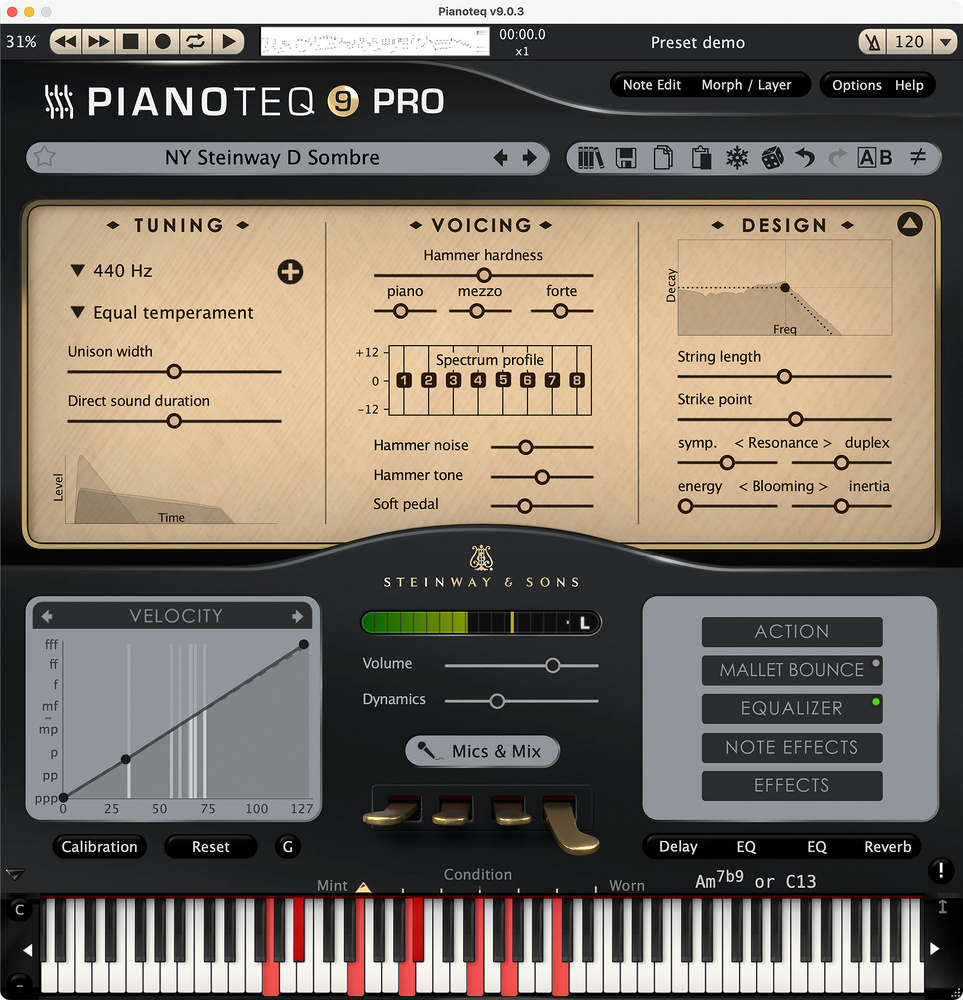
Now in its 20th year, Modartt’s Pianoteq software continues to grow and improve.
Modartt’s Pianoteq dates back a remarkable 20 years. In the earliest groundbreaking days it was a piano‑only affair, but its sound palette now encompasses electric pianos, pitched percussion instruments, steel pans, harps, classical guitar and harpsichords. The ‘piano’ part of the name arguably no longer quite cuts it...
On the off‑chance it’s completely new to you, Pianoteq is a virtual instrument that mathematically models sound in real time, rather than playing back samples. This supports stepless dynamic response behaviour, remarkable sympathetic resonance and pedalling effects, surprising scope for sound design, and a mind‑bogglingly minuscule installation size: about 54MB for the macOS version I downloaded. It runs in Windows and Linux, and on iOS and iPadOS too. Happily, owners of a desktop licence can authorise the mobile app at no extra cost.
Purchasing Pianoteq still involves some choices, about price versus features and sounds: www.modartt.com/buy explains all, and I went into some depth about this and many other aspects in my review of Pianoteq 8. Almost all of that is still relevant.
What’s New
But version 9 is here now, with an improved soundboard physical model that Modartt say enhances all available instruments (or at least those with soundboards, I suppose) with regard to their stereo and spatial qualities. The Harp instrument pack has acquired an Italian Baroque‑era triple, alongside improvements to the existing concert and celtic harps. Meanwhile, the Electric Piano pack gets a lift too, with enhanced dynamic response.
Additionally, ‘Sombre’ presets have been added to all grand pianos, felt‑hammer presets have now come to the various historical pianos too, and updated binaural presets are offered across the board. Supplementing Pianoteq’s already impressive pedal‑type provision is a new ‘thunder pedal’: depress it and you’re instantly smashing away at the top end of the dynamic response. More subtle is a Hammer Tone parameter, which EQs the very first milliseconds of impact of all notes. Onboard effects now include a ping‑pong delay, and there are useful improvements to EQ controls and reverb EQ. Finally, desktop plug‑in and standalone app windows are continuously resizeable with a corner drag handle.
In Use
All very good stuff. And comparing similar presets in both, I think Pianoteq 9 sounds classier than v8. Note decay and pedal resonance has more ‘swirl’. As for the Rhodes MkII presets: wow! They were always good, but the response to muscular playing now is a much fatter, more complex sound. The smoothness of transition to that from delicate light‑dynamic bell textures has to be heard to be believed. The triple harp is unusual but very nice, almost clavichord/clavinet‑like compared to the existing concert and Celtic harps.
Paradoxically, those Sombre presets had me beaming. Many seem to show Pianoteq at its very best, with a lovely combination of warmth and intimacy. If you’ve avoided Pianoteq thus far because of what can be an up‑front sonic character, these might change your mind. Looking back over the Pianoteq reviews I’ve written over the years, it’s telling that I’ve always mentioned something about the potential for fleeting (and hard‑to‑define) unnaturalness within the Pianoteq sound. I still hear something of the same in v9 if I set out specifically to look for it: for example, the flagship New York Steinway D has a couple of surprisingly stiff‑sounding bass notes in several of its main presets. But they only stand out because everything else is spectacular, and are not there in the Sombre preset, which suggests some special per‑note tweaking or a different acoustic capture approach. Talking of which...
Pianoteq 9 has an updated virtual miking scheme.
User‑configurable in the Standard edition and above, Pianoteq 9 has an updated virtual miking scheme. You now get to move around, in three dimensions, up to eight virtual mics of varying directional characteristics (some of which have desirable name‑checks, à la DPA, Schoeps, Neumann), which incorporate their own impulses for the onboard convolution reverb. And though one will be plenty for most jobs, the mics mix to eight independent busses, feeding output pairs on your audio interface or virtual inputs to your DAW mixer.
Just as in real life, mic positioning makes night‑and‑day differences to the sound, and many piano presets blend close and distant placement to good effect. Electric pianos can be miked too, or use a special Line Out option, or both. Good, flexible stuff.
Syngular

One Pianoteq 9 development that very few users will have seen coming is a new optional instrument pack, Syngular. Essentially, it makes Pianoteq into a synth, albeit one that uses the same physical modelling engine as the pianos and vibraphones. The ‘init’ sound is a weird chimera of 1970s ensemble keyboard fizz and acoustic piano decay, but the 50 or so presets reveal a range that goes light years beyond this, encompassing pads, choirs, basses and slow evolvers, some of which take advantage of the existing layer and morph features.
Additional sine, saw and square wave starting points, as well as fully‑sustaining sounds, suggest hidden parameters, but in fact everything’s achieved with existing user‑facing controls. Actually, Syngular puts some synth‑leaning parameters — for an LFO and an ADR envelope (which does more than it at first suggests) — front and central. But they’re merely convenient duplicates of what could already be found hidden deeper.
Syngular is no virtual analogue... But it’s got a distinctive, pleasantly synthetic quality all its own, and isn’t quite like anything else.
Summary
With valuable improvements to the core sound, and all sorts of other little enhancements, Pianoteq 9 is a really welcome release. For serious users of virtual pianos and related instruments, it’s still one of the best options out there.
Information
From €139 including VAT. Upgrade pricing available.
From $139. Upgrade pricing available.