

Neural DSP step out of their amp‑sim comfort zone, with a multi‑module mix processor aimed at polishing your vocal recordings.
If you have much interest in guitar‑rig simulation, then Neural DSP should be familiar to you: though only founded in 2017, they have quickly established themselves among the leading lights in this sector. Their product range started with some very well‑received guitar/bass rig plug‑ins, including some developed in collaboration with A‑list guitarists, bands and amp brands, before bravely expanding into hardware, with products such as the Quad Cortex and, more recently, the Nano Cortex (reviewed in SOS February 2025). Their latest software, Mantra, is not just another wonderful virtual guitar rig, but rather a vocal processing chain. Could it win Neural an audience amongst producers and engineers? Let’s find out.
Links In The Chain
Mantra is intended to put all the tools you need for vocal production — bar the mic, of course! — in a single AU/VST2/VST3/AAX plug‑in. Elements of the GUI design and layout will be familiar to users of Neural DSP’s guitar rig plug‑ins, and as well as looking modern, it’s super easy to navigate. The processing options are organised into three sections: Correction, Harmonies and Post FX. You can switch between them using the large buttons located towards the top of the display, and double‑clicking on the same buttons toggles the processing for that section on and off. The control set for the selected section fills the main part of the display.
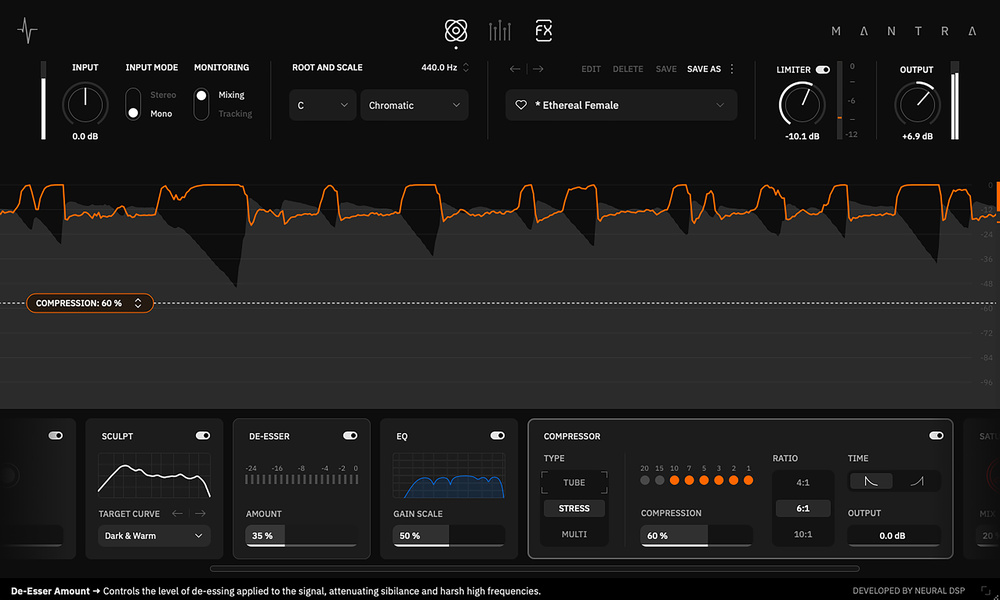
 The Correction section features seven individual processing modules.
As the labels suggest, Correction provides a collection of corrective processing tools, Harmonies provides a suite of options for generating automatic harmony parts from a vocal, while the Post FX section provides delay, reverb and modulation effects. That last section also includes a rather neat doubling effect, for when you just want to thicken a vocal part without digging into the details of the Harmonies section.
Tracking mode means Mantra can be used in real time while tracking or even performing live.
In the topmost row of global controls, one that’s worth noting is the Monitoring switch, which selects between two modes. In Mixing mode, you get all of Mantra’s features and the full depth of its processing capabilities, but with a modest latency. Cubase registered 56ms on my test system, which would not be an issue in a mixing context but is obviously too much for live performance and artist cue mixes. Hence Tracking mode: this reduces the latency (to a minimum of 3ms on my test system) by disabling a couple of features and employing some slightly ‘lighter’ processing algorithms. As with Neural’s guitar rig modelling, Tracking mode means Mantra can be used in real time while tracking or even performing live. This is an important element of the plug‑in’s feature set and will, I’m sure, appeal to many potential users.
Processing Options
When the Correction section is selected, a set of seven mini panels is displayed along the bottom of the plug‑in. The signal chain, running from left to right, consists of Tune, Gate, Sculpt, De‑Esser, EQ, Compressor and Saturation. As far as I can tell, this order is fixed, but it has been arranged logically and, in use, it didn’t ever feel constraining.
Each of the mini panels displays one key control for that module, as well as the module’s individual bypass switch. However, clicking on an individual module brings it into focus, expanding its mini panel to show a more detailed control set, and further controls or visual information associated with that module are then shown in the central portion of the GUI.
Gate is pretty straightforward, but elsewhere there’s plenty to discover. For example, the Tune module provides automatic real‑time pitch‑correction based on chromatic, major or different forms of the minor scale. Although you can’t define a custom scale, you do get full control over the speed of tuning, the sensitivity of the pitch analysis (Tolerance) and the option to ‘humanise’ the correction. You can do overcooked correction as an effect, of course, but you can also just apply enough processing to gently nudge the occasional stray note back into line. You can also apply a semitone‑based pitch‑shift, and shift the formants. Whether used on pre‑recorded tracks or a live source to give your singer a confidence boost (note that engaging the Tune module in Tracking mode increased the latency to around 13ms on my system), I thought this module pretty impressive.
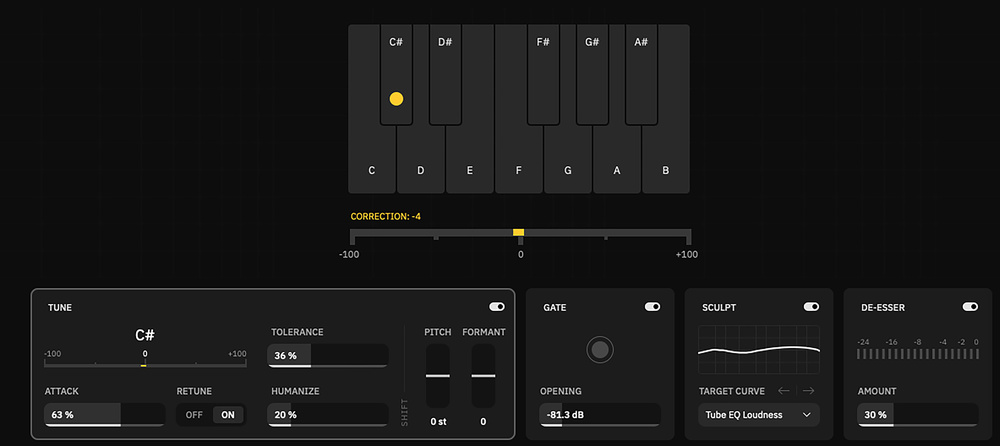 Mantra includes a very effective auto‑tuning capability.
The De‑Esser, EQ, Compressor and Saturation modules are all well‑featured too, but do exactly the kinds of things you’d expect. With the De‑Esser you can define the frequency range it operates within, pick between three intensity settings and adjust the amount. The EQ module provides a combination of low‑ and high‑pass filters, low and high shelving, and four parametric bands, as well as a neat control that adjusts the gain range for all EQ bands simultaneously — so you can exaggerate or dial back your overall EQ moves, while preserving the relative boosts/cuts of the different bands.
Compressor offers three ‘types’: Tube (an LA‑2A‑style optical tube‑amplified compressor), Stress (a FET‑style compressor like the 1176) and Multi (a modern multiband compressor). The available control set changes according to your choice. Similarly, the Saturation module offers three types: Tape, Tube and the more aggressive‑sounding Digital. Used individually, or in combination, all four of these modules are very effective, and the control sets easy to navigate.
The Sculpt module — in essence, a ‘tonal balance’ module — deserves a few more words. It can analyse the frequency content of the input and then suggest a customised EQ curve that’s intended to smooth out any overbearing frequencies. This is done with reference to a number of built‑in target profiles, of which there are currently nine in total, with labels such as Balanced, Mids Forward, Vintage Warmth and Modern Scooped. You can control the depth of the EQ adjustment using an EQ slider. But if working in Mixing mode, you also get access to spectral compression using the Dyn slider. While Mantra’s take on this process is handled through a very streamlined control set, it is essentially very similar in intention to plug‑ins such as Oeksound’s Soothe and Baby Audio’s Smooth Operator. The Sculpt module is both easy to use and effective.
Harmonious Harmonies
The Harmonies section can generate up to eight voices based on your input signal. You can configure the pitch (a fixed‑scale step relative to the pitch of the input voice), volume and pan of each voice or voice pair. These settings are achieved by two control panels at the base of the GUI, and there’s an intuitive visual layout of the generated voices in the central part of the display. The latter contains a drop‑down menu, with a range of harmony presets based on different chord types and voicings. They provide a good starting point, but it’s easy to configure your own options if you just want a simple harmony voice pair to support your lead vocal.
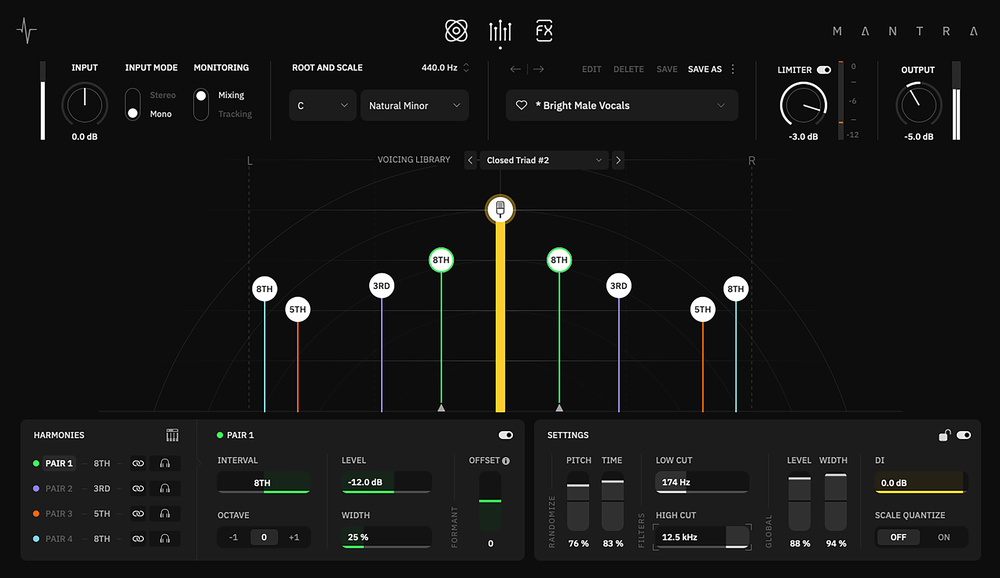 The Harmonies section provides automatic harmony part generation, using either scale‑based intervals or MIDI note input.
Controls for the individual voices/pairs are in the lower‑left panel, while the lower‑right panel provides global controls for all the harmonies. These allow you to humanise the pitch and timing, apply high‑ or low‑cut EQ, offset the formants and adjust the overall balance relative to the input voice. You also get the option to turn off Scale Quantize, which I felt produced a more natural result.
You can also control the harmony pitches that are generated by using MIDI note input, engaged using the mini keyboard icon in the lower‑left panel. This activates a MIDI input into the plug‑in, and you can send data to it from a suitable MIDI track either in real time from a hardware device like a keyboard, or from a recorded MIDI clip. It makes it very easy to experiment with harmony options that are perhaps scale‑based rather than following chordal intervals, and I found the results impressive. In isolation, as with pretty much every auto‑harmony generator, you can discern the synthetic nature of the voices (and the occasional artefact), but Mantra does this trick as well as any of the competition, particularly with that Scale Quantize control bypassed.
To Good Effect
The Post FX section’s Delay, Reverb and Modulation modules are all described as ‘multimode’, which means that each offers different styles of emulation. I’m not a massive fan of modulation effects on vocals, but I know some of you will be, and here you have three modes to choose from: Chorus, Flanger and Phaser. They all do exactly what you’d expect.
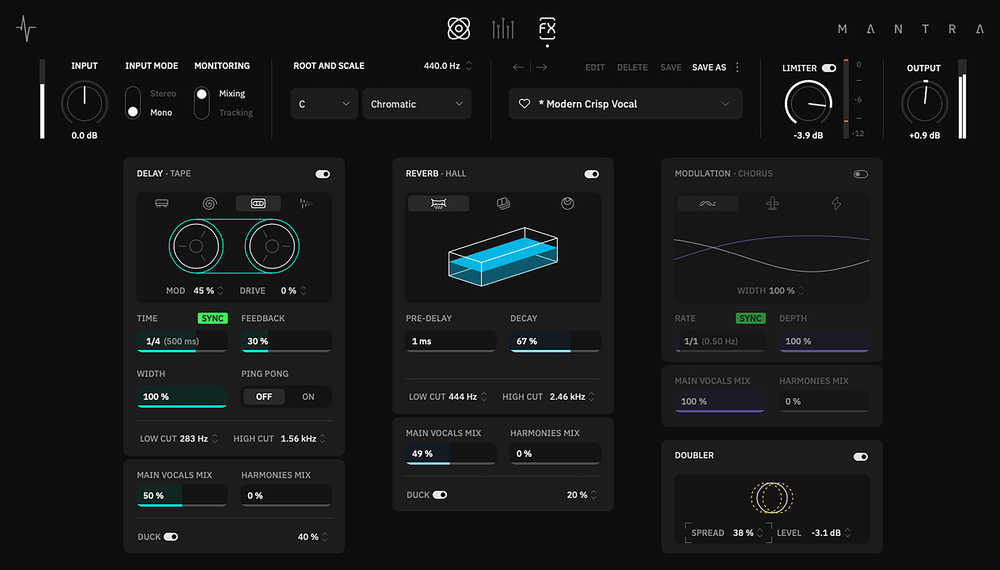 With its Delay, Reverb, Modulation and Doubler modules, the Post FX section lets you get very creative.
Everyone should find lots to love in the Delay and Reverb modules. Delay offers Analog, Circular (a multi‑tap mode), Tape and Dual (independent left/right delay processing) modes. Each has its own particular set of controls, while the Delay’s global controls include independent Mix options for both the main vocal and any additional voices you generate using the Harmonies section. You also get a ducking option to attenuate the delay when the main vocal signal is present, which can help with vocal and mix clarity. It’s a similar story with the Reverb, which offers three modes: Hall, Plate and Ambience. The Delay and Reverb are both more than functional tools: you have more than enough control, but there’s plenty of character to coax out of them and they sound excellent.
Oh, and don’t ignore the Doubler module. It’s simple but very effective: if you just want to thicken and support a lead vocal, it’s a no‑fuss way to do it.
New Dog, New Tricks
Quite a number of Neural DSP’s guitar rig plug‑ins cater for a rock/metal user base and, having experimented with a couple of different styles of rock vocals during the review process, I think the same audience should find plenty to like in Mantra. The plug‑in ships with a good collection of presets, and these include plenty of rock/metal options that, with the tiniest of source‑specific tweaks, can almost instantly take your dry vocal to ‘fully produced’ status.
But Mantra isn’t just for the rock and metal crowd by any means. There are some equally impressive presets that are obviously aimed at other genres (for example, Intimate Billie, R&B Tuned Vocals and Ethereal Female), as well as a huge additional suite of artist presets that have been designed by some of Neural DSP’s many collaborators. And, of course, this sort of processing needn’t be confined to use on vocals — to that end, Neural include compact preset categories for drums, general mixing duties and special effects. Just as impressive as the quality of the presets is that this plug‑in is so intuitive to work with, so if you prefer to dial in your own route between vocal zero and vocal hero, that’s easy too.
As I said at the outset, despite their success in the guitar world, Neural DSP are still a relatively young company, and Mantra suggests that this young dog is keen to learn new tricks. If Mantra is just their first foray into the wider world of mix processing tools, and what follows is as good as Mantra is, then Neural should do very well indeed in this market.
...it’s an impressive product that can deliver great results with ease and deserves consideration alongside the very best of the established options.
There are plenty of reasons — not least convenience and speed of use — to have a good one‑stop‑shop vocal chain plug‑in in your mixing toolkit, even if more experienced engineers are happy building vocal‑processing chains from the processors and effects they already know and love. It’s a product category with plenty of contenders, but with Mantra, Neural DSP really have hit the ground running: at this price it’s not a casual purchase, but it’s an impressive product that can deliver great results with ease and deserves consideration alongside the very best of the established options. The free 14‑day trial is well worth exploring.
Pros
- Powerful suite of vocal processing options in a single plug‑in.
- Quick and intuitive to use.
- A range of good presets, and not just for vocals!
Cons
- Could it be more affordable?
Summary
An impressive first move outside of guitar‑rig modelling for Neural DSP, this powerful all‑in‑one vocal processing suite boasts a slick workflow and is capable of very good results.