

You are here

Quantum Electric Q24

Valve Capacitor Microphone By Gunnar E Olsson
Published February 2026

This Swedish‑made valve mic offers all the character of vintage designs, but without the noise!
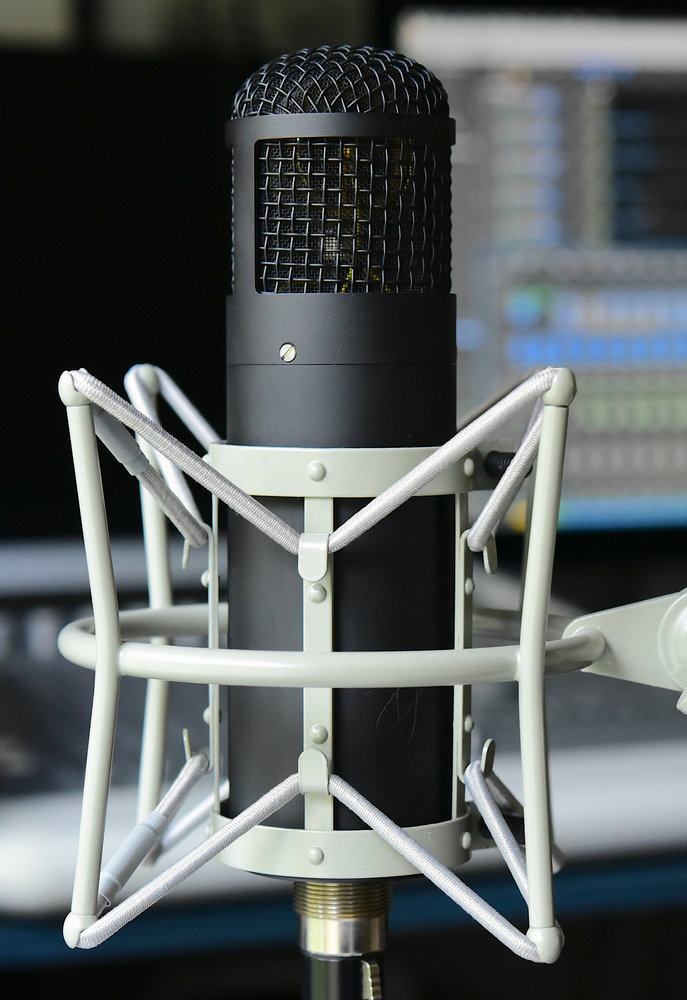
Quantum Electric Q24Quantum Electric are a new Swedish microphone manufacturer. I was incredibly impressed with their first product, the Q47, but its price tag could be a bit of a deterrent for anything but truly professional recording or broadcast contexts. A colleague who also tested this mic argued that the Q47 was not expensive per se, but agreed that it would be out of reach of anyone with a modest wallet. Now, Quantum Electric have catered for this market too, with the new Q24.

Quantum Mechanics

The Quantum Electric company were founded by Vladimir Carrasco Castillo, who is a Grammy‑nominated music producer, songwriter and screenwriter among other things. His first creation, the Q47, was released in 2023, and was a tribute to a vintage predecessor with the number 47 in its model designation. For its successor, Vladimir chose a number based on the year in which development started, and aimed to hit a more manageable price without compromising quality. Thus the Quantum Q24 was born.

The Q24 is assembled by hand in Sweden. Components have been chosen with great care, and the entire microphone exudes quality. The mic offers just one polar pattern, cardioid, and lacks bells and whistles such as a switchable attenuator or high‑pass filter. For key components, Vladimir has tried to track down NOS parts such as the RFT‑manufactured capacitors. Other parts, like the specially designed M7‑style capsule and transformer, are custom‑made. The amplifier section uses very few components, and signal paths are made as short as possible in order to keep self‑noise down. The brass microphone body has been treated with a technology called Cera Coating, which is also used for handguns and watches, giving a durable finish. The result is a high‑quality matte black finish.

Attention to detail is also evident in the basket surrounding the capsule, which is made from two layers of stainless steel wire mesh. Among other qualities, this gives the microphone a better chance of surviving a fall to the studio floor — something I’m told a couple of users have already expressed their deepest gratitude for. Some might argue that stainless steel is less good from the point of view of electromagnetic shielding than brass or copper, but other manufacturers have also used steel for its strength and impact resistance, such as AKG with the C12, C28 and D12.
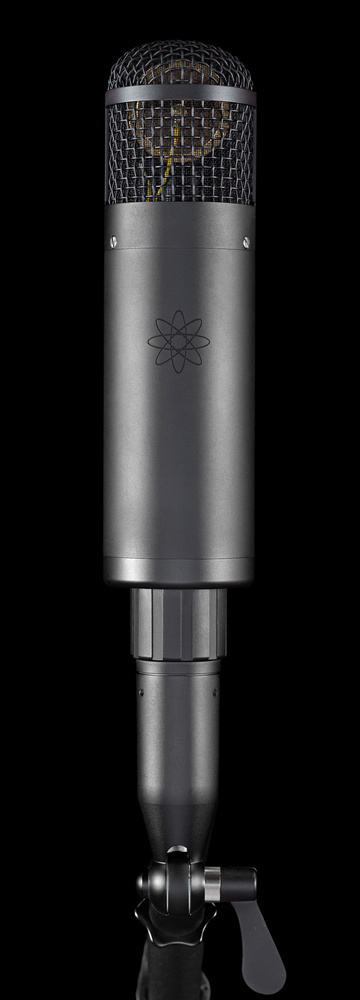
A swivel mount is available as an optional alternative to the standard shockmount.A swivel mount is available as an optional alternative to the standard shockmount.The Q24 comes in an unassuming but rugged and impact‑resistant plastic case. Included is a very substantial shockmount, plus a rugged PSU and a 5m‑long cable, with Sommer connectors. A swivel mount combining Sommer cable and Binder connectors is optional. Opening up the PSU reveals an incredibly neat build, with really substantial decoupling capacitors. As well as a Neutrik XLR output and Binder connector for the mic cable, there’s a standard IEC mains inlet, an on/off‑switch with a vintage‑type glow lamp, and a fuse holder.

Honey, I Shrunk The Valve

It’s obvious that Vladimir’s intent is to recreate the vintage sound of the mics from which he draws inspiration, such as the Neumann M49 and the Church microphone. However, in his bid to keep the Q24 affordable, he’s moved away from a conventional valve as used in those mics and in the Q47. Instead, the Q24 uses a military‑grade Nuvistor miniature valve as its impedance converter. The first Nuvistor was introduced by RCA in 1959, and its design and manufacturing process were radically different from those of traditional glass or steel valves. Nuvistor valves were manufactured by remote control inside a vacuum chamber, before their metal casings were sealed with a ceramic bottom plate. Most variants of this power‑efficient valve were less than an inch high and about half as wide, and this minuscule size meant that they could be used in contexts where conventional valves were impractical.

The Q24 is based around a recreation of the classic Neumann M7 centre‑terminated capsule.The Q24 is based around a recreation of the classic Neumann M7 centre‑terminated capsule.Today, Nuvistors are mainly used in hi‑fi amplifiers, but in the early ’60s, they enjoyed many applications including TV sets, radio receivers and transmitters, and for various military purposes. They were also used in the Ampex MR‑70, a one‑inch four‑track studio tape recorder from the mid‑’60s — and in studio microphones such as the AKG C12A. For a time, Neumann offered a conversion kit to replace the hard‑to‑obtain VF14 valve in their U47 with a 13CW4 Nuvistor. Quantum Electric chose the Nuvistor for its mechanical robustness, low microphonics, excellent noise figures and its extremely compact format.

On The Down Low

Having heard recordings made with the Q47, I was curious as to whether Quantum Electric would be able to produce a microphone with the same type of sound, but at a third of the price. I wasn’t disappointed. I found the Q24 to be just as free from noise and hum as the Q47, if not better still. In fact, the specifications claim a self‑noise figure of 8dBA, which is remarkable for a valve mic. Both the meticulously constructed power supply and the Nuvistor probably contribute to this. The Q24 was also 4 or 5 dB more sensitive than my reference mic, a Peluso 2247. Once the mics were level‑matched, the noise from the Peluso was quite disturbing, while the Q24 was dead quiet. I even replaced the valve in the Peluso for a fresh 6072M, in order to rule this out as being the cause of the higher noise level.

The published frequency response chart is fairly flat, without the 10kHz presence boost that makes some large‑diaphragm mics sound a bit harsh. The response slowly falls off above 15kHz in a way that is reminiscent of the mics Vladimir used as role models. Output impedance is stated as 600Ω. I tested the Q24 with a few different mic preamps: the ones built into my audio interface plus a pre from TK Audio, a Summit Audio 2BA‑221, and finally a VMS One from Slate Digital, which is designed to have a neutral and uncoloured sound character. For me, the combination of the Q24 and TK’s M81D Mk2 worked the best.

True Q

Quantum Electric recommend the Q24 for recording voices and all sorts of acoustic instruments. I tried it with guitar, mandolin, harmonica, flute, and two different valve amplifiers: a Fender Blues Junior and a Tweed Deluxe clone, both with multiple guitars. I also took the somewhat drastic step of recording my own voice, both in spoken form and with a certain (barely discernible) tendency towards singing. I have never really liked my own voice — who does? — but the Q24 managed to showcase a side of it that I had previously only dreamed of. Instead of the thin, slightly nasal sound that I had previously experienced, the Q24 presented a significantly warmer, fuller and almost enjoyable baritone voice. Well, let’s not exaggerate: obviously the Q24 cannot perform miracles, but it managed to hold back my more disturbing frequencies, while still giving it just the right amount of warmth, thanks to the slight valve/transformer coloration. The combination of low noise and this warm yet neutral sound character makes the Q24 an excellent microphone for voiceover and for other post‑production or broadcast contexts.

I have never really liked my own voice — who does? — but the Q24 managed to showcase a side of it that I had previously only dreamed of.

In fact, the Quantum Q24 made everything I placed in front of it sound unreservedly good: rich, transparent and natural at the same time. In other words, it had the characteristics that I normally associate with a well‑maintained vintage microphone. The Q24 also made it easy to discern different signal sources. I could hear a very distinct difference when I tried small changes in mic placement in front of an acoustic guitar, and the difference in sound quality between my Blues Junior and my Tweed Deluxe was clearly apparent. The Q24 handles transients in a fairly typical way for vintage valve microphones, adding a small amount of tube compression without sacrificing dynamics. Its off‑axis response is also well controlled. Q24_03

I tested the Q24 alongside the Lauten Horizon and Golden Age Premier GA‑47, similarly priced microphones that also aim for a vintage sound. To me, the Q24 sounded more neutral and transparent on all my sound sources, especially on acoustic guitars and voices, where it could handle my sometimes sibilant voice better than the rest of the crowd. But above all, what impressed me the most was the low noise level. In addition, the qualities that we sometimes call warmth or valve sound were inherent in the Q24 to a high degree. I would go so far as to say that this is one of the best‑sounding microphones I’ve tested in my 30 years as a tech writer. While working on this review, I spoke to a Swedish engineer/producer named Charles Storm, who bought two of these Quantum Electric microphones at launch. I asked him what he used them for. He replied, with a big smile: “Pretty much everything!”

I can see his point.

Pros

  • Very low noise for a valve mic.
  • A great all‑rounder that sounds good on acoustic instruments as well as vocals.
  • Handmade in Sweden using high‑quality components.

Cons

  • The case is practical rather than stylish.

Summary

An extremely low‑noise, good‑sounding valve mic inspired by classic German designs.

Information

SEK 24,995 including VAT (approximately £2000).

www.quantumelectric.se

SEK 19,996 (approximately $2100).

www.quantumelectric.se