

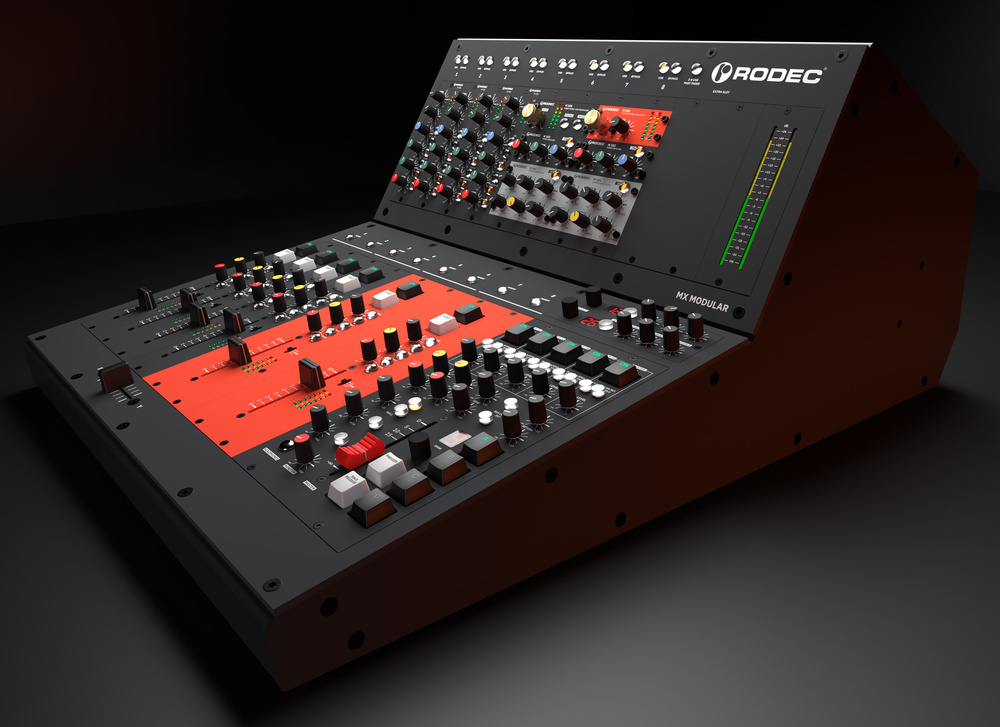
Compact and stylish, this console aims to cater for those working across the DJ, stage and studio worlds — and includes some novel performance features.
If you DJ’ed at any club in Europe during the 1980s or 1990s, you’ll likely have been crossfading on a Rodec mixer, specifically the MX‑180. From radios, amps and speakers in the 1950s and 1960s, to DJ mixers in the 1980s and 1990s, they remained a small but successful outfit making boutique products. Things have been relatively quiet for Rodec over the last 15 years, though, so it was a pleasant surprise when they began teasing the MX Modular at various trade shows in 2023. Finally, it’s here.
The MX Modular is a culmination of many of Rodec’s previous specialisms. It’s a mixer, of course, but it feels distinctly different from any mixer you might have encountered. It’s aimed at the traditional mixer market, but also at the audio interface and DJ markets. You can customise the number of mono or stereo channels (any combination of eight mono or four stereo). It incorporates a 10‑slot 500‑series rack that allows for personalisation of the first eight channels, as well as the master channel. It’s also an 18 I/O, class‑compliant USB audio interface capable of sample rates up to 192kHz. There’s even an assignable crossfader — something that might at first appear to be a playful nod to Rodec’s club heritage but which, it turns out, is genuinely useful in the studio and on stage.
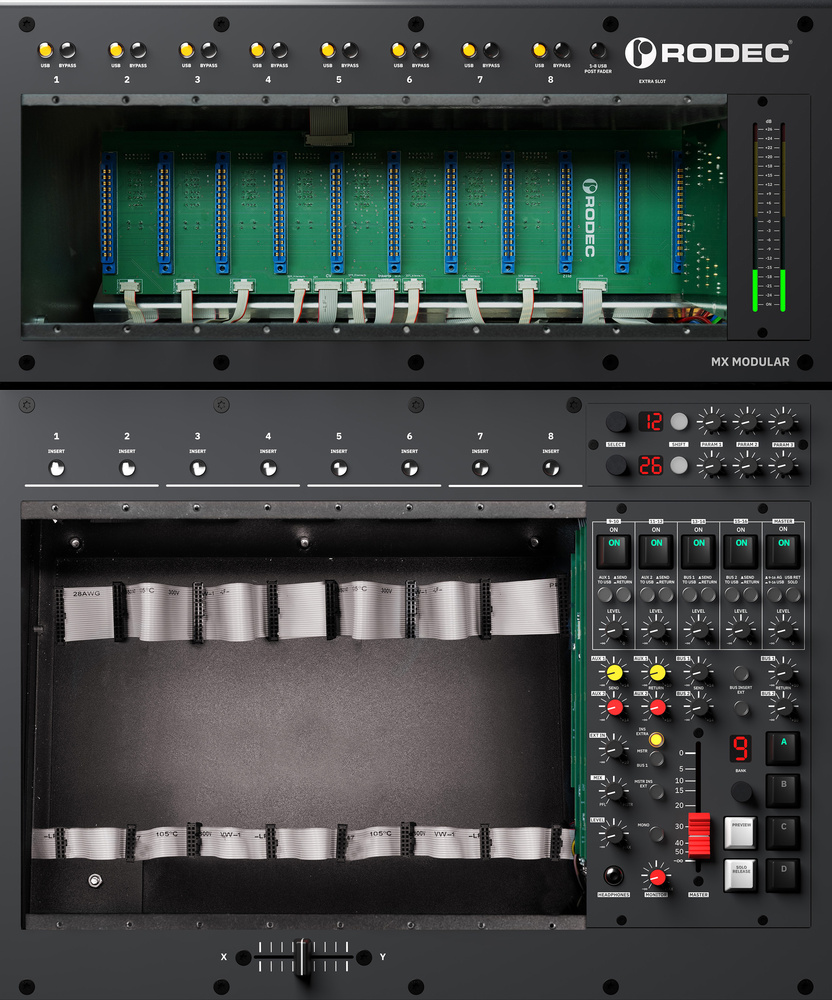
As the name implies, this console is fully modular, and there’s a range of different options for populating both the upper and lower sections of the frame.
The idea is simple: put your favourite 500‑series preamps, EQs and dynamics directly inside the mixer that you perform and track with. Instead of a traditional inline console, with fixed channel strips, you treat the desk as a curated Lunchbox that houses your mixer, effects and audio interface.
Basic Channel
The mixer’s 16 channels are split into two groups of eight. The first group consists of mono/stereo channels that are configurable and removable. If your main focus is tracking, you might choose to populate the main panel with eight mono channels. If, on the other hand, you’re a DJ or work with lots of stereo sources (many modern synths, samplers and drum machines, for example) then you might opt instead for four stereo channels. The model sent for this review had four mono and two stereo channels, which feels to me like a nice ‘compromise’ setup for a smaller studio.
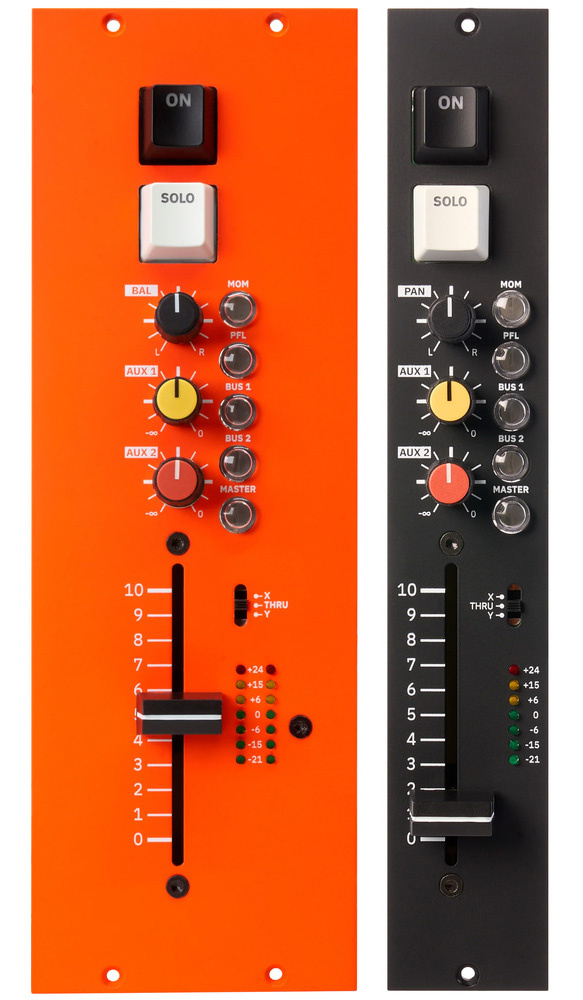
Unusually, the modularity extends to fader options for mono or stereo channel configurations.Whether it’s mono or stereo, each channel is equipped with an on/off button that serves as the channel mute, a solo button, a pan control, two auxiliary send pots, and toggle buttons for momentary mode, pre‑fade listen, and bus 1, bus 2 and master bus routing. There’s also a small three‑position switch that allows you to assign the channel to either side of the X/Y crossfader.
The second group of eight channels is found above the monitor section, and it’s configured as four stereo pairs, with a simple level pot and an on/off button. When used as an audio interface, these four pairs can be individually switched to send aux 1, aux 2, bus 1 or bus 2 as a digital signal, either as a dry send signal or as a wet return signal.
The built‑in class‑compliant USB‑C audio interface has 18 inputs and outputs, and Rodec have thoughtfully added an extra pair of inputs at the beginning of the list for the master bus. This is something that many mixers with built‑in soundcards get wrong — its inclusion means that you don’t have to waste a pair of channels for your computer audio. The first pair of inputs and outputs is always the master channel, whether that’s your DAW’s master stereo output, your general computer audio, or, in the reverse case, the master stereo pair from the MX Modular. For computer audio, there’s a dedicated return level control, an on/off switch, and a solo button, allowing you to easily solo your computer’s main audio output whilst all the direct outputs and USB outputs remain active. This makes it easy to process an entire mix in your DAW and monitor only the processed output. Bravo to Rodec for this simple yet elegant solution to dealing with master channels over USB.
The MX Modular is an inline console, meaning that every channel (individually on channels 1‑8 and as a group with channels 9‑16) can accept as its source either the analogue or USB input, and you can choose whether the audio signal going to the computer is pre‑ or post‑fader. In short, you can track to your computer with effects, bypass those effects, and mix the recorded stems back on the MX.
Monitor Section
This mixer’s monitor section is compact and straightforward, yet it’s also very flexible in its design. In addition to the master fader, there’s a dedicated monitor volume pot for your speakers, and a quarter‑inch headphone jack with its own level control. There’s a mono button for checking for mono translation (‘phase issues’), and a master insert switch for engaging any master insert effects. Additionally, an external input volume pot sets the level of an extra, faderless analogue stereo input that feeds the master bus directly.
The monitor section also houses all the aux and bus controls. Both aux channels are stereo, so they’re ideal for monitor mixes or stereo effects. They send to two built‑in digital effects processors and to the rear‑panel balanced outputs simultaneously. Internally, the digital effects processors will be mixed with the physical aux returns. There are no independent volume controls for the digital effects, so if you wish to use both at once you’ll need to adjust the volume of the effect accordingly — but it is possible. Alternatively, you have the option of disabling the internal effects, and using only outboard auxiliary effects. Each aux has a master send and dedicated return channel. Similarly, the two busses also have send and return channels, as well as an insert switch to engage the balanced insert points on the rear. All busses and auxes are stereo, but use just the left input or output and they can handle mono.
The dual digital effects aren’t bad — perfectly usable — although, as is typically the case with built‑in effects, they aren’t really ‘great’ either. There are three algorithms to choose from: reverb, delay, and delay‑plus‑reverb. Each algorithm has 6‑9 parameters, and these are accessed using three macro knobs. A two‑digit LED display shows the number of the currently selected preset (there are 20 factory presets, and 99 user slots), or the value of the parameter you are currently adjusting. Unfortunately, there’s no labelling or helpful feedback on what the numbers mean, or what parameter you might be controlling with a knob labelled Param 1. So it’s essential to keep a handy cheat sheet nearby. Given the price of this mixing desk — which, in general terms, seems fair given the quality and feature set on offer — it does seem stingy not to put in a small OLED display to show more useful information.
Still, the effects sound good. The reverb is pleasing. It’s straightforward in character and, with only six parameters, it won’t cover all bases, but it can muster anything from reasonable room reverb for drums to a long bloom reverb for synthesizers. The delay is a little more flexible, offering bpm sync (without MIDI Clock, just select a bpm and a clock division) and modulation. The delay‑plus‑reverb algorithm replaces the delay’s modulation with a compact dual‑parameter reverb. Again, the effects won’t top anyone’s all‑time favourite list, but they work well and are handy to have available. The ability to save presets is also useful, especially in the sort of performance environments this mixer is intended to cater for. I also appreciate the addition of high‑ and low‑pass filtering on all the effects — a simple but thoughtful touch that allows you to shape the wet signal to sit nicely in the mix.
Hold the Preview button, select a mute group, and you can see which channels are muted without actually muting them. Brilliant for live performance!
The mute groups are also located in the monitor section. Anyone who has used mute groups on any mid‑ to large‑sized console will feel instantly at home. There are four mute group buttons and an encoder to switch between nine banks. That gives you 36 mute groups, and that should be enough even for an entire live set. Because the MX Modular is more performance‑oriented than the average mixer, it has a couple of additional tricks up its sleeve. Hold the Preview button, select a mute group, and you can see which channels are muted without actually muting them. Brilliant for live performance! Additionally, the Solo Release function is excellent for performative build‑ups where you gradually add tracks into a mix.
Channels 1‑8 also feature something called Momentary mode, the status of which can be saved in mute groups. Momentary mode switches the channel’s on/off button from its normal typical behaviour to momentary toggling, allowing you to use it to perform DJ‑style rhythmic gating. It’s not a momentary mute as such, because there are no mute buttons, but a momentary ‘on’ state for as long as your finger is held on the on/off button. It’s a great touch — though it would be greater still were there an option to invert this behaviour, so that the channel is only muted when the button’s held down, as that would cover more performance styles, and align better with the momentary mute found in many DJ mixers.
Continuing the DJ‑like influence, the monitor section includes a mixer pot to crossfade the headphones signal between the pre‑fade listen (PFL) bus, that’s available only for channels 1‑8, and the master bus. This allows you to use headphones for cueing channels, just as a DJ would. Alternatively, in a studio environment, you might use the headphone output to send channels to a sampler or, potentially, as a third bus (in which scenario you could use the external input as the return).
The Micro‑modular 100 Series!
Now, let’s explore one of the most interesting aspects of the MX Modular: its generous 500‑series hosting capability. It incorporates a 10‑slot rack, with slots 1‑8 hard‑wired as inserts to mixer channels 1‑8, and the other two, which Rodec refer to as “extra”, being switchable as inserts on bus 1 or the master bus.
Any 500‑series single (mono) or double‑width (stereo) module can be used, and given that the main channels in the MX Modular have no EQ built‑in, this would seem a good starting point. To this end, Rodec have released the M‑501 module, which features both a mic/line preamp and a three‑band EQ. The review model Rodec sent to me had four of these installed in slots 1‑4, for each of the mono channels. The 501 uses discrete op‑amps and Lundahl transformers are employed on the input and output for a clean but musical sound. The preamp can add up to 70dB of gain and offers phantom power, high‑impedance switching, a 20dB pad, and polarity inversion. The EQ is a simple but lovely‑sounding design with ±15dB gain in each band: 100Hz for the low end, 10kHz for the high end, and a 500Hz to 13kHz sweepable mid, with switchable (wide or narrow) bandwidth. I’d say that the M‑501 is the perfect partner module for mono channels if you’re looking for a classic, transformer‑style mixer channel — and of course could appeal equally to anyone looking for a good 500‑series channel strip for use in a separate rack or other compatible console.
But because the MX Modular is not like every mixer, Rodec have reasoned that not everyone will be looking for a classic mixer channel, and have come up with an interesting way to make the 500‑series slots more flexible. The trouble with a 500‑series slot is that it generally hosts one thing: an EQ, a compressor, or a mic preamp, for example. A minimal channel strip at a push. To overcome this limitation, they came up with a new format: the 100‑series module.
While Rodec aren’t the first console manufacturer to support the 500‑series modular format, their innovative 100‑series format offers something different from the norm: as pictured here, the horizontal stereo 100‑series modules sit within dual 500‑series slots, to form a modular stereo signal chain.
A 100‑series module is a smaller device that fits into a 500‑series adaptor — you could say it’s a modular within a modular. Several 100‑series modules in an adaptor will be processed in series, from top to bottom. The 100‑series format is an open standard that Rodec hope will be adopted by other manufacturers. For now, Rodec have released the K7 adaptor and four 100‑series modules, with more planned.
The K7 adaptor occupies a double‑width 500‑slot, and the 100‑series modules are stereo processors (at least in the context of the MX Modular). The modules can be of any height, but Rodec’s current modules come in one of two heights: 6HP or 10HP. An ideal combination is two 6HP modules and one 10HP module, which fills the 22HP adaptor. The modules are connected internally and to the 500‑series input and output by ribbon cables.
The modules already available are the M‑101 stereo phono and line preamp, the M‑102 stereo EQ, the M‑104 stereo filter and the M‑108 stereo line preamp. In addition, in collaboration with fellow Belgian manufacturers Sherman, there’s a module based on the legendary Sherman Filterbank, called the Ministyler. This utilises the drive circuit and LP/BP/HP self‑resonating filter from the Filterbank to provide you with that signature, crunchy filter sound. Currently, this is the only module that utilises the MX Modular’s side‑chain CV input (see the ‘Connections’ box).
The 100‑series invention is a nice way to expand and modularise a familiar format, without seeking to replace it. Whether it will take on or not, time will tell, but in some ways, it doesn’t really matter: the 500 series is here to stay, and if you want to fill the MX Modular with names like SSL, Neve, API, Chandler, or Shadow Hills (I’m drooling just thinking about it!), then you can.
In Use
Out of the box, I have to say that this console looks fantastic, thanks to its ’60s‑inspired sloping top section and industrial design. The colour scheme of black and acid‑orange makes it stand out, and it looks and feels just as impressive in person as it appears in photos. The faders feel smooth, the knobs are panel‑mounted and wobble‑free, and the mechanical keyboard buttons used for mute and solo feel great. The overall vibe sits somewhere between ‘high‑quality broadcast desk’ and ‘boutique console’, which makes sense given Rodec’s aims — reliability on tour and flexibility in the studio. The sound quality is equally robust. With a master output built around discrete amplifiers and Lundahl transformers, there’s space and clarity to any mix, and +28dBu of headroom means you can push your mix without it falling apart.
The Lundahl transformer module for the master output stage.Ultimately, of course, the workflow must click if any mixing desk is to serve as the heart of your studio. And it does. Rodec’s hybrid approach to mixing and digital audio interfacing is about as good as I’ve come across, and I love that you don’t have to waste a mixer channel on your DAW’s main outputs. Switching between tracking in the analogue domain and mixing in the digital domain is seamless.
So who might the MX Modular appeal to? Well, the obvious catchment is anyone who values audio signal quality. Beyond that, anyone with a synthesizer‑based studio, or with modest recording needs (although, that said, you can daisy‑chain units for up to 48 channels if you wish!). Beyond that, the nice features aimed at performance, such as the crossfader, Momentary mode, mute groups, and the headphone PFL bus, should appeal to live performers and DJs alike. As a DJ mixer, it’s a big unit to carry around on tour, but then there’s nothing else quite like it either. Performing with the MX Modular (particularly the crossfader) feels like DJ’ing with stems.
The MX Modular is undoubtedly a high‑quality product and it’s a correspondingly high‑tier purchase — tantalising as it is, that means the price is inevitably going to be an issue for many. But consider that it could replace not only your current mixer, but also your audio interface, possibly your ADAT expander and some of your outboard gear, such as preamps, EQs, and compressors, to boot. If it can do that for you, then it might look like a more interesting proposition.
Some of the MX Modular’s features, such as the expander connection and some of the CV inputs, are still “reserved for future use”, and whether the industry will adopt the new 100‑series format remains to be seen (I hope they do; it works well!). But none of that’s significant, really, because Rodec have already delivered a truly impressive modular mixer, with a high‑class sound, and a modern approach to tracking and mixing that means it can adapt to almost any scenario. Rodec, as a company, have seemed quiet for several years — I have to say that the MX Modular is a very impressive comeback.
Connections
As with any serious mixer, there’s a lot of connectivity around the back, but it’s all labelled well and evenly spaced. Hidden in the recessed bottom section is an IEC socket with a rocker switch for power and, if you look carefully enough, the USB‑C port for the class‑compliant audio interface. The master outputs are on balanced XLRs and the monitor outputs on unbalanced 6.35mm TS jacks. Master insert sends/returns, bus 1 and 2 insert sends/returns, and both auxiliary sends and returns are on balanced TRS.
Another departure from most studio consoles is the support for turntables on the RCA inputs (a suitable module must be installed) and, for future planned modules, control voltages.
Balanced DB25 D‑Sub connectors are used for all 16 channel inputs, direct outputs (the signal being taken just after the 500‑series module), and the inserts for channels 1‑8. The RCA connectors provide alternative unbalanced inputs for channels 1‑8, and are configured as four stereo pairs — these can only be used in combination with Rodec’s M‑101 phono preamp 100‑series module, to connect turntables. There’s also a ground pin for connecting any turntable’s ground lead.
A CV input section allows control voltage signals to be passed to the 500‑series slots: there’s a stereo mini‑jack for each pair of channels, including the extra slot. Rodec’s M‑104 dynamic filter’s filter frequency will respond to CV and Rodec say that more modules with CV integration are planned. There’s also a stereo mini‑jack input for a side‑chain signal, which is routed to all 500‑series slots. However, at the time of writing this review, only one module can utilise it: the Rodec/Sherman Ministyler.
A PFL link facility is also catered for by a mini‑jack, and this is designed to link multiple MX modular consoles: connected consoles can share a common pre‑fade listen bus. The Control Link in and out DB15 D‑Sub connectors also allow for connecting multiple units: mute groups and solo functionality will be shared across all connected consoles. Finally, an Expander In D‑Sub connector is reserved for a future system expander product.
Pros
- High‑end electronics deliver a gorgeous sound.
- Beautiful build quality.
- Well‑thought‑out hybrid DAW/analogue workflow.
- More than a 16‑track mixer: 500‑series rack and 18 I/O interfacing built‑in.
Cons
- The price may put some people off (but it’s not exorbitant for what’s on offer).
Summary
The MX Modular is Rodec’s new 16‑channel flagship ‘performance mixer’. With an integrated 10‑slot 500‑series rack, 18 I/O, class‑compliant digital audio interface, built‑in digital effects, and some nice performance features including a crossfader and flexible channel muting, it offers a unique package of features that could appeal to small bands, audio engineers, electronic musicians, sound designers, DJs, and mastering engineers — which is just about all of us, right?
Information
Review model (MX Modular Hybrid Performance with additional Ministyler) £12,114. ‘Empty’ MX Modular, with four mono and two stereo fader channels but no modules £6749. Ministyler and One chassis bundle £645. Prices include VAT.
Source Distribution +44 (0)20 8962 5080.
Pricing depends on the chosen console configuration. Empty Rodec MX Modular base console $6670. Modules range from $176.81 to $999.68. Typical ‘fully loaded’ configurations range from $11,563 to $16,456.

