

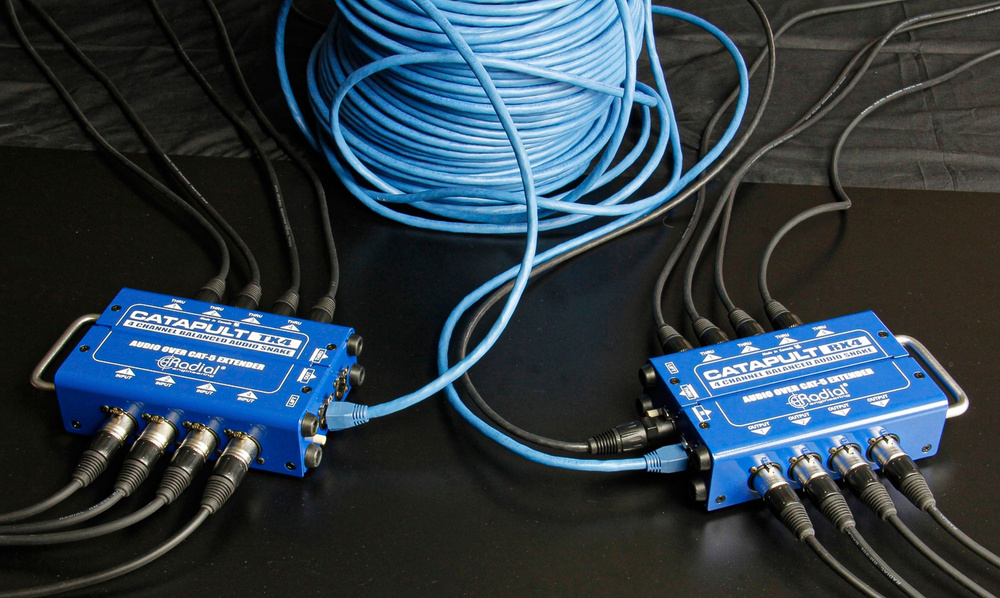
 Radial’s Catapult system: one of several brands who make similarly useful analogue audio over Cat‑cable systems, but whose products are generally incompatible.
Lots of useful boxes now allow you to send analogue audio signals over Ethernet‑style Cat cables. But sadly there’s little progress towards wiring standards...
It’s becoming increasingly common to employ standard Ethernet cables and passive breakout boxes to convey four separate, balanced analogue signals from one location to another. This scheme works very well with line‑level analogue connections — but mic‑level analogue, AES3 digital audio and DMX control signals can also be conveyed over such systems equally successfully. Commercial examples of this breakout‑box‑and‑tails arrangement include Thomann’s Cat Sssnake, Radial’s Catapult, Cranborne Audio’s CAST, Neutrik’s Stageboxes, and SoundTools’ Cat Box... amongst many more.
The concept takes advantage of the construction of standard Ethernet cables that contain four tightly‑twisted pairs of wire, making it trivial to connect each pair to a separate XLR or TRS socket, to convey differential signals like balanced analogue audio. Since Ethernet cables are designed for high‑frequency data, the characteristic impedance and bandwidth are also ideal for digital audio signals like AES3, and DMX.
Cables & Shielding
Note, though, that whereas standard analogue audio multicore cables always have individually shielded pairs (and sometimes an overall shield), common Cat 5e and Cat 6 cables are usually unshielded (UTP) types. This lack of screening might seem problematic, but fortunately its absence is rarely a problem in practice, because most interference sources are magnetically coupled to the wires and the very close and tightly twisted pair construction ensures both wires in each pair attract identical levels of interference — this allows a differential receiver to reject that interference to a very high degree.
Nevertheless, cable screening is important in reducing electrostatically coupled interference, as well as crosstalk between channels, and in analogue microphone applications a continuous screen also provides the return ground path for phantom power. Consequently, it’s a good idea to use shielded Cat cables where possible, and overall‑shielded (STP) Cat 6 cables are generally specified for use with RJ45 breakout boxes.
When it comes to Cat 7 cables... the S/FTP type is generally preferred for deployable cables, because it’s more flexible and easier to handle.
If you’re planning to pass mic signals (with or without phantom power), or for critical applications in hostile RF environments, many argue the benefits of Cat 7 cable, which has individually screened pairs in addition to the overall screen — this type of cable is more...
You are reading one of the locked Subscribers-only articles from our latest 5 issues.
You've read 30% of this article for FREE, so to continue reading...
- ✅ Log in - if you have a Digital Subscription you bought from SoundOnSound.com
- ⬇️ Buy & Download this Single Article in PDF format £0.83 GBP$1.49 USD
For less than the price of a coffee, buy now and immediately download to your computer, tablet or mobile. - ⬇️ ⬇️ ⬇️ Buy & Download the FULL ISSUE PDF
Our 'full SOS magazine' for smartphone/tablet/computer. More info... - 📲 Buy a DIGITAL subscription (or 📖 📲 Print + Digital sub)
Instantly unlock ALL Premium web articles! We often release online-only content.
Visit our ShopStore.