

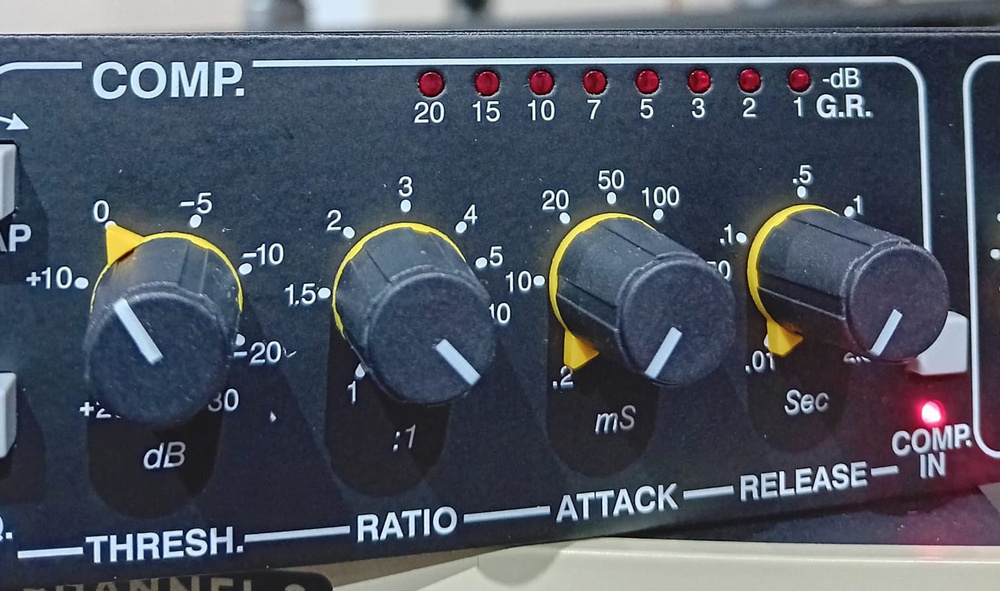
 A fast compressor with a ratio over 10:1 can serve as a limiter — but it still might not be able to detect the peak amplitude of incoming transients.
People often say a 10:1 or 20:1 compressor is “effectively limiting”. So is a genuine limiter just a compressor with a high ratio, or are there other differences, such as the attack times, or the nature of level detection? If so, does it make any practical difference?
Nathan Young
SOS Technical Editor Hugh Robjohns replies: Although they can be used creatively, the role of a limiter is fundamentally protective: to ensure that whatever its output is fed into never receives excessive signal levels. The ultimate expression of that would be a ‘look‑ahead brickwall limiter’, which is something I’ll return to. Most situations, though, don’t require such precise control, which is why there are many variations on the limiter theme.
Your mention of the ratio is a good example. The ultimate limiter — the so‑called ‘brickwall’ limiter would have a ratio of infinity:1. But it’s not only extremely difficult to achieve that in analogue circuitry (the only option when limiters were invented), but also unnecessary in most situations and, often, aesthetically undesirable too.
In real life acoustics, limiting only happens in extreme situations such as bomb explosions or lightning strikes. Consequently, hard limiting tends to sound obvious and unnatural, and any ratio above 10:1 is considered practically to be limiting. The majority of limiters have a ratio of around 20:1, since that’s relatively practical to construct in analogue equipment.
If you think about it, a ratio of 10:1 means the input signal has to rise 10dB above the threshold level for the output to grow by 1dB. If we’re trying to prevent the output exceeding, say, +12dBu, and we set the limiter threshold to +11dBu, the input signal would need to exceed +21dBu (ie. +11dBu +10dB). While that’s technically possible, it’s unlikely in real‑world mixing situations. Use a 20:1 ratio, and the input signal would need to reach +31dBu to generate an output of +12dBu — in which case the input circuitry is probably clipping already! Thus, a 20:1 ratio is considered acceptable for most real‑world protective limiting applications.
But the ratio is just one aspect of a dynamics processor. The kind of detection circuitry in the side‑chain makes a big difference too, and limiters need to use a peak‑sensing system to detect the true peak amplitude of incoming transients. In contrast, compressors typically sense the RMS or average energy of the material, to help control the perceived loudness rather than the peak levels (though some offer a choice).
The reaction time of the side‑chain sensing circuitry (and gain‑reduction element, for that matter) is also critical, because if the limiter is slow to introduce the required gain‑reduction, a brief transient peak will pass through the limiter before any attenuation can be applied. So a very fast attack time and fast‑acting gain‑reduction element is desirable... up to a point.
Unfortunately, conventional limiters can only react once the transient has arrived, and if the introduction of gain reduction is too fast, it will dramatically change the waveshape of that transient. We often hear that as ‘transient distortion’ — an unpleasant ‘crackle’ at the start of sounds — especially on harmonically simple sources such as flutes and pianos. Conversely, too slow an attack allows brief transients to slip through uncontrolled (this is known as an ‘overshoot’), potentially overloading subsequent equipment. Interestingly, though, if the transient overload in analogue equipment lasts for less than 1ms, the ear/brain generally won’t recognise it as an overload at all. So the attack time of most analogue limiters is rarely faster than just under 1ms.
Sadly, in digital signal paths even the briefest overloads cause aliasing, and the ear is much better at recognising that! Rather than reacting after a peak transient has arrived, then, a technologically superior solution is for the side‑chain sensing circuitry to analyse the signal slightly in advance of it reaching the gain‑controlling element. In this way, the required attenuation can be applied fractionally before the transient arrives at the gain‑reduction element, thereby avoiding any risk of transient distortion. Called a ‘look‑ahead limiter’, this is achieved in practice by inserting a short delay of, typically, a few hundred microseconds between the point in the signal path that feeds the side‑chain and the gain‑reduction element. It’s easy to achieve this digitally, and look‑ahead limiter plug‑ins are readily available. Although possible in analogue equipment, it’s difficult and expensive to implement, so generally found only in really critical situations like broadcast transmitters and high‑end mastering studios.
A very fast release helps to maintain an impression of loudness, even though the actual peak level is being tightly controlled.
Finally, the release time of a limiter is also generally faster than that used in a compressor. In the latter, the gain reduction is typically released relatively slowly to give a smooth sense of level control and so that the background noise doesn’t rush back up after heavy gain‑reduction. But limiters generally process loud sounds, and we usually want to maintain that sense of peak loudness. One way our ears/brain recognise ‘loud’ is the speed of amplitude change, moment to moment. A very fast release (around 50ms) helps to maintain an impression of loudness, even though the actual peak level is being tightly controlled.
So, if you really need the ultimate in peak control, you want a look‑ahead brickwall limiter with an infinity:1 ratio. But in most practical situations, a conventional peak‑sensing compressor or limiter with a ratio of 20:1 or more, and fast attack and release times, will give perfectly acceptable results. Listen out for transient distortion caused by too fast an attack, and low‑frequency modulation caused by too fast a release, and if the true peak output level is critical look out for overshoots, and set the threshold a decibel or two lower than the allowable peak.