

The Stockholm Studio Orchestra have added their magic to countless hits. We tracked down the orchestra’s linchpin, Erik Arvinder.
 Founder and Creative Director of Stockholm Studio Orchestra, Erik Arvinder.As founder and Creative Director of Stockholm Studio Orchestra, Erik Arvinder has become the first‑call string arranger for pop’s biggest names, including Childish Gambino, Lady Gaga and Avicii. His work also includes a vast catalogue of top‑tier films, TV shows and game scores.
Erik Arvinder grew up in a deeply musical household. His mother and father were both career violists; respectively performing with the Royal Stockholm Philharmonic Orchestra for over 40 years, and doing studio gigs with ABBA in addition to his full‑time position with the Swedish Radio Symphony Orchestra. Erik picked up his first 16th‑size violin at age five, which in his family was almost considered too late. “I remember my father yelling things like ‘Too flat!’ from the top floor of our house when I was practising as a kid. Music was an essential part of my upbringing which made a lot of things feel natural when it came to learning and developing into a musician as I moved on.”
Erik’s musical development followed a pretty standard template for a young Swede. However, after completing his education at the Royal College of Music, he distinguished himself by winning an audition with the Royal Stockholm Philharmonic Orchestra, becoming the youngest permanent member of the first violin section — where he shared the stage with his mother for four years. Many musicians would have regarded such a prestigious role as the pinnacle of their careers, but Erik felt the need to create as well as to perform, and decided to set off on his own path. Today he is arranger, conductor, producer, orchestrator and founder of Sweden’s busiest string orchestra, the Stockholm Studio Orchestra. “It wasn’t so much about missing something, as much as a different kind of hunger. There’s so much more to arranging music and running an orchestra. As my conducting responsibilities have expanded, I’ve found myself playing less and leading more. Conducting fascinates me, it challenges me in ways that playing never could.”
Continuity
In a sense, Erik was following in the footsteps of his father, who had appeared as a session player with Swedish icon Evert Taube, Björn Skifs, Bengt Palmers and ABBA, and moved in the same circles as the father of Erik’s future collaborator, Mattias Bylund. This was the generation that established the studio sound of Swedish pop. Decades later, the Stockholm Session Strings became the go‑to players for nearly everything leaving Swedish studios in the late ’90s and early 2000s, and the iconic backwards Bollywood sample on Britney Spears’ ‘Toxic’ is rumoured to have been played by Erik’s dad, amongst others.
Erik Arvinder: “In pop projects, I’m an arranger, shaping the song, its harmony, and how the strings interact with it. In film or orchestral work, I’m an orchestrator. I translate someone else’s composition into a playable, emotionally convincing score.
Today, Erik has taken up that baton, and as Creative Director of the Stockholm Studio Orchestra, he in turn is shaping the sound of contemporary pop. “In pop projects, I’m an arranger, shaping the song, its harmony, and how the strings interact with it. In film or orchestral work, I’m an orchestrator. I translate someone else’s composition into a playable, emotionally convincing score. One builds the form, the other brings it to life. As a conductor I make sure that the orchestral performance is at its very best, like a producer in real time.
“For a long time, the Swedish sound was ‘forest’. Clean. Now, the orchestra is moving toward a more American expression: bigger, bolder, more attitude and away from that slightly slim Nordic aesthetic. Less Nordic design and a bit more extra. At the same time, adaptability remains essential. One hour we are doing tight EDM rhythms, the next Nordic pop with restrained vibrato, then a ’60s pastiche full of glissandi and slow rubato phrasing.”
The Human Element
SSO’s home base is one of ABBA’s former studios of choice in Stockholm. Now known as IMRSV Studios, it was originally modelled after Abbey Road Studio 2 in London, and dates back to 1969. There, under Erik’s guidance, shared sessions and cross‑project collaborations have replaced the old models, offering a level of flexibility unheard of in Los Angeles, where union rules still keep strict boundaries. In part, it’s a response to competition from sampled orchestras and, increasingly, AI. “Real instruments are limitless in ways digital ones are not, but they’re demanding in every sense. There are practical realities to consider: recording a full string orchestra for a single song is expensive. Studios must be booked, arrangers hired, and musicians paid. My idea was to extend recording days while musicians are already there, allowing more work to be done at a lower cost, without compromising quality. String recordings shouldn’t be reserved for those with big budgets. The industry has also become much more single‑oriented, with projects often focusing on one or a few songs. That shift creates a natural synergy between different sessions. We can keep prices down thanks to Sweden’s lack of union restrictions, which allows several projects to be recorded in the same day — something that would be impossible in a union session in LA.
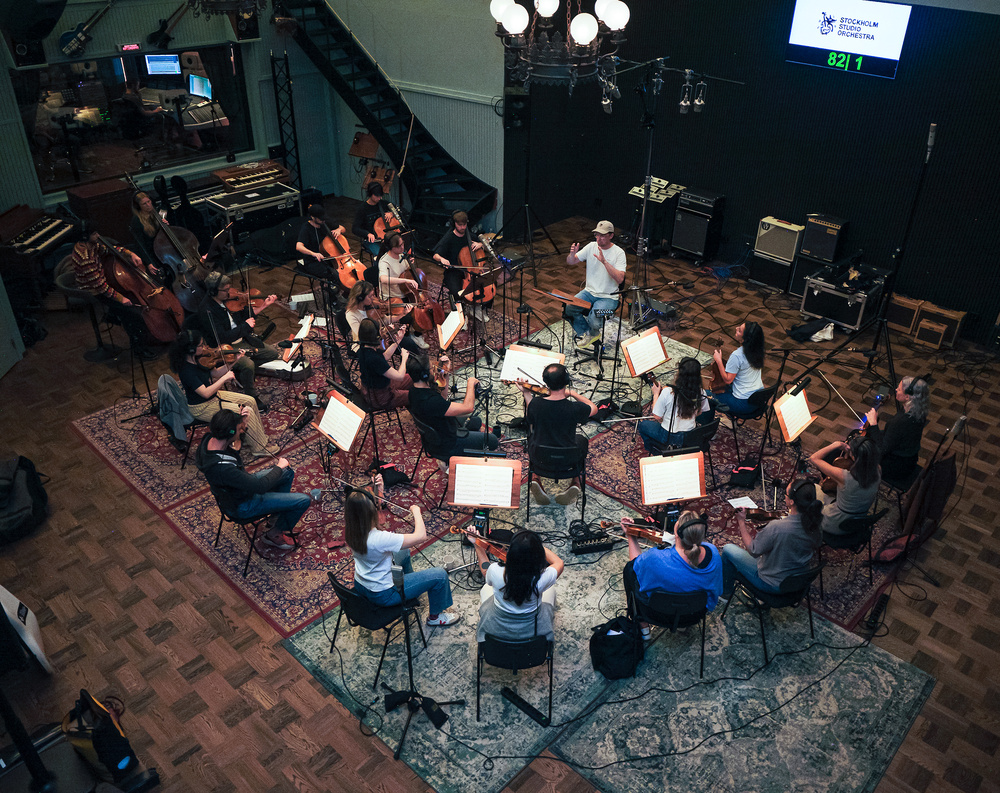 The Stockholm Studio Orchestra’s home base is one of ABBA’s former studios of choice, IMRSV Studios in Stockholm, originally modelled after Abbey Road Studio 2.
“I think we’re living in a time where AI and technology have made music production more accessible than ever, but at the same time, they’ve created this growing hunger for what’s human. The presence and energy of real musicians playing together in the same room... you just can’t fake that. When AI really takes over, I don’t think the human part will disappear. I think it’ll be even more desired. Real music played by real people will mean more than ever. You can hear the craftsmanship. You can come here and record with us. You can feel it. The biggest difference in our work has been harnessing digital tools to streamline everything that isn’t creative. Take contracting a session, for example — it used to mean calling 21 people, checking availability, negotiating fees, and starting over when someone got sick. Together with a web developer partner, I built ‘dwnbeat’, a platform that lets me contract an entire session from my phone in just a few clicks. It keeps events, contacts and rosters in one place. Updates go out instantly, responses are tracked automatically, and the right musicians are always in the loop.”
Erik Arvinder: "When AI really takes over, I don’t think the human part will disappear. I think it’ll be even more desired. Real music played by real people will mean more than ever.
Economies Of Scale
Erik’s business model is built on volume: SSO records 250 to 300 tracks every year. The rate is set per song, with length as the main variable. “We basically break even on recording days. Today I think I even lost some money, but I wanted to be a part of the project, and it pays back in royalties over many years. The royalties are paid through so‑called Neighbouring Rights. Everything is handled as a full buyout, with no cut on the master and no publishing share. In Sweden, this income doesn’t come directly from artists, producers, labels or songwriters, it comes from the use of the music itself. In the US and in union setups, it works differently. Two schools. We follow ours.
“It’s exciting to think that Stockholm could one day operate on the same level as the great session cities: Los Angeles, London, and now Nashville, where musicians make a full living from studio work. The dream of building an orchestra that can offer full‑time employment is what drives me. We already have incredible musicians in Sweden, and after nearly 3000 songs together, we’ve built a group of session players who are truly world‑class. Combine that with Sweden’s central role in the global music scene, and I believe it’s entirely within reach. We just have to keep up the pace. We’ve done four sessions in the last two weeks, six songs today, 12 on Sunday, then two weeks off. Ideally, we’ll stay steady at three to four sessions a week.
“A few years ago, I did almost everything myself. Today, I have a team around me: an engineer, a couple of external arrangers, and two project managers, which makes everything much easier. It allows us to move fast without losing control. During busy periods, we can record a high number of songs each week, which demands both structure and sensitivity. It’s important to dare to give people responsibility, to secure quality, and still leave a personal fingerprint on the work. This isn’t a factory, and we never feel like we’re running on autopilot. Every song opens a new field of possibilities: What’s the dramaturgy here? How does it balance against the vocals? Where do the strings belong and when should they disappear? We write according to the genre, letting the core of the song lead, not our egos. We always align with the creative team’s vision. The clients, the process and the demos. Over the years, SSO’s clients have been as diverse as they are numerous, but their internal process has remained largely the same.
“Producers, artists and record labels are our biggest clients. Some say, ‘do your thing’, while others arrive with clear references and demo strings. Most fall somewhere in between. There’s a direction, and our task is to bring it to life. It’s always a great feeling when the producer says, ‘This is exactly what I imagined.’ That’s when you know you’re speaking the same language. A few years ago, we began a regular collaboration with the legendary arranger and producer Mattias Bylund, who has since routed a number of projects through SSO. Commissions can really come from anywhere. The process often begins with a demo notated in Steinberg Dorico, a full score and audio files, both with and without the track. Feedback goes back and forth before the players step into the studio. The final arrangement might land at one in the morning. A few tweaks, and we’re off to work. Maybe a chromatic run takes up too much space, or a blue note feels too bluesy for the context. Simple things. Most of it falls into place quickly when you’re working with real talent. And when our work ends up on a Taylor Swift album [as on her song ‘Cancelled’, recorded in collaboration with Bylund] it’s not a coincidence. It’s proof that we’re doing things right. In the end, no PR beats a job well done.
“Everything leaves our hands as clean as possible, all made in close collaboration with Willem Bleeker, our very experienced and competent head studio engineer. We secure the source: the right mic, the right preamp, depending on the studio, the right distance and room. With multiple genres passing through in the same day, it’s ‘belt‑and‑braces’ engineering.
“Delivery is always tailored to the project. Sometimes it’s all the raw tracks, sometimes edited and comped stems. Many clients ask for a string mix. Many ‘don’t know what to do with 30 string channels’, so the team provides a stereo file, and often an additional stereo file with reverb. The talented Gustav Lindelöw at Ingrid Studios in Stockholm handles the post‑production mix and makes it shipping ready.”
Erik Arvinder: Never just say ‘Let’s take it again.’ Say why. Intonation? Timing against drums and bass? Tone?
A Matter Of Trust
So how do you run the show, putting together a world‑class orchestra that hits every note and maintains incredibly high standards? And how do you keep everyone happy along the way?
“It’s easy to talk about technology, but the real machinery here is the people. Twenty‑one players is typical for our shared sessions. A standard setup would be six first violins, five second violins, four violas, four cellos, and two basses. The music is brought to life by a network of highly skilled soloists and musicians from the major Nordic ensembles. They’re hand‑picked every time, depending on what the project needs. People travel across the country just to take part. I’m incredibly grateful for that. The culture here is built on professionalism and clarity. Never just say ‘Let’s take it again.’ Say why. Intonation? Timing against drums and bass? Tone? 1940s vibe or modern pop? Clarity in feedback saves takes, and earns respect. The people who make the strings sound the way they do are the musicians. My job is to give them the best possible conditions, then get out of their way and let them do their jobs. I might ask for a glissando, and get one. But it wasn’t the right glissando. I give a quick note, and instantly everyone adjusts their playing. That’s the magic of a shared musical language and real talent in my colleagues.
“The default line‑up of 21 players is designed for adaptability and flexibility in pop arrangements. Sometimes parts are doubled; sometimes the orchestra is scaled up. The next natural step is 29, adding eight more players. Some sizes work better than others — balance in an orchestra isn’t linear. We might also use 19 musicians [6‑5‑4‑3‑2], or 20 with a slightly different balance. A full symphonic setup, which we sometimes have, means 16‑14‑12‑10‑8. For pop, our current configuration is optimal. For certain projects — musicals or film scores — we go a little bigger. It’s a different sound, but a really exciting one. And the orchestra can be way more than strings, depending on the commission. We do brass, winds and percussion too. We’ve had hurdy‑gurdy, nyckelharpa and even recorded the players singing. Though our home base is IMRSV, we also collaborate with RMV Studio and Ingridstudion, both in Stockholm. That flexibility is a huge advantage when it comes to recording different constellations of players, instruments and schedules.”
The first take always has a few rough edges, but by take three it’s usually there. After the recording is done, an editor starts the selection and editing process. The files are comped vertically (even note‑by‑note for EDM‑level precision) or horizontally (longer sections when the performance needs to breathe). Are there cardinal rules when it comes to being a great captain under these circumstances? “I’m not an incredible conductor technically by any means, but I know what people need in order to do their job. Structure is a form of care. Don’t run 10 extra takes. Don’t make people wait because you don’t know what you want. You get what you give. If the musicians trust you, they give everything back.”
Northern Stars
Perhaps because of a climate that leads people to spend lots of time indoors, or perhaps because of its excellent, free music education programme, Sweden punches above its weight in music production, especially pop music. “None of this would have happened without Sweden,” insists Erik. “A small country with an enormous music export — producers, artists, film composers, songwriters. The demand exists right here at home — and it goes a long way. International projects are exciting, of course, but there’s a quiet pride in playing a small part in what many still call the Swedish music phenomenon.”
Miking The SSO
A typical Stockholm Studio Orchestra miking setup features multiple main mics, plus one spot mic per desk. The principal main array is a Decca Tree of three FLEA 50 mics for “the archetypal Hollywood sound”, with a FLEA 49 as an alternative centre mic in the array for when something wider and smoother is needed. The main three‑mic setup is augmented by FLEA 251 mics as outriggers, plus Royer SF‑2 active ribbon mics to provide an alternative main array — “no mic is more flattering for recording strings,” says Erik of the latter — and DPA 4006 omnis as ambient room mics.
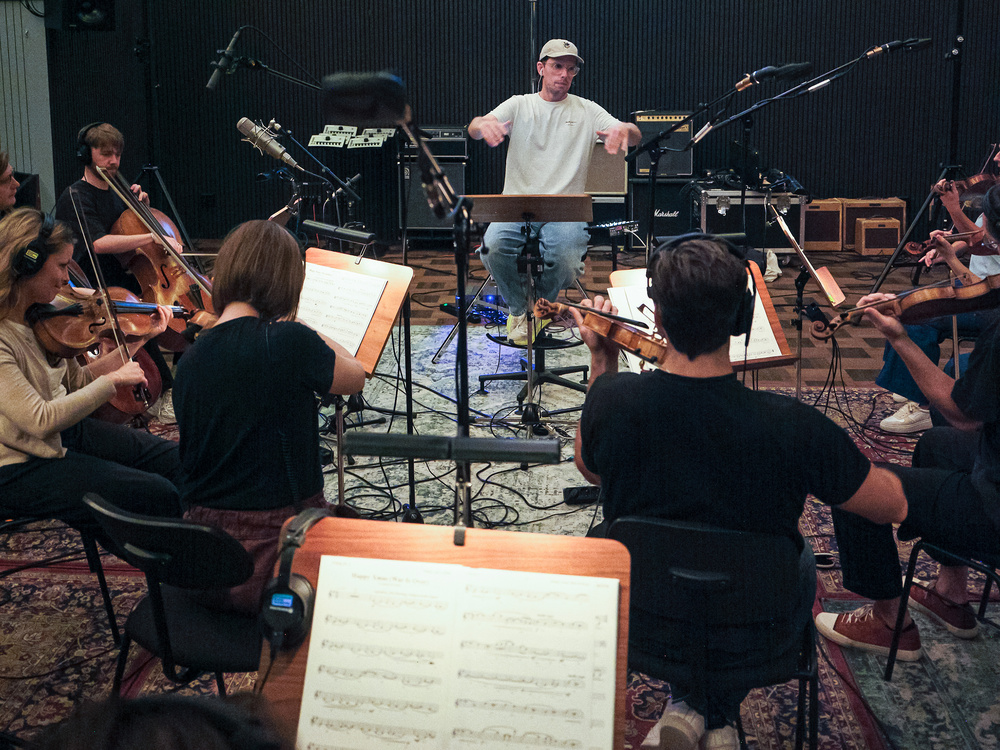 Standard SSO practice is to close mic each desk (pair) of players.
Favoured spot mics are Coles 4038 ribbons on violin, Schoeps MK4 on viola, Neumann U47 or FLEA 47 on cello and either AEA ribbon mics, Neumann U67 or FLEA 12 on basses.
Erik Arvinder Selected Discography
Violin or viola
- The Weeknd ‘Drive’
- Coldplay ‘Jupiter’
- Ariana Grande ‘bye’
- Sam Smith & Madonna ‘Vulgar’
- NSYNC & Justin Timberlake ‘Better Place’
- Ed Sheeran ‘A Beautiful Game’
- John Williams Star Wars: The Force Awakens
- Lady Gaga ‘Alejandro’
- John Williams Star Wars: The Last Jedi
- Harry Styles Harry Styles
- Demi Lovato ‘Confident’
- Morrissey Low In High School
- Lady Antebellum Heart Break
With Stockholm Studio Orchestra
- Taylor Swift The Life Of A Showgirl
- Lord Huron The Cosmic Selector Vol. 1
- Avicii Stories
- Childish Gambino Because The Internet
- Dolly Parton & Galantis feat Mr Probz ‘Faith’
- Kate Hudson Glorious
- Zara Larsson Introducing EP
- Netflix Chef’s Table
- Ludwig Göransson Community
- Loreen ‘Tattoo’
- First Aid Kit Palomino
- James Arthur ‘Quite Miss Home’
- The Knocks & Dragonette ‘Slow Song’
- Lupe Fiasco ‘Stellar Light’