The original Herchild impressed us hugely, and this new, alternative version costs a fraction of the price — can it really deliver a similar sound and performance?
A shade over three years ago, I reviewed Heritage Audio’s impressive Herchild 670 (SOS February 2023). It was a ‘reassuringly expensive’ 22‑valve take on the legendary Fairchild 670 variable‑mu compressor. The company didn’t stop their Fairchildish endeavours there, though, and in late 2023 released the 500‑series Grandchild 670/500. Then, toward the end of 2025, they invited me to review their Herchild Next Gen 670N. Another rackmount offering, this time it harnesses the Grandchild’s four‑valve compressor engines, and while it’s still very much a professional piece of kit with a price to match, it is reassuringly less expensive!
Controls & Connections
Like other units in Heritage’s 670 series, the Herchild Next Gen 670N — let’s just call it the 670N from here — has a black panel with white and red legends, and the dual channel names (Left/Lat and Right/Vert) remain too, pointing to the Fairchild 670’s role in vinyl mastering. The 670N’s 19‑inch rackmount chassis is 5U high, which is 1U shorter than the Herchild 670, yet it carries an additional control per channel. There are also some important operational differences in the controls. On the back are XLR connectors to carry the two channels’ transformer‑balanced inputs and outputs, together with the five‑pin XLR connector for the external ±17.5V switch‑mode power supply.
 The rear panel hosts the transformer‑balanced XLR I/O, as well as a socket to connect to the external switch‑mode power supply.
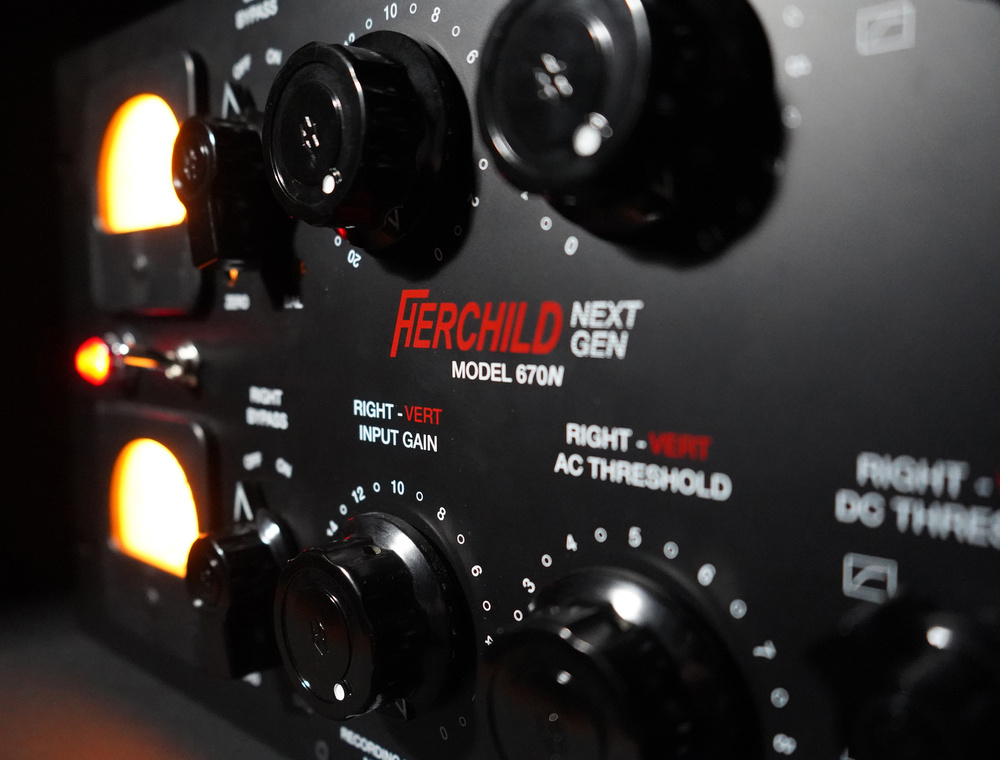
The two channels have identical controls, a combination of rotary switches and 40‑position, lightly detented potentiometers. First in line on each channel is a two‑position on/bypass switch, outfitted with the same large chicken‑head knobs used in the Herchild 670. In the on position, the channel VU meter illuminates to give you instant visual confirmation that the compressor is active. Next come two potentiometers with large, circular knobs. The first is Input Gain, though technically speaking it’s an input level attenuator. The second, as its AC Threshold legend implies, determines the signal level required to trigger compression.
Following these is a trio of controls, each equipped with a smaller chicken‑head knob. The upper left of these, a pot, is labelled DC Threshold. Combining the functionality of a conventional compressor’s ratio and knee setting, this allows you to move seamlessly backwards and forwards through the compression curve from hard‑knee, high‑ratio limiting, to a light, transparent, soft‑knee, low‑ratio compression. Top right of the trio is a six‑position Time Constant switch that selects fixed combinations of attack and release times that, on paper at least, are identical to those of the Fairchild and Herchild 670. Beneath and between them is the SC Filter selector switch. In addition to its off position, this side‑chain filter offers high‑pass options at 80Hz, 160Hz and 5kHz, as well as peaking (bell) filters centred on 1 and 3 kHz. This is a pretty radical departure from the Herchild 670 (which has 50, 100, 200 and 350 Hz side‑chain high‑pass options). The last channel‑specific control sets the post‑compression make‑up gain. Fitted with a smaller version of the knobs used for the Input Gain and AC Threshold, this control is not present on the Herchild 670.
 Though still very large, this Next Gen version of the Herchild 670 occupies 1U less rack space than the ‘full fat’ original.
The 670N’s final front‑panel control is the AGC (Automatic Gain Control) mode switch, which configures the 670N’s two channels. The four options are Ind and Link, for dual‑mono or linked‑stereo operation, and unlinked and linked Lat Vert. This Lat Vert terminology has its roots in vinyl mastering and today we generally know it as M‑S, or Mid‑Sides. When a Lat Vert mode is selected, the L‑R signals are fed into a passive M‑S encoder, placed before the gain reduction stage, and a decoder after the make‑up gain converts them back to L‑R. The 670N follows the convention of routing the Mid signal through channel 1 at the top, and the Sides signal through channel 2 below.
Inner Space
Internally, there’s a single, hand‑assembled internal PCB that’s populated with the highest‑quality components, including the four, centrally‑positioned 6BA6 valves and the two custom‑designed input transformers that flank them. Each channel’s audio and side‑chain output transformers are also custom‑designed, and these are mounted directly on the chassis.
 Inside, almost all the components, including the four valves, sit on a single circuit board, though the output transformers are attached to the chassis independently.
As in the Grandchild 670/500, the 670N’s gain‑reduction stages each employ two 6BA6 valves, configured as two triodes per channel. The valves are run at a plate voltage of “slightly under” 250V, which is comfortably within their specified 300V maximum. Two 6BA6 ‘triode halves’ make up the channel compressors’ gain cells, each of which is driven in push‑pull by the input transformer. The compressor output flows to a +10dB make‑up gain stage, based on Heritage Audio’s proprietary, transformer‑coupled HA‑880 op‑amp. This highly‑regarded, transparent op‑amp then drives the channel’s transformer‑balanced output.
In contrast to the Herchild 670, the 670N’s side‑chain control voltage is generated by solid‑state circuitry, but the side‑chains nonetheless retain the feedback characteristic of their predecessor, and they’re equipped with newly designed custom output transformers, to deliver the control voltages to the gain cells. Side‑chain linkage through the AGC control functions as you’d expect: the Ind (independent) setting separates the left and right control voltages; the Link position derives a common control voltage from whichever channel (left or right) is triggering the most compression, and delivers the result to both channels. The first Lat Vert setting, which you’d use for independent level control and compression of the Mid and Sides, again keeps the control voltages separate, while the Lat Vert Link position uses the same methodology as the stereo position to derive and deliver a common control voltage for both the Mid and the Sides.
Child’s Play
As with the original Fairchild and other Herchild units (indeed, most valve devices), the 670N requires a significant warm‑up period to reach its full, stable operating temperature. The manual recommends 20 minutes — that’s about the time it takes me to turn on my studio, set up a few mics, make a cup of tea and get the computers and interfaces to wake up! At switch‑on, the 670N’s VU meter needles remain at full negative deflection and start to climb towards 0VU over the next 15‑20 seconds, as the valves heat up. At switch off, the needles slowly sink back to their rest position. During the review period I ran the 670N for a good number of 12‑hour days. The needles never failed to come up to precisely 0VU, and didn’t drift at all as the hours passed.
Although the Herchild 670 remains the best ‘glue’ compressor I’ve ever had the pleasure of using, the 670N possesses an impressive ability to bring mixes and stereo stems together. It’s certainly in the same sonic ballpark as the original Herchild, and delivers a similar subjective sense of cohesion and tangible presence between the loudspeakers.
It’s certainly in the same sonic ballpark as the original Herchild, and delivers a similar subjective sense of cohesion and tangible presence.
As with the Herchild 670, I found that (for my preferred way of working, at least) the simplest route to success was to think of the Input Gain, AC Threshold, DC Threshold and Time Constant as an interactive control group. All that’s needed is a starting point, and I tend to use one of the programme‑dependent settings and the Time Constant that I suspect will work best for the material, and go from there. Talking of time constants, the paper specifications of the preset attack and release time combinations are exactly the same as on the Fairchild and Herchild 670 compressors. However, it feels to me that the 670N’s solid‑state side‑chain delivers a faster, somewhat more agile response overall compared with my memories of the 670.
I also found the 670N’s different side‑chain filter options very useful. As you’d expect, the 80 and 160 Hz high‑pass filters help prevent low‑frequency energy from triggering unwanted compression ‘pumping’. But, by effectively increasing the side‑chain’s sensitivity to their frequencies, those 1 and 3 kHz bell boosts let you tame nasty transients in the midrange and upper midrange. 5kHz might sound very high for a high‑pass filter, but it comes into its own should you need to target vocal sibilants and other high‑frequency transients (for example in drum overheads) without changing the dynamics of the underlying track.
Vari Good?
The Herchild Next Gen 670N is undoubtedly a very, very good variable‑mu compressor. It delivers the warm, smooth, natural‑sounding compression that, given its combination of transformer‑balanced I/O and valve‑based gain reduction, you’d expect. Yes, there are fewer valves than in the ‘full fat’ 670, but as well as coming in at about a third of the price, this new version offers enhanced functionality that’s genuinely useful, while delivering a sonic performance that’s much closer to that of its ancestor than you might anticipate. The dual‑mono, stereo and Mid‑Sides capabilities make it an attractive all‑rounder, even if its fixed attack and release times mean it probably won’t be the only compressor in your studio. So, if you’re lusting after a Fairchild 670‑style compressor, and don’t require total ‘authenticity’, I highly recommend that you audition the Herchild Next Gen 670N.
Pros
- Doesn’t stray far from the Fairchild character.
- Beautifully constructed.
- Useful side‑chain options.
- Much cheaper than a slavish emulation!
Cons
- None.
Summary
As ‘lite’ versions go, this clever adaptation of the Fairchild 670 design has to be one of the best, delivering a similar sonic character but boasting some useful enhanced functionality, not least in the side‑chain.
Information
When you purchase via links on our site, SOS may earn an affiliate commission. More info...