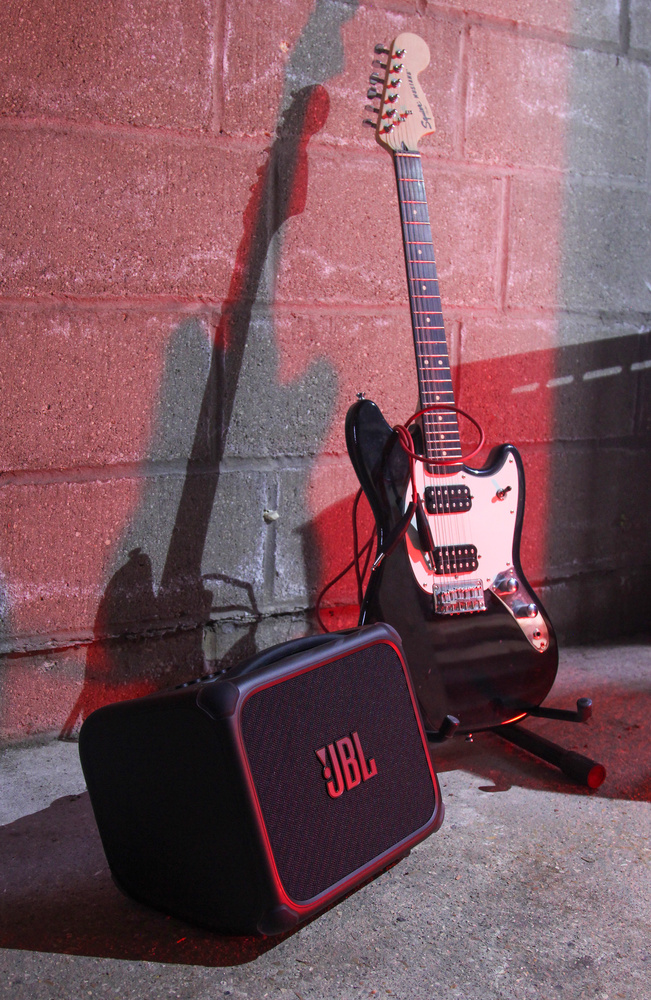
With AI‑powered stem separation on board, JBL’s new portable speaker gives performers the freedom to replace vocals and instruments in any backing track.
JBL were pioneers of highly efficient, high‑power‑handling loudspeaker designs, so it is not entirely surprising to see them offering a powered speaker capable of delivering 135 Watts from an enclosure measuring just 320 x 260 x 240mm! However, the BandBox Trio (and its even smaller sibling the BandBox Solo; see box) is far more than just a compact speaker. Designed to cover roles ranging from portable small‑venue sound reinforcement to home practice and songwriting, it combines a four‑channel digital mixer with DSP effects, recording capability and an unusually ambitious suite of tools. Perhaps its most notable feature is AI‑powered stem separation, which allows users to extract customised play‑along tracks from their favourite recordings by removing the vocals, guitar parts or both in near real time.
Physically, the BandBox Trio is solidly constructed in a robust polymer enclosure with comfortably rounded corners and a tough grille cloth sporting a large JBL logo. A soft‑touch carry handle sits flush in a recess on the top panel, while the base has rubbery feet and is angled to allow stable placement on the floor or a desktop. Power for the speaker can be drawn either from the mains or from an internal rechargeable battery, which is user‑swappable for extended sessions and offers up to 10 hours of operation on a full charge. Despite its compact appearance, the unit feels reassuringly substantial but is still an easy carry at just under 8kg including the battery. The 135W (RMS) Class‑D amplification drives a single 6.5‑inch woofer alongside two 25mm tweeters. With a quoted frequency range of 50Hz‑20kHz, the Trio is able to reproduce not only vocals and guitars but also backing tracks with a surprisingly solid low‑frequency foundation given the cabinet’s diminutive size.
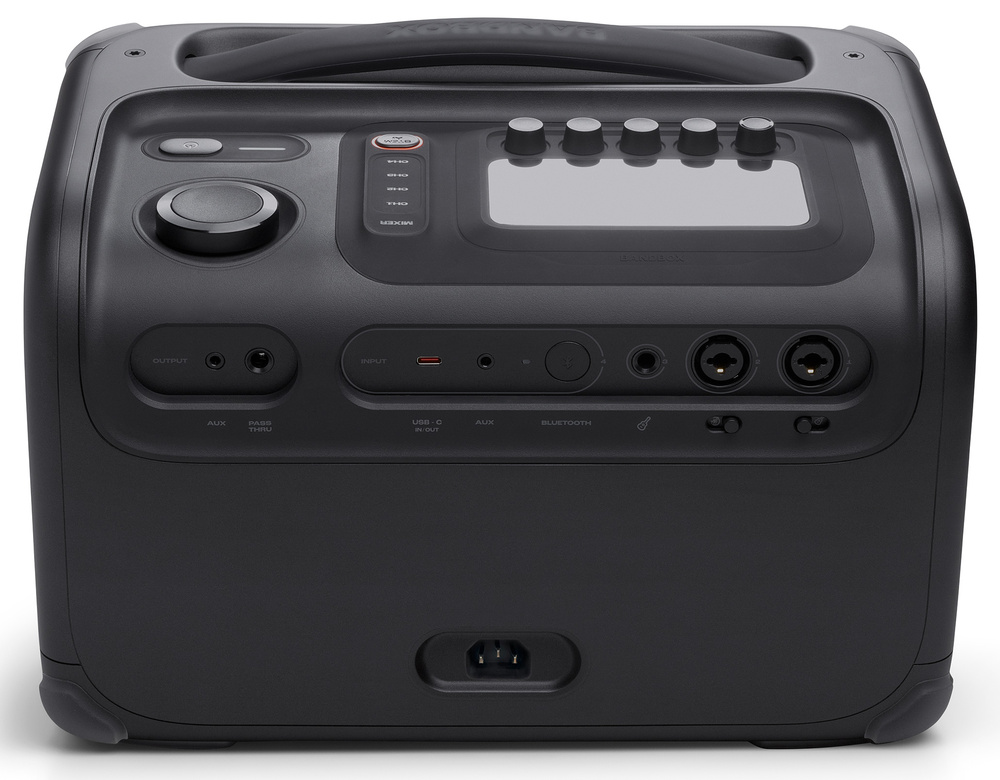 The BandBox Trio boasts a four‑channel mixer, with mic/line/instrument preamps on channels 1 and 2, a guitar‑optimised jack for channel 3, and a stereo input (analogue mini‑jack or Bluetooth) on channel 4. There’s also a pass‑through output, as well as a headphone jack.
Handling the inputs is a built‑in four‑channel digital mixer designed to accommodate microphones, instruments and line‑level sources without the need for external hardware. Channels 1 and 2 use combination XLR/jack inputs and can be switched between microphone and line or high‑impedance instrument operation, making them suitable for dynamic microphones, battery‑powered capacitor mics (there’s no phantom power available) or direct guitar and bass connections. Channel 3 is optimised for guitar, while channel 4 accommodates either a stereo analogue source on mini‑jack or a Bluetooth stream, with support for Bluetooth 5.x with standard audio profiles (A2DP and AVRCP), for stable wireless connection from phones, tablets and laptops. Multiple devices can be paired simultaneously, allowing for quick and easy switching. In terms of outputs, there’s a quarter‑inch ‘pass‑through’ jack for sending the mix on to another speaker, and a mini‑jack headphone output, which mutes the Trio’s built‑in speaker.
Each channel can be independently controlled within the DSP, with access to EQ and effects, and with amp modelling available on the instrument input and vocal processing available when needed. In practical terms, this allows a singer‑guitarist or acoustic duo to work comfortably from a single box. It is also possible to pair multiple Bluetooth devices for switching on the fly. Finally, in terms of features, there’s a tuner mode that mutes the output while tuning.
Trio Grande
Navigation and parameter adjustment are handled from a central large colour LCD screen and a large rotary encoder with an integral push‑switch. Beneath the screen sit five additional rotary encoders, used to adjust the parameters displayed on the screen, with the first also incorporating a push‑switch. Five buttons switch the default screen display between showing the whole mixer overview and focusing on the individual mixer channels, while a further large button powers up the speaker, which takes a few seconds. This layout allows control over all the essentials without the clutter of a traditional mixing console, and proves particularly effective in low‑light environments, where a screen‑based interface is often preferable to rows of mixer‑style knobs.
Connectivity includes Bluetooth 5, which, as well as supporting audio streaming, facilitaties connection to the control app (see below), while a USB‑C port allows the BandBox Trio to function as a four‑input USB audio interface when connected to a computer, tablet or compatible phone running DAW software, allowing the various sources to be recorded separately.
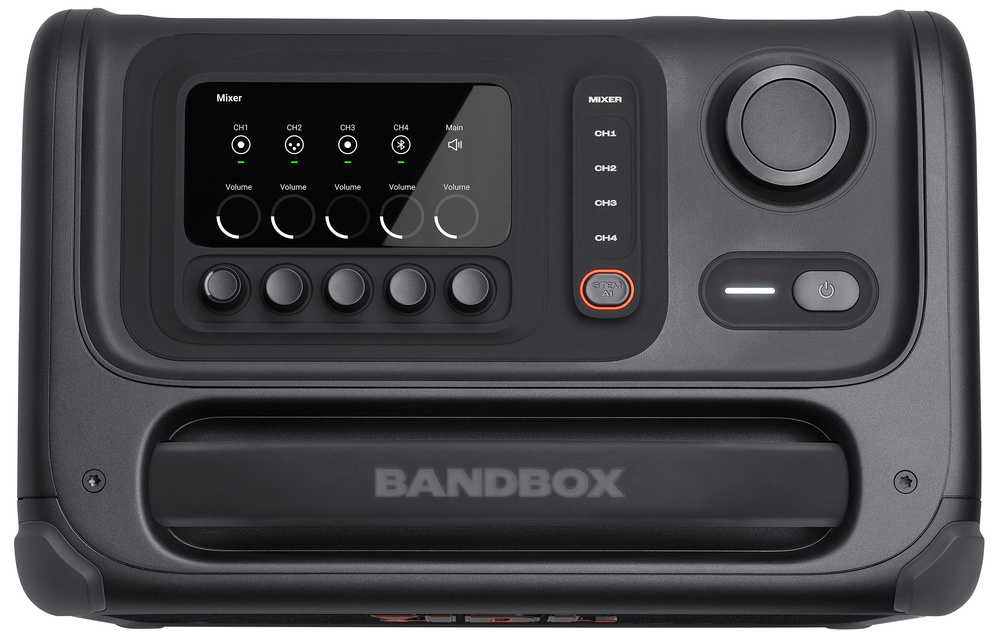 Most of the mixer’s functions can be accessed from the top panel, using the colour screen and rotary encoders.
For guitarists, JBL have included a selection of amp models covering familiar tonal territory, ranging from clean and articulate sounds through to more driven tones suited to rock and blues playing styles. These models can be combined with onboard effects and cover all the main types: drive, compression, auto‑filtering, phaser, delay, reverb and so on. The effects are actually rather good and are certainly more than adequate for practice, rehearsal and many live situations too. Of course, the BandBox Trio remains perfectly happy to accept an external pedalboard if required.
Vocalists are provided with straightforward delay and reverb effects that will meet the needs of most small‑scale live performances. Practice tools are also well catered for, with an onboard tuner, a metronome and a basic drum machine. This offers a choice of styles in 4/4 or 12/8 time signatures and adjustable tempo. A looper function is also built in, potentially removing the need for a separate looping pedal as long as you don’t need more than 60 seconds of loop length. Note that there is no footswitch jack, so loop recording has to be started and stopped by pressing physical controls — you might need the help of a second pair of hands if you need to play on the first beat of the loop. The documentation makes no mention of support for a Bluetooth footswitch.
Powers Of Separation
Even with this extensive feature set, the Trio has a couple more tricks up its digital sleeve: backing tracks can be shifted in key or fine‑tuned to suit the performer, and more impressively, the unit’s stem‑separation system — a feature more commonly associated with DAWs and online services — only delays the start of the music playback by around three seconds, which is seriously impressive. And unlike with many software stem separation systems, the processing takes place entirely within the unit itself, without the need for an Internet connection. As with other stem separation systems I’ve tried, this is extremely good at taking out vocals or guitar but occasionally confuses lower guitar notes with higher bass notes. In most cases this won’t be a problem but is something to be aware of. The levels of the three separated parts (Vocals, Guitar and Other) can be adjusted from the panel controls, though as is now common with digital audio devices, deeper control is available via the JBL One app.
It Starts With One
Available for phones and tablets (but not laptops), the JBL One app provides access to channel EQs, amp models and effect chains, as well as the various practice tools such as the metronome and drum machine. Guitar rig or vocal chain setups can be created and stored in the app, with the option to replace and rename the factory presets. It can also control the stem‑separation features.
When the AI stem technology is used, the Vocals, Guitar and Other stems each have faders in the app controlling their respective levels. In practice, this allows a guitarist to remove the guitar part from a commercial recording and play their own version, or a singer to mute the lead vocal and perform against what effectively becomes a karaoke backing track (I’ll leave you to navigate the licensing implications!). Until now, I’ve only ever encountered stem‑splitting tools in software form, so the inclusion of this feature in a standalone hardware unit where it can be used during performance feels genuinely significant. It will be especially welcomed by the many performers who routinely use backing tracks in their shows.
 The JBL One app lets you control a BandBox remotely from your phone via Bluetooth. Pictured are the mixer, guitar rig and stem separation pages.
In use, the app feels like a natural extension of the hardware rather than a requirement for basic use, and I found it very intuitive with no real need to resort to a manual. Increasing control values involves swiping down on the phone screen rather than up, but that doesn’t take much getting used to. Factory presets can be accessed from the BandBox control panel, so you don’t need to run the app all the time. The app only allows access to parameters for a channel that has an input, so if nothing is plugged into an input, its controls are dimmed and can’t be adjusted. Note that to stream audio from a phone and to also run the app on the same device, it seems to be necessary to pair the phone with the BandBox Trio in the usual way for sending music before you start using the app. If you get the sequence wrong, the app works but audio playback doesn’t. Another feature of the app is Party mode, where several BandBox devices can be linked to work together as a single system.
When setting up a guitar chain, the pedal, amp and speaker models appear as graphics, and each can be selected in the app for more detailed editing. The layout of the guitar chain is not dissimilar to the way many plug‑ins work, and here you’ll find separate slots for the amp model and speaker cabinet, with three slots for effects before the amp and three after it. The pedals are activated by swiping down on them or bypassed by swiping up. Select one and a larger version becomes visible so that you can access the individual controls. The six slots are occupied by a noise gate, a compressor and an auto‑wah before the amp with a phaser/chorus, echo and reverb after the amp. These all have simple pedal‑style controls with no more than four knobs each, and they sound very much like typical pedals. There’s a wide‑ranging drive pedal among the pedal emulations, and the 11 amp models run from country style clean via bluesy breakup to heavier rock and high‑gain metal tones. More variation can had by swapping out the default speaker cabinet for one of the 12 available models, which include 1x12s, 2x12s, 4x12s, 8x10s and 4x10s, with names and graphics providing a strong clue as to what they are based on.
Box Clever
Under battle conditions the BandBox Trio delivers on its promise, supplying more satisfying electric guitar tones than I’d anticipated and with plenty of volume. It also handles vocals very clearly, with plenty of level, and seemingly with less inclination to feedback than many powered speakers I’ve tried. Used at a pub jam night, it proved more than capable of carrying vocals and acoustic instruments with ease, while maintaining clarity and tonal depth at higher levels than you might imagine given the speaker’s modest size. Electric guitar also sounds satisfying through the internal modelling chain, which covers most stylistic choices (and, interestingly, I found it easier and faster to get a decent recorded guitar sound from the BandBox than from some of the big‑gun amp modelling packages). The twin‑tweeter design helps preserve intelligibility off‑axis, which is particularly useful in small rooms where audience placement is unpredictable. Noise levels are low (though there is a noise gate pedal in the guitar armoury which you might want to use with high‑gain sounds), and the DSP seems happy juggling all its various tasks without grumbling. When used as a USB audio interface, the sound quality of both the recorded sound and the headphone output leaves nothing to complain about.
Battery‑powered operation will be an obvious attraction for buskers seeking portable, high‑quality sound with the ability to mix voice and instruments, but the Trio is equally well suited to solo and duo pub gigs, rehearsal spaces, garden parties and home practice. Songwriters will appreciate its mixing, looping and recording‑friendly features, while its stem separation opens up creative possibilities for both practice and performance using existing recordings.
In summary then, the BandBox Trio feels equally at home as a rehearsal companion, a portable performance rig or even as a compact creative workstation. Versatility is its superpower: almost everything you need is built in, yet nothing prevents guitarists from using their own pedalboards or vocalists from integrating external processors if they wish. For larger gigs the BandBox Trio could get pressed into service as a personal monitor, and the only omissions I could find were that there’s no stand socket (presumably because the internal architecture doesn’t leave room for one), and no provision to use a footswitch to control the looper.
Viewed alongside competing products, the BandBox Trio occupies a distinctive but impressively wide niche. Portable battery‑powered PA systems from companies such as Bose, Yamaha and Mackie may offer comparable output power, but don’t include the practice tools, amp modelling and AI‑based stem separation found here. Few are this compact, either. Dedicated practice amplifiers from manufacturers like Boss, Fender or Positive Grid may provide deeper modelling where guitar tone is the priority, and some will also double up as audio interfaces, but then they can’t match the BandBox Trio’s ability to mix microphones, instruments and an audio feed while using stem splitting to turn full recordings into backing tracks.
Rather than attempting to replace any single category of equipment, JBL have created a hybrid solution that spans multiple roles, and they have done so very effectively without sacrificing quality along the way.
Rather than attempting to replace any single category of equipment, JBL have created a hybrid solution that spans multiple roles, and they have done so very effectively without sacrificing quality along the way. Given the flexibility and sound quality on offer, the cost seems more than reasonable.
BandBox Solo
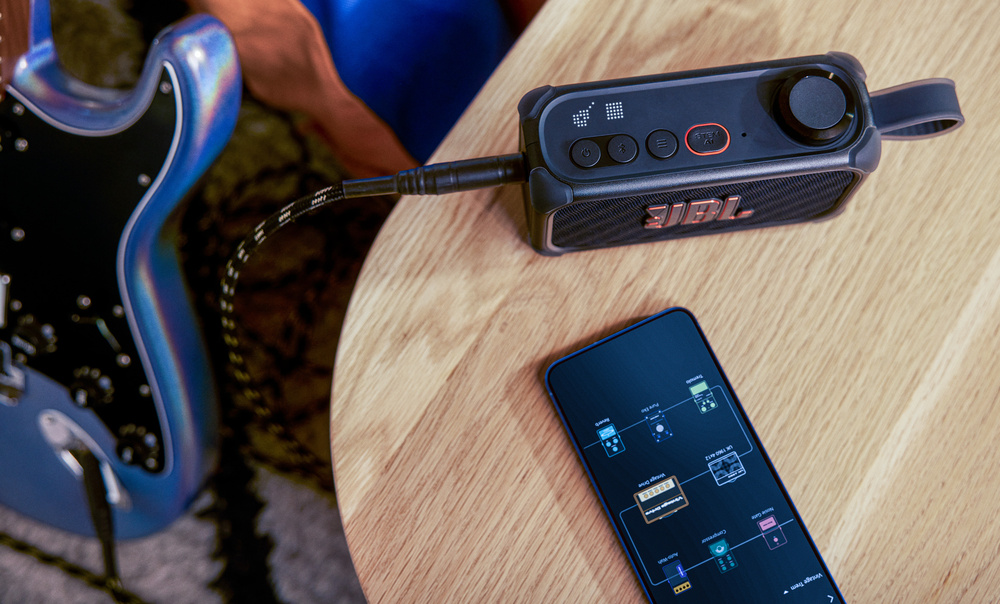
At approximately 150 x 80 x 50mm and weighing just 0.53kg, the JBL BandBox Solo looks at first glance like any consumer portable Bluetooth speaker. In reality, however, it incorporates almost all of the key features of the much larger BandBox Trio, including the same stem splitting and guitar modelling, and can go far louder than its size would suggest. It has only one physical input: a TRS jack that can accept a line‑level source, a guitar or a microphone (with the appropriate adaptor cable). Like its bigger sibling, it can also stream audio over Bluetooth and be controlled using the JBL One app. A mini‑jack output on the rear panel allows connection to headphones or a larger sound system if required.
Almost unbelievably, all the sound comes from a single 2.5‑inch, full‑range driver, but this compact amplifier is rated at up to 30W RMS, with a quoted frequency response of approximately 73Hz to 20kHz (‑10dB). The result is a sound with far more depth, volume and clarity than you might reasonably expect, while background noise is impressively low. It isn’t going to outpace a Vox AC30 on full throttle, but you will be surprised at what it can do. One practical tip is that you may gain even more level and low end by placing the Solo against a wall or in a corner, where the boundary effect will help bolster the sound.
A built‑in microphone lurks behind a small hole in the top panel, which can be used for practice and recording. The headphone output is optimised for low‑impedance (16‑32 Ω) models but will also work with higher‑impedance designs.
There’s no LCD screen this time around, but behind the seemingly blank top panel there hides a matrix of white LEDs that spell out text or outline icons as required. Control over master volume or preset selection is handled by the familiar press‑and‑turn rotary encoder, with a press of the Bluetooth button toggling between the two. Other than the large encoder there are just four buttons; the first two control power and Bluetooth pairing, while the third displays the currently active guitar preset name. Turning the encoder scrolls through presets or adjusts the master volume, and the fourth button activates stem splitting, exactly as on the Trio model.
Like the Trio, the Solo features both Bluetooth support and a USB‑C port, which again is used for charging and audio interfacing. When selected as an audio interface, the device likewise appears as a four‑input source with channel 1 carrying guitar/mic from the jack input and channel 2 carrying the internal mic signal. Headphones must be connected for monitoring when using the mic. Direct source monitoring is possible with either version of the BandBox, and any added effects are recorded. If not connected to a DAW the internal mic along with its effects can be used for vocal practice with backing tracks, and I must say that the mic gives unexpectedly good results.
Power comes from the internal battery, providing up to six hours of continuous use, with a recharge time of around 3.5 hours via its USB‑C port. Unlike the larger Trio, though, you can’t swap out to a second battery pack during a gig.
By now you can probably gather that I’m rather impressed by these two sound systems, and having tried and tweaked some of the guitar presets, I’ve decided to buy a BandBox Solo for use on holidays and for sofa noodling. It’s genuinely loud enough, and tonally convincing enough, to serve as a compact guitar amp for jam sessions, as I confirmed at the local pub jam night where it held its own against percussion, sax, bass and acoustic guitar. At one point I was even asked to turn it down! This may be the first serious guitar amp that you could lose down the back of the sofa, and like its big brother it is useful in many different situations.
Pros
- Compact and light.
- Very capable guitar amp/pedal and vocal effects modelling.
- Can function as an audio interface.
- Integral stem splitting that works on Bluetooth audio in real time.
- Easy‑to‑use app expands operational possibilities but is not essential for basic use.
- Clean, clear sound with plenty of volume.
- Long battery run time.
Cons
- Neither unit has a footswitch facility to control the looper.
- No pole mount for the BandBox Trio.
Summary
I hesitate to call the BandBox a Swiss Army knife as that is such a cliché, but if I did say it, I’d have to report that all the blades are well chosen and very sharp — and there are some unexpected extra tools in there too! Both these BandBox products outperform expectations, and the stem splitting is a real winner for those who use backing tracks.
Information
BandBox Trio £529, BandBox Solo £199. Prices include VAT.
Sound Technology +44 (0)20 8962 5042.
BandBox Trio $599.95, BandBox Solo $249.95.
When you purchase via links on our site, SOS may earn an affiliate commission. More info...

When you purchase via links on our site, SOS may earn an affiliate commission. More info...