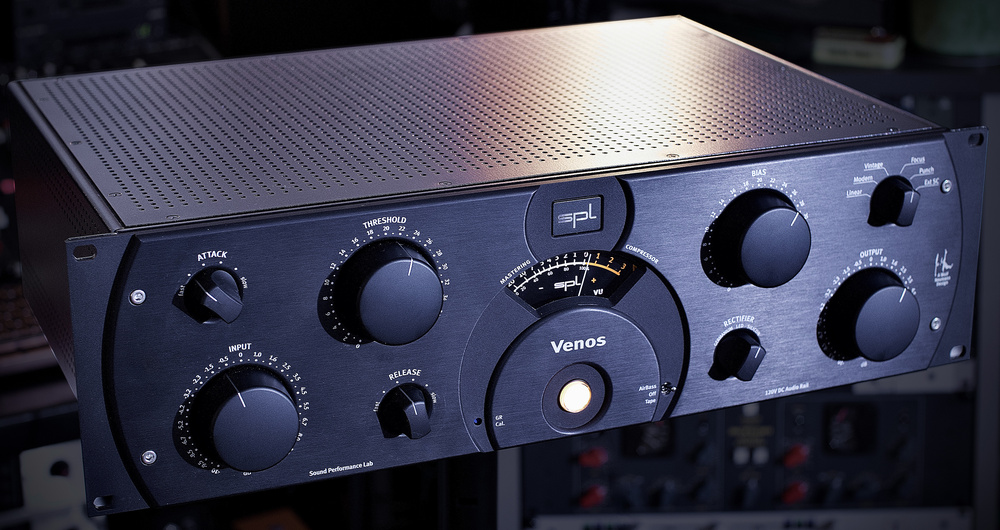
Variable‑mu compressors have remained popular for three‑quarters of a century, and with good reason. But could they be made better? SPL believes so...
Yes, I know... another day, another valve compressor! But believe me, if you’re thinking of stepping up your mixing game with the addition of a high‑end bus compressor, then the SPL Venos is well worth your attention. The Venos is a stereo device, and it utilises the variable‑mu principle for gain reduction, whereby the side‑chain control signal alters the bias voltage on the grid between a thermionic valve’s anode and cathode. It occupies three units of 19‑inch rackmount space and is available in your choice of red or black. The overall aesthetic is appealing, and puts me in mind of those chunky‑yet‑elegant steam locomotives of days gone by.
More Than Just A Vari‑mu
One of the Venos’ key features is that, like some of the other high‑end SPL designs, it operates on a high internal voltage of ±60 Volts (so 120V in total). This is far more than most other audio devices use, and it makes possible some astonishing technical figures. For example, the maximum input and output gain are both 32.5dBu. THD+N (+10dBu) is 0.002%, while (A‑weighted) noise is given as ‑98dBu. Unless you plan on building a firework, you cannot use off‑the‑shelf op‑amps in such a design, so SPL designer Wolfgang Neumann created the company’s own discrete SUPRA op‑amps, which you’ll find in their Iron, PQ, Crescendo and various other devices as well as here.
Four huge control knobs dominate the front panel, and they’re all stepped to ensure precision. Bias adjusts the valve’s grid voltage, Output gain is the final ‘fader’ before the signal leaves the device. Input sets the level prior to the transformer, immediately before the ECC82 triode, whereas Threshold sets the control‑voltage level in the side‑chain. This is where it gets really interesting: a mode selector allows the user to choose between different side‑chain (and, subsequently, compression) behaviours. The mode labelled Linear should be self‑explanatory, while Vintage and Modern apply side‑chain equalisation. The latter cuts off both low and very high frequencies, while Vintage cuts between 0.5 and 1 kHz, and applies a boost above that.
 The different modes are way more than a gimmick — they’re an integral part of the Venos concept, and are what make it so supremely versatile.The Focus and Punch options are different: their compression curve drops after a maximum level, leading to the tight, hard‑hitting sound of over‑compression, but it doesn’t stop there. Another switch selects Germanium, Silicon or LED rectifier diodes, a choice that influences not just the six attack and six release times but also their timing curves, and can enliven the sonic character. A final feature to highlight is that SPL have also implemented a little frequency correction option called AirBass, which is a smiley‑curve boost; and Tape, which engages the sort of high‑frequency roll‑off you’d experience when transferring signals to an open‑reel machine.
I mentioned above that the SPL Venos evokes the look of a steam locomotive, and the same can be said of the build quality. As we’ve come to expect of SPL, the massive front panel is accompanied by a very sturdy case, and all the controls offer a solid tactile response — neither too loose nor too stiff. This is due in no small part to SPL’s use of high‑quality components throughout, including parts from ALPS. Also worth nothing is that SPL say that, because some parts’ specs might change in the first operating days in a circuit, they don’t rely simply on selecting good parts and testing the final product once — each Venos (like many other SPL products) is subject to a thermal burn‑in stage, to ensure stable component behaviour. But of course, as much as that all inspires confidence, it’s what the Venos can do to your audio signals that really matters...
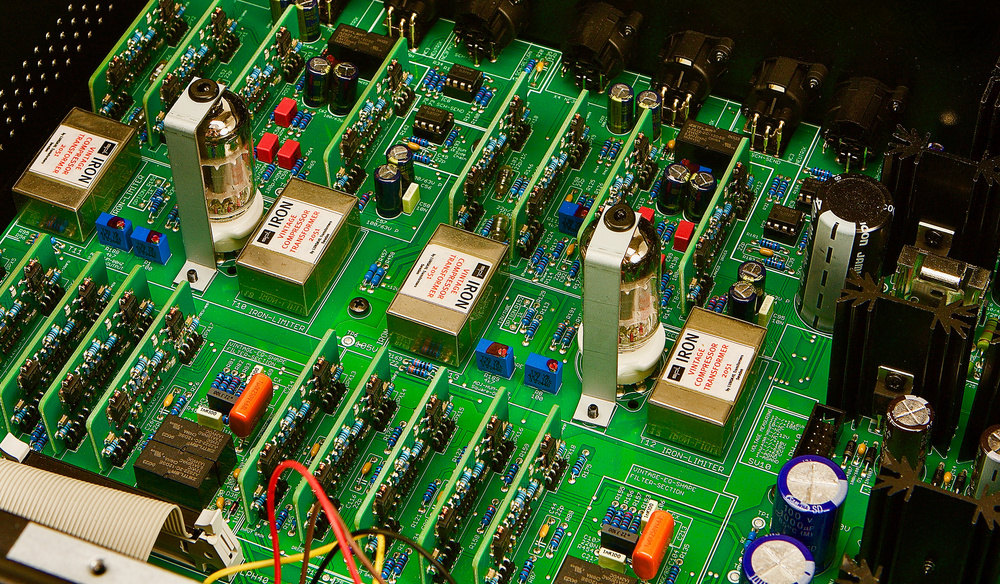 Valves, transformers and, on the vertical daughter boards, lots of SPL’s custom discrete 120V op‑amps.
In Operation
The Venos instantly vivifies any bus signal a little, even when the gain‑reduction meter needle remains unmoved. Its signal path seems to add a little ‘edge’ to the details, analogous to a little sharpening of an image in Photoshop. Thanks to this behaviour, all audio passed through the Venos sounds more ‘contoured’, or more ‘hi‑res’ if you like — but never seeming artificial. There’s good consistency between channels too: by swapping the left and right, I was never able to tell one channel from the other, except when deliberately pushing way too far with the Germanium rectifier to see what it took to hear a difference.
Starting in Linear mode, with the Silicon rectifier and very moderate gain reduction of one or two decibels, this compressor reveals how thoughtful and empathetic it is. Others may refer to it as ‘musical’, and you might wonder why I chose those adjectives. Well, I’m always banging the drum for vari‑mu compressors, because they seem almost to ‘understand’ the signal being fed through them, and to ‘sing along’ somehow, instead of working against it. The SPL Venos masters this task perfectly and, seeming even more cautious than most vari‑mus, it’s exactly what you need when you’re compressing the more complex signals that are usually routed to stereo busses.
Although the five modes do differ quite substantially, they also speak the same language: the grip the Venos has on your audio doesn’t loosen if you switch from Modern to Vintage, for example. Linear is the most transparent of those modes. Subgroups or mixes with a lot of energy in the lows and the highs, though, can lead to a shaky dynamic behaviour when compressed a lot, and in that case the Modern setting is very helpful. If you need to tame a drum bus, Modern’s side‑chain filtering reduces not only the impact that bass instruments and kick drums have on the compressor, but also gets rid of the problem whereby the sharp hi‑hats, claves or cowbells found in lots of electronic music trigger a little too much bus compression.
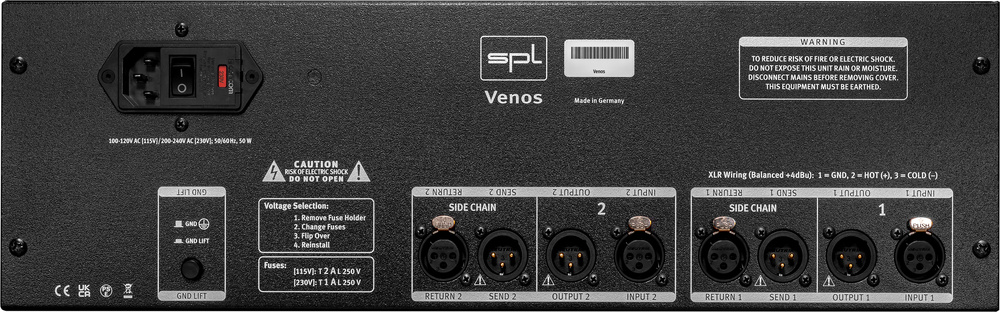 The Venos is a dedicated stereo processor, with side‑chain inputs for both channels.
I can imagine that many users will stick to using either Modern or Linear, and not the other modes at all, just as only a few people use figure‑of‑eight or omni patterns on their multi‑pattern capacitor mics. But, being the softest‑sounding mode, Vintage has its place. We know the side‑chain filter curve of course, but in practical terms this mode seems to react more to snare drums in drum busses and short consonants in vocal subgroups. It’s just a tendency — you wouldn’t use the Venos to ‘repair’ a mix, but rather as a refined tool to get out of it as much as you can. And it can be beautiful!
A slack snare, a kick drum lacking definition, or weak brass: all of these can seemingly be enhanced using Focus mode.
The compression behaviour of Focus mode reminds me of my Amtec Model 099 in feed‑forward mode, with its slope set closer to Lim than Comp. For example, if vocals risk getting lost in the mix, the Focus mode on the vocal bus can help to push them forward. A slack snare, a kick drum lacking definition, or weak brass: all of these can seemingly be enhanced using Focus mode, so I’d suggest that its name is well chosen. The same goes for Punch mode. A drum bus or even a full stereo mix can be given an extra boost of energy when needed, or could even be smashed. Despite being able to compress quite heavily, though, even in Punch mode the Venos responds organically to the signal, without it ever feeling like there’s any artificial resistance. This is what differentiates it from, say, an over‑compressing dbx compressor.
Many users will appreciate the subtle corrective options provided by AirBass and Tape. Attack and Release don’t leave you wishing for more steps. And there’s Bias: this ranges from a rather clean, cold sound, to one that’s enriched but can become somehow ‘tattered’ when fully blown. When wanting to bring this into play, I always ended up balancing the signal right around the breakup point, in a sweet spot where things start to get slightly gritty.
The LED rectifier is a bit more forgiving, while the Silicon option sounds a bit tighter. But Germanium is something special. It’s not intended to enrich the signal too much, and in fact makes it a tad ‘woolly’: a little fuzzy, less transparent, and less sharp. That might sound a strange quality to praise, but it’s a useful alternative to LED and Silicon and can be exactly what’s needed for some signals. If you plan on pushing this effect very far, do pay good attention to the L‑R symmetry, though: the diodes are matched as far as is possible, but if Germanium diodes receive input signals above their specified and designated range, they’ll always distort differently from each other.
I’ve discussed the characteristics of the different stages and options individually, but they can also complement each other, and while working with the Venos I noticed that I developed a habit of pairing up certain modes and rectifiers. Punch and Focus were often good friends with the Silicon rectifier, for example, while Vintage, as you might expect, got along very well with Germanium.
Verdict
I’ve owned or used many nice bus compressors, and I don’t feel that I’m exaggerating by saying the SPL Venos is one of the best available. You always hear the music and, unless you dial in something really strange, you never hear it working as an effect. You’re never in doubt that you’re compressing with a vari‑mu, because it’s always so sympathetic to the source. But it doesn’t impose a unique sound stamp on a drum bus in the way that, say, an API 2500 might. Nor does it only perform that one ‘glue’ stunt like a certain English bus compressor. Yet, the Venos is more versatile than most vari‑mus, with controls that offer access to a wide sound palette while remaining really easy to set up.
The Venos, then, is the perfect bus compressor for drums, vocals, guitar stems, and, of course, your main stereo bus. I also see plenty of potential for the Venos as a mastering compressor, even if the stereo controls mean you cannot use it for two different individual signals, as you’d need for Mid‑Sides compression. The price might make you pause before having one delivered next Monday, but if you decide to take the plunge I reckon this skillfully designed and impeccably built variable‑mu compressor will probably never leave your rack.
Pros
- Wonderful performance.
- A range of tonal and compression character options.
- Excellent build quality.
Cons
- This sort of quality doesn’t come cheap!
Summary
SPL have refined and expanded upon the classic variable‑mu approach to compression in this great‑sounding new bus compressor, which offers a range of tonal and compression options.
Information
£4399 including VAT.
Sound Service UK +44 (0)3301 222 500.
When you purchase via links on our site, SOS may earn an affiliate commission. More info...