

I’ve evaluated a number of Becos’ CompIQ range of analogue soft‑knee VCA compressor pedals now. They’ve all been well conceived and beautifully constructed, and, most importantly, have without exception sounded excellent: crystal clear, with great definition and very low noise. Inside they use high‑quality ‘name’ components throughout. They do what you intend them to do to your signal and nothing else.
There are various configurations with different features, control sets and form factors, and the company’s latest offering, the CompIQ Yuna, comes in the same size black‑powdered Hammond box as the original CompIQ Stella, but I think aims at a different user — one who does appreciate the sonic quality and wants more control than on a typical guitar compressor, but is perhaps looking for something easier to set up. Intended primarily for use on electric guitar and bass, the Yuna can also easily accommodate the output from keyboards and synths.
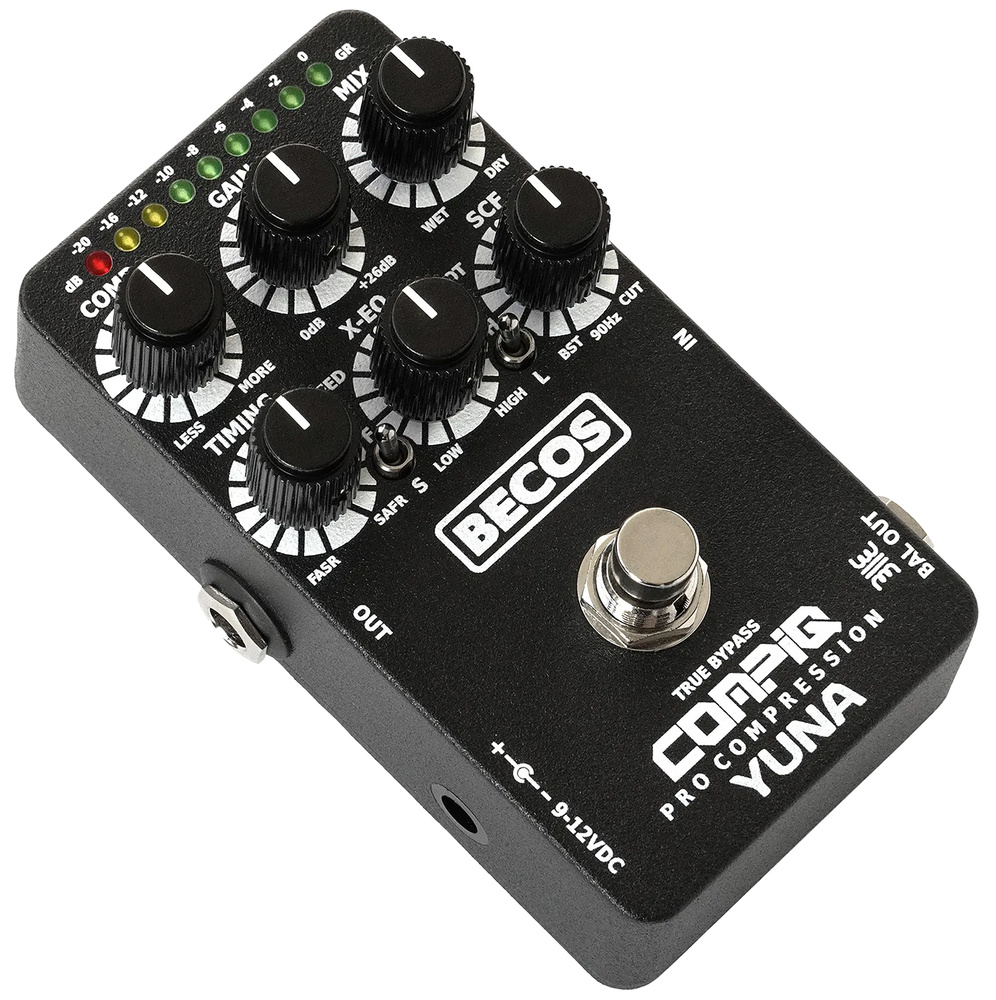
It accepts standard centre‑negative 9‑12 V DC power (no PSU is supplied) through a 12mm barrel connector on the left side of the pedal; an unusual placement, but not a problematic one. You could use a 9V battery if you prefer, though there’s no easy access to the compartment — opening the box requires the removal of four screws. The main unbalanced TS jack input is on the right, and the output to your pedals or amp is on the left. Optionally, there’s a slightly more expensive version with a second, transformer‑balanced TRS jack output on the right — this is the version I was sent for review, and this output has both sonic and practical applications, of which more below. With this fitted, there’s no battery option, as it occupies the same internal space.
Control Knobs
Top left of the control panel is a Comp knob. This controls a combination of ratio and threshold — rather like on the dbx 163 that initially inspired this range — and with a nine‑LED gain‑reduction meter (0 to ‑20 dB) running across the top of the panel it’s easy to see (not just hear) what’s going. On the same row are separate knobs for manual make‑up gain, with a chunky 0‑26 dB range, and the wet/dry mix.
On the next row are three more knobs. The first, Timing, acts on both the attack and release, with the fastest anticlockwise position labelled as FASR (faster) and the opposite end SAFR (safer). It’s interesting terminology, which could help the pedal feel more intuitive to those not used to studio compression. Essentially, FASR offers a fast attack and slow release, while turning towards SAFR gives you a slower attack and faster release. A metal toggle switch marked Speed then changes the range of timings available, so there’s always a good, usable range on the pot, making it easy to dial in. Next up comes X‑EQ, an analogue one‑knob tilt EQ, with an adjacent toggle to select one of two pivot frequencies (300Hz, which is generally better for bass, and a more guitar‑oriented 1kHz).
Finally, in terms of the top‑panel controls, as well as the on/hard‑bypass footswitch, there’s a side‑chain filter and, unusually (though Becos have used this circuit before) it isn’t simply a high‑pass. The neutral position is at 12 o’clock and turning anticlockwise effects a bass boost, while turning the other way introduces a bass cut. It’s a really neat feature because this single knob can be used effectively to focus the compressor’s sensitivity on or away from the low end.
Yet, there’s further scope for tweaking on the inside. First, a jumper switch can change the compressor from feedback to feed‑forward operation. Essentially, in feed‑forward mode it can react faster to transients, whereas feedback is arguably easier to control and generally sounds smoother. Second, there’s a Voicing DIP switch, with four ‘colour’ options: Spark (intended to emulate FET compression behaviour while keeping noise and distortion low), Tight, Punch and Flat. Lastly, there’s a jumper to set the RMS level detector reference levels (‑10dBu, the default ‑20dBu, or ‑30dBu), which is a thoughtful touch.
Becos suggest starting with all knobs in their 12 o’clock position. You might need to adjust the Comp setting to suit your guitar’s output level, but in general it’s good advice — plugging in a Strat‑style guitar, straight away it seemed to give me effortless, natural‑sounding control, even if I deliberately started to play... let’s say ‘too dynamically’! In that configuration, of course, you’re using parallel compression, so whatever the compressor is doing, the presence of the dry signal ensures there’s always some definition to your note onsets. Dial the Mix knob back, and you can hear precisely what the compressor is doing.
I love tilt EQs: they’re so simple and immediate when you just want to brighten or darken a sound without collateral damage or upping the volume too much. Inevitably, the compression can change the overall tonality of your signal, and this EQ is really handy for countering that. That’s largely why it’s here. But even when not compressing you can use this EQ to adjust your tone. It’s quicker and better sounding than a typical graphic EQ, and way faster than setting up than a parametric one.
The different Voicing options will no doubt appeal to some who want to tailor the pedal to their own playing style and a specific instrument, and particularly I suspect to bassists. And the tilt EQ can be used in conjunction with them to give you a surprising amount of tonal versatility. But honestly? I play guitar primarily, and really didn’t feel the need to change from the factory setting. It’s fine to have this option on the inside too, as for most players it’s a set‑once‑and‑forget thing.
But a ‘voicing’ option that I did really enjoy was the transformer balanced output. There’s enough make‑up gain on tap that I could use this output to hook the Yuna straight into the balanced line‑level gear on my studio patchbay, and use a fairly long cable — noise‑free and with no discernible loss of high end. To my ears, there’s a little more body to the lows with this option, and a slightly sweeter high end than with the regular output. It served well as a front end for amp modellers in my DAW, and removed the need for a DI box.
Becos have delivered another cracking compressor pedal, and they have got the balance of sound, control and immediacy spot on.
Bottom Line?
So... what’s not to like? I can think of nothing, other than that some synthesists might have liked a stereo version. There might be an argument for a buffered bypass option I suppose. But, the bottom line is that Becos have delivered another cracking compressor pedal, and they have got the balance of sound, control and immediacy spot on. And if you feel anything is lacking, it’s probably available on one of their other CompIQ models! There’s also a manufacturer’s worldwide three‑year warranty as standard, which speaks volumes. Recommended.
Information
Standard model €259 (about $300). With transformer output €319.