

You are here

Black Corporation ISE-NIN Voice

Eurorack Module By William Stokes
Published February 2026

Black Corporation ISE-NIN Voice

“If you’re spending half your life hunting for obscure reasons to decry modern recreations of vintage synths, you’re not spending enough time making music.” Those were the words of Gordon Reid in his SOS review of Black Corporation’s ISE‑NIN synth last year, and to that I say: quite right.

Gordon was of course writing up Black Corporation’s eight‑voice recreation of the Roland Jupiter‑8; a polyphonic analogue powerhouse promising nostalgia and exploration in equal measure. Or, perhaps, more of a 70/30 balance. That standalone synth offered a clutch of mod‑cons but suffice to say its faithful recreation of the Jupe’s analogue architecture was its raison d’être, and this it did extremely well, as stringently demonstrated by Gordon alongside the real thing. Now comes the ISE‑NIN Voice; a single‑voice version of the ISE‑NIN with every single slider and switch found on its older sibling, presenting a complete Jupiter‑style semi‑modular synth voice in Eurorack form that happily makes up for the deficit in that aforementioned 70/30 balance. Rejoice!

I should point out at this stage that the ISE‑NIN Voice is a truly excellent recreation of the Jupiter’s architecture and sound. But have I long dreamed of being able to install a Roland Jupiter voice into my Eurorack system? Honestly, no. Am I glad it’s now there? Resoundingly, yes. Indeed, faithfulness to a predecessor for its own sake is — or, at least, should be — just one of many criteria one looks for when it comes to any synth of this type, and if I’m honest for me it often amounts to little more than a footnote unless I’m disappointedly buying it because I genuinely can’t access or afford the real thing. To quote Gordon one last time, “If you were to record the same track four times with contributions from a Jupiter‑8 or Arturia’s Jup‑8 V4 or the appropriate model in a Jupiter‑X or an ISE‑NIN, I doubt that your audience would be able to tell the difference. And even if they could, would it matter?” Again, well said.

Immaculately Built

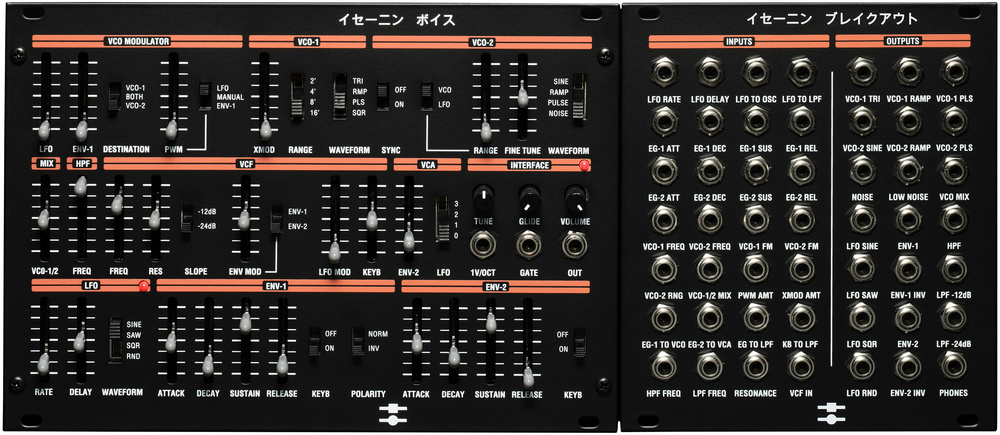
I should say that before even switching it on, this module is just a lovely thing to behold. Immaculately built and finished, its diminutive sliders are solidly mounted and firm to the touch, its panel is impeccably designed with sections demarcated by trademark Jupiter‑esque orange bars on matte black, and it also has a back panel to protect the PCB, which is always welcome.

I won’t waste column space listing functions, which have both already been outlined by Gordon in his ISE‑NIN review and well documented as components of the actual Jupiter‑8, but it’s worth taking a minute to remind ourselves of the fundamentals. The ISE‑NIN Voice constitutes two oscillators with selectable waveforms (triangle, ramp, pulse and square on VCO 1, and the same but with sine and noise in place of triangle and square on VCO 2). The low‑pass filter is selectable between 12 and 24 dB/octave slopes and can be modulated by either of the onboard envelopes or by the single onboard dedicated LFO (VCO 2 can dive to sub‑audio frequencies if desired). There’s also a high‑pass filter. The LFO is pleasantly manipulable, with selectable waveforms (including random) and a Delay control for dialling in some latent movement across a held note. Finally, there’s an input for pitch and gate and a single output, beneath knobs for tuning, glide and volume.

In terms of a standalone synth voice, it’s excellent. Its sliders are a pleasure to use, it’s nicely laid out and I honestly can’t really fault its sound. Rock‑solid oscillators, a beautifully responsive, smooth pair of filters, the list goes on. With no jacks for patching to speak of, in this respect it’s not so much a Eurorack module as it is a standalone synth that happens to be Eurorack mountable. As far as complete analogue voices go, you won’t easily find one as powerful as this in so small a form factor. But as you might have seen coming, with the ISE‑NIN Breakout in the picture, the ISE‑NIN Voice doesn’t just offer patchability, it offers maximum patchability. Which is to say, voltage control over literally every single control on the panel and outputs for, well, pretty much anything that outputs voltage or audio. Crikey. It’s a no‑compromise approach, albeit one that will test your wallet as a £379 $299 investment on top of the £1022 $999 price of the main module. But it’s one I happen to like; almost a transverse workflow between two sides of a brain: fairly traditional and linear on the one side and then almost completely open‑ended on the other.

It’s also highly gratifying blending these two poles. I was not only able to straightforwardly patch an external modulation source into the filter cutoff, I could also compound its signal with that of the internal LFO, and multing the external CV to also modulate the cross‑modulation input made for even more dynamic movement. I was also able to do some internal patching to reroute certain aspects of the architecture if I wanted to, for instance sending either envelope any which way, truly stretching the bounds of what an apparent Jupiter clone can really do. Aside from the usual suspects the expander also offers jacks for more complex things, like inputs for the individual stages of both envelopes, outputs for two pitches of noise, and even a headphone output.

Amid an increasingly digital Eurorack industry, the ISE‑NIN Voice is a welcome dose of iconic analogue goodness.

My favourite fact about Black Corporation is that the director JJ Abrams is a big fan of the company; so much so that he decided to name one of the planets in Star Wars: The Rise Of Skywalker after their Kijimi synth. Apparently the name ISE‑NIN could mean many things in Japanese, or not a lot (it’s “just from us being weirdos” according to BC’s Bob Rogue), but to my mind it is synonymous with utterly premium quality, both in build and in sound. Amid an increasingly digital Eurorack industry, the ISE‑NIN Voice is a welcome dose of iconic analogue goodness, whose price might make you think twice (particularly alongside the likes of the Rides In The Storm SED‑CSM), but whose sound and functionality will serve your system for years to come.

Information

ISE‑NIN Voice £1022, Breakout £379.

www.black-corporation.com

ISE‑NIN Voice $999, Breakout $299.

www.black-corporation.com