

How many times have I used the phrase ‘more than the sum of its parts’ when talking about modular synthesis? A lot, I’d imagine. But how else can one express one of the primary things that, really, keeps us coming back to the nebulous art of modular? We take what might be the simplest of building blocks and, with some creative routing and lateral thinking, turn it into something that, quite often, nobody has ever heard before. As a critic, considering such things in a design context means that quite often I’m persuaded toward modules that encapsulate that duality of simplicity and potential.
The SW3 Splice from Sweden’s DPW Design is a module that seeks to deliver both: with a compact panel of 6HP, the all‑analogue SW3 expects two disparate signals and offers various ways of splicing them together. These might be audio or sub‑audio frequencies, static or moving; it’s the kind of thing whose efficacy really has no limit, since it simply depends on what you decide to feed it. In a nutshell, the SW3’s USP is that it can take two signals and switch between them ultra‑quickly when their signals converge, making for some pretty seamless splicing and modulation, combining signals in a rather unique way.
The first thing to applaud here is that be it processing LFOs, VCOs or samples, the SW3 is essentially click‑less (though more trad hard switching is also on offer). And being fully analogue there’s no latency or phase delay. It can also work equally well with line‑level signals. A trifecta of benefits if, like me, you find these sorts of things to often plague splicing audio to the degree that it dissuades you from experimenting with certain sounds. But I will say now that the option to switch in some clicking actually made for some interesting results at times.
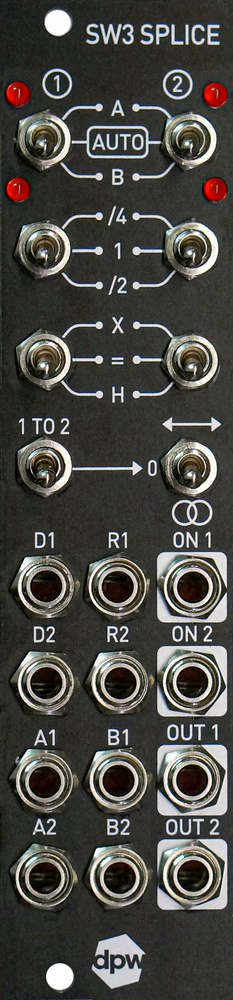
The module offers two channels of switching; totalling four inputs and two outputs, which can be discrete outputs or configured to stereo (it’s also, usefully, possible to create mono‑to‑stereo patches). Each of these has three switches. The first selects which input, A or B, to send to the output, with a centre position for Auto, which will automatically toggle between the two when their values are equal. The accompanying LEDs here are very responsive and useful visual indicators, and give a good indication of what’s going on under the hood.
Next is a Division switch with options for 1, /2 or /4 intervals. At 1, every time the two values are equal a switch will take place; at /2 this occurs every second time they’re equal, and every fourth time for /4. In practice this mean that subharmonics are introduced to the composite signal, which I found at times made for some very pleasing injection of harmonic energy. This also applies with just one input signal (ie. when the other input is at zero), so if nothing else the SW3 makes for a very quick way of adding harmonic excitement to pretty much anything, even a perfectly clean sine wave. Some types of audio responded much better than others; at best I was able to achieve something gorgeously hovering between distortion, octave shifting and ring modulation.
Lastly is the X/=/H mode switch, which dictates the SW3’s switching behaviour: X for equal‑level click‑less switching, = for smoother switching (both when A and B are equal and when their signals are rising or falling at the same time), and H for traditional hard switching via the below‑mentioned D input. Each of these presents a different sonic take on the combination of whatever is present at the A and B inputs, once again adding a healthy dose of musical flexibility into the equation. Beyond this are two switches for stereo behaviour (ultra‑quick ‘swap’, dual mono or full stereo for, well, processing stereo).
If logic functions are your thing then there’s also a decent amount to get your teeth into here.
If logic functions are your thing then there’s also a decent amount to get your teeth into here, with an On output for each channel producing 5V whenever input A is selected. This also makes a brilliant sort of analogue‑does‑digital, bit‑crushed audio output, or even a kind of pitch‑following, octave‑dropped square wave. There’s also an R input for hard resetting the input and division toggles (useful when you’re sync’ing rhythmic signals), and a D input for directly controlling the switching logic from elsewhere. All of these can change the character of the output hugely, and in this way I found it very rewarding to simply patch a handful of gate signals into the SW3’s CV inputs and then flick switches until I found something I liked. Which, most of the time, I did.
Earlier you might have noticed the phrase ‘essentially’ click‑less; I say this only because at many points clicks of one sort or another were still perceivable, only far less disruptive than usual and often negligible. A small point, but it would be remiss not to make it. It’s also worth mentioning that the SW3 isn’t a magic‑bullet audio effect. It’s a fresh take on older‑school analogue patching, and like any analogue workflow it often requires trial and error when it comes to working out which input signals work best, along with careful tweaking and tuning once up and running.
Indeed, modules aren’t like other instruments, because they must always look beyond themselves, to an intimately woven ecosystem. Or, as DPW Design founder Dan Wahlbeck put it at last year’s Superbooth, “get more out of the things that you already have,” which is more or less DPW Design’s raison d’être from what I can tell. The Splice SW3 illustrates that ethos with elegance, bringing the aforementioned poles of simplicity and potential together in an impressively diminutive package with an affordable price tag to boot. I can’t think of a setup that won’t benefit from it.