

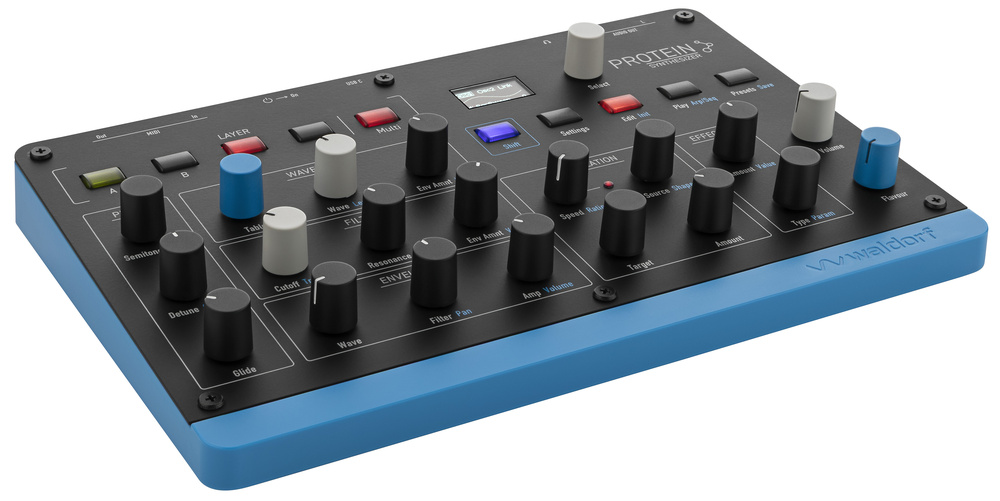
Waldorf’s tiny wavetable wonder packs classic DNA into a portable package.
Waldorf Music have been synonymous with wavetable synthesis since the late 1980s. The Microwave, released in 1989 and derived from the PPG Wave, launched a long series of wavetable‑based instruments. Over the decades, they’ve refined this formula across numerous products, from the Wave and Blofeld to the modern flagships, the Quantum and Iridium. The Protein takes the essence of Waldorf’s wavetable history and distils it into a small, affordable synthesizer that can still produce those classic crunchy digital sounds.
At just 252 x 170 x 48mm and weighing under a kilogram, the Protein sits roughly with the Waldorf Blofeld, Rocket and Streichfett in terms of size. It’s bus‑powered via USB‑C (battery power isn’t an option), and there’s no keyboard. The build is plastic but feels substantial, and the buttons and knobs feel sturdy.
The Protein Philosophy
The Protein is an eight‑voice desktop sound module with a Multi mode allowing up to four sounds to be layered and split. It is built around dual wavetable oscillators derived from the original Microwave ASIC chip, featuring the classic 64 factory wavetables, drawn from the PPG Wave and Microwave lineages. Each oscillator can load a different wavetable (something the original Microwave couldn’t do), and you can morph through 64 waveforms per table. The last three waveforms in each table are reserved for basic analogue shapes — triangle, square and sawtooth — a quirk inherited directly from the Microwave, but you can deactivate these to avoid any glitches when sweeping through tables. You cannot add your own wavtables. If that’s important to you, you’ll need to upgrade to the Waldorf M.
The synthesis architecture is straightforward and close to the original Microwave. Two wavetable oscillators, a noise source, a CEM‑modelled multi‑mode filter (everything is digital here), three ADSR envelopes (wave, filter and amp), two LFOs and an eight‑slot modulation matrix. Rounding things off are dual effect slots with chorus, flanger, phaser, tremolo, drive, EQ, compressor, delay and reverb.
Hands‑on Experience
The front‑panel design retains as much of a ‘big synth’ feel as you can reasonably expect from something of this size. There are plenty of knobs and buttons. The parameters that do have dedicated knobs are logically grouped, with more available via the Shift button. The display is small, but easy to read.
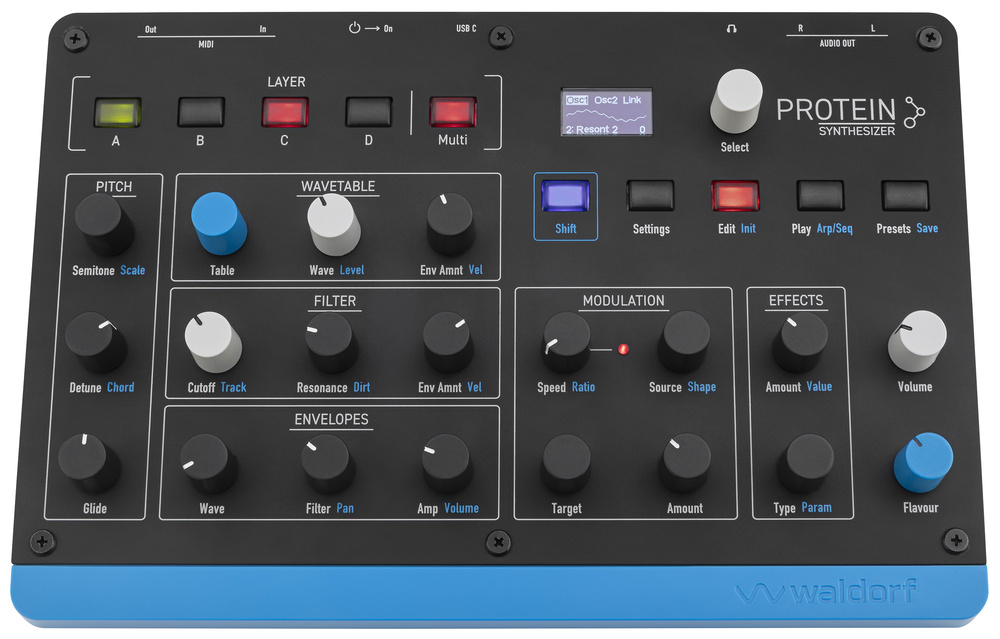 The Protein is a compact box, measuring just just 252 x 170 x 48mm and weighing 900g.
I want to say that the Protein avoids menu‑diving, but the workflow can be disjointed at times because you’ll be combining dedicated controls with Shift functions, and other parameters can only be accessed through the screen. Also, I wish manufacturers would stop using dark fonts on a dark background. The blue‑on‑black labelling of the Shift parameters is impossible to read in low light.
The screen is small, but nice and clear. When accessing parameters on screen, the data encoder can be clicked to select a value for editing. The 10 buttons are used for layer management and general navigation.
You are reading one of the locked Subscribers-only articles from our latest 5 issues.
You've read 30% of this article for FREE, so to continue reading...
- ✅ Log in - if you have a Digital Subscription you bought from SoundOnSound.com
- ⬇️ Buy & Download this Single Article in PDF format £0.83 GBP$1.49 USD
For less than the price of a coffee, buy now and immediately download to your computer, tablet or mobile. - ⬇️ ⬇️ ⬇️ Buy & Download the FULL ISSUE PDF
Our 'full SOS magazine' for smartphone/tablet/computer. More info... - 📲 Buy a DIGITAL subscription (or 📖 📲 Print + Digital sub)
Instantly unlock ALL Premium web articles! We often release online-only content.
Visit our ShopStore.