

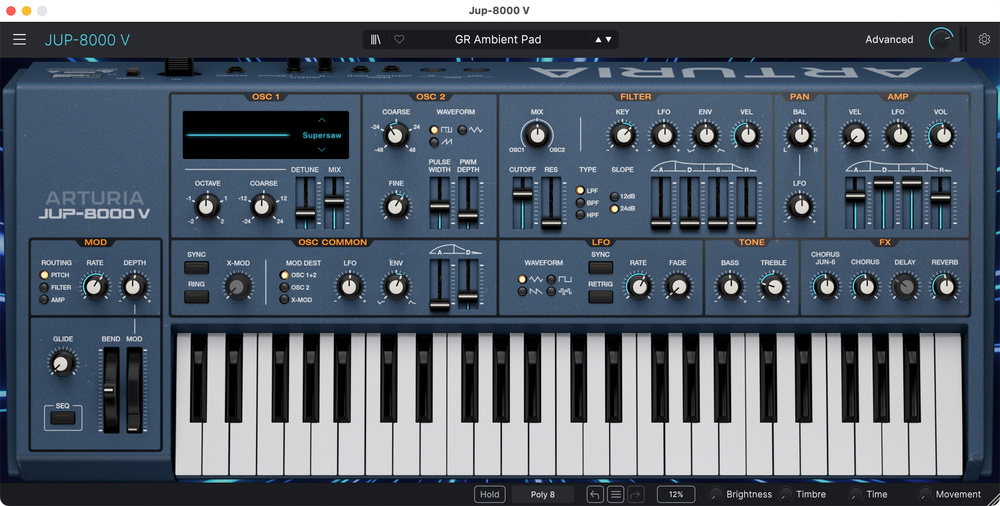
 The Roland JP‑8000 lives again in software form!
V Collection 11 is here, and yes, it’s bigger than before, better than before and better value than ever.
Yet another year, yet another V Collection and, as has become traditional with previous incarnations, the improvements in V Collection 11 comprise a combination of new instruments, some existing instruments that are new to the Collection, updates to instruments already in the Collection, and new sounds that may (or may not) be exactly what you need.
Jup‑8000V
The most eye‑catching of the new instruments is a recreation of the Roland JP‑8000, although I’m not sure why Arturia chose this in preference to other — possibly more useful — synths that they could have modelled. After all, the big selling points of the original were its SuperSaw waveform and its Feedback Oscillator, both of which could be the basis of interesting and, at the time, innovative patches. There are now many other ways to obtain these timbres, but somebody in Grenoble must still be a big fan and have managed to persuade everyone else of the JP’s desirability.
Arturia’s marketing materials for JUP‑8000 V lean heavily toward EDM sub‑genres such as Goa, trance, and something called progressive underground, which sounds to me like a tube train that leans slightly to the left. But despite the company’s concentration in these areas, it would be a mistake to think that the soft synth is constrained within these walls. While I wouldn’t normally choose to use an instrument that promises me a “mainstage breakdown” (whatever that may be) it took me just moments to create some lovely pads, leads and basses and, no doubt, greater time spent with it would have led to even more interesting sounds. Unfortunately, JUP‑8000 V exhibits a problem that was endemic to Arturia soft synths in years past: the dual oscillators in each voice have a non‑random and constant phase offset assigned when you play them. This means that you can program a sound and play chords that exhibit an extreme dee‑dee‑doo‑doo‑doo‑doo‑doo‑dah effect — sometimes even missing notes entirely because of cancellation — as you cycle through the voices. I don’t know whether the original synth ever did this, but I wish that JUP‑8000 V didn’t. That issue aside, it’s a powerful ‘virtual‑virtual‑analogue’ synthesizer, and adds yet another colour to Arturia’s already extensive palette.
Pure LoFi
For me, a more interesting addition is Pure LoFi, which offers a highly unusual slant on sound generation. Built largely upon sample‑based synthesis (but with extra spice in the form of a little analogue modelling and wavetable synthesis) it offers numerous ways to degrade the initial signal. These include the ability to replay the samples and oscillator waveforms through emulations of the signal paths of early digital samplers such as the Fairlight and Emulator, the addition of various noise types from a dedicated noise engine, and a ‘lofi’ mode that adds the types of imperfections and coloration imparted by tape replay and aging speakers.
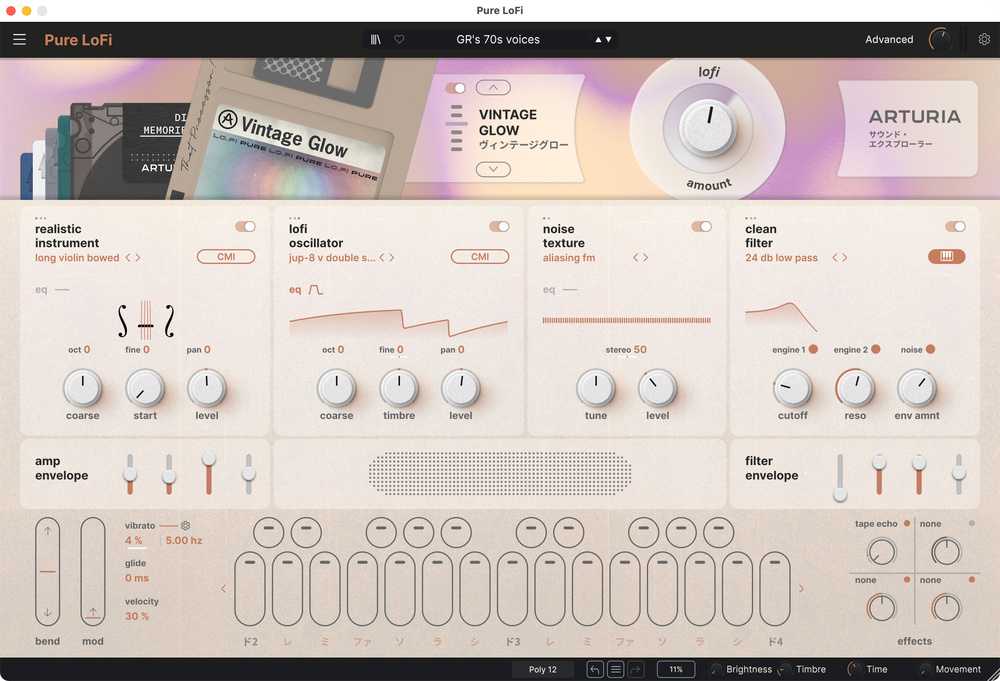 Pure LoFi is a reminder that V Collection is more than just vintage synth recreations.
Interestingly, applying the lofi parameters doesn’t make Pure LoFi sound low‑quality; if anything, they can add to its appeal. You can coax a huge range of interesting sounds from it, and I must admit that I was surprised by how much I liked some of these. I might even go so far as to say that it produced some sounds that I haven’t heard before, which is a huge accolade in a world where almost everything seems to be possible if you’re prepared to search for it. What’s more, you can import your own WAV and AIFF samples into both the instrument and noise engines, and there’s no practical limit to the length of these (only the amount of RAM in your host computer) so the possibilities are enormous. If I have a criticism it’s that, whether you’re programming solo instruments, pads, percussive sounds, chimes, special effects or whatever, the sounds exhibit a common underlying character. That’s not necessarily a bad thing — after all, the likes of Minimoogs, DX7s and Mellotrons can all be accused of the same — but it’s something to consider when choosing sounds for a given project. What’s more, I tripped over a couple of bugs while learning how to get the best from Pure LoFi, but I understand that Arturia are aware of these and are already working on fixes.
Wait, There’s More
In addition to the above, Arturia have chosen to make their latest version of SEM V a new instrument. Transitioning from V2 to V3, it now looks rather different and has a quite different feature set. I ran both versions simultaneously and ended up unsure which I preferred. In its Advanced mode, V3 offers all of the current Arturia goodies to enhance the underlying structure and sound, but the older one forced me to think about sounds within many of the constraints imposed by the original SEM and its polyphonic n‑Voice derivatives. Sometimes, less can be more. But whichever version you choose to use, they both have that Oberheim‑y character that we know and love.
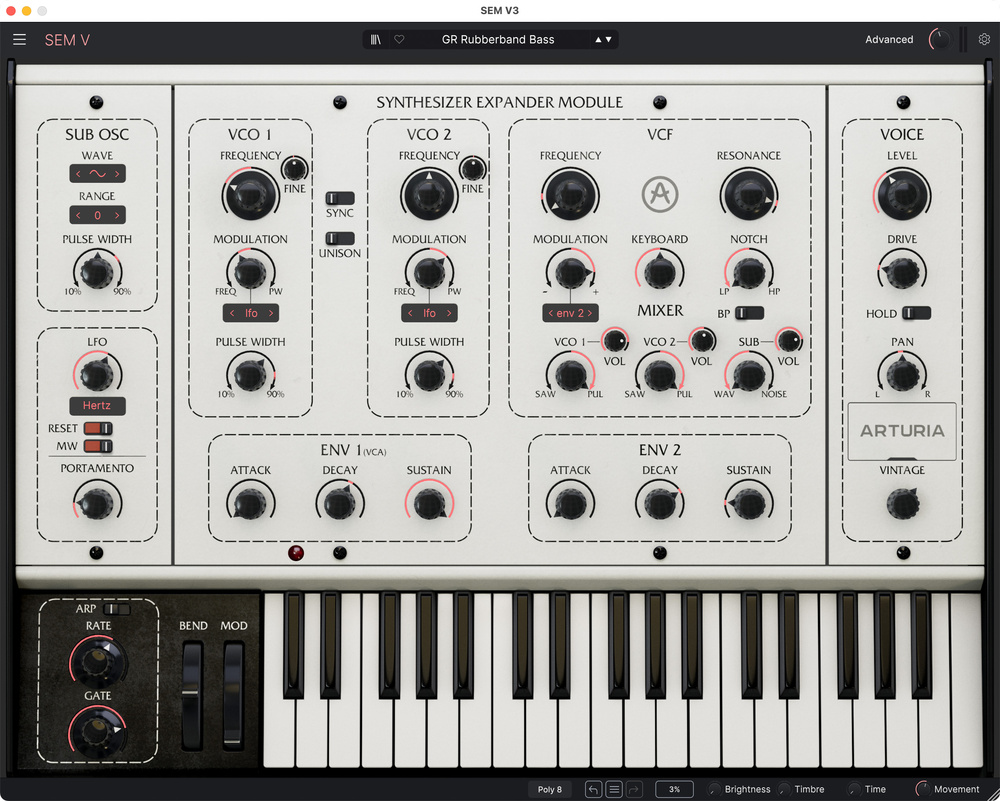 The updated SEM V.
Two further additions are not new synths but existing ones that have been incorporated into the Collection for the first time. The first is Synthx V, which I reviewed in the March 2025 edition of SOS. The second is MiniBrute V, which, by offering up to eight‑voice polyphony, provides some of the underlying sound of the PolyBrute, notwithstanding the lack of all of the sophisticated filtering and modulation capabilities of the hardware polysynth.
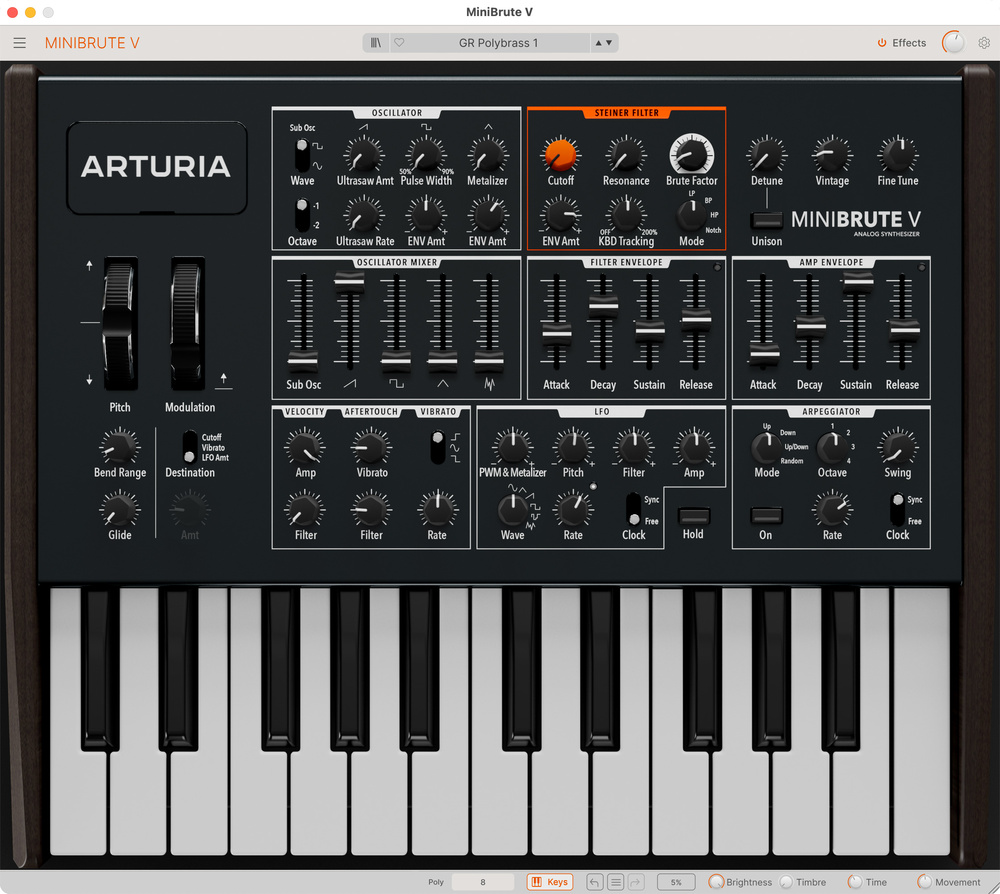 Arturia are now in the happy position of being able to plunder their own back catalogue for classic instruments.
The last changes are the inclusion of Augmented Mallets and Augmented Yangtze, and upgrades to all of the Augmented‑series synths: Brass, Grand Piano, Mallets, Strings, Woodwind, Voices, and Yangtze. These are treated as straightforward updates, so I had no opportunity to compare the latest versions against the earlier ones. However, a bit of digging revealed that the changes include improvements in morphing, modulation, arpeggiation, effects and user interfaces, while some also include expanded sample libraries. I fear that I may be in the minority when I say that I like some of the Augmented instruments a lot, and the new — dare I say ‘augmented’ — versions are even better than before. They may not look like conventional synths, but there’s a huge amount of potential in each of these, so they deserve much more than a casual glance.
To Buy Or Not To Buy?
So, V Collection 11 is complete and all‑encompassing, yes? No, of course not. There are still many keyboards and synthesizers that Arturia could be persuaded to include in version 12, or 13, or 14... and you only have to look across the pond to see that there is still significant room for expansion. In particular, Arturia were beaten to the market by a competitor’s recreation of the ARP Pro Soloist, as well as its intriguing Korg PS‑3300 and, most recently, its EDP Wasp. But there are many other instruments that none of the major softie companies have yet addressed. I would still love to see a Logan String Melody II V, a Korg PE‑2000 V and a Roland RS‑202 V, and I will continue to exhort Arturia’s engineers to turn their attention toward an RMI 368 Electrapiano V and a Hammond L100 V. Then there are rare instruments such as the Yamaha GS‑1 and the monster that is the GX‑1, neither of which have yet been properly addressed. If you disagree with my choices (and I’m sure that you will) you could no doubt name yet more that would enhance your music‑making. But please don’t take this to imply that V Collection 11 is limited or limiting. The number of possible sounds is almost beyond comprehension, as are the ways that you can combine and use them. Indeed, I suspect that you’ll spend your whole life trialling and tweaking sounds rather than creating music unless you limit yourself to using a manageable number of the available instruments on any given project.
Of course, you might wish to claim that a particular imitative instrument ‘sounds nothing like the real thing’, which is a moan that I’ve heard hundreds of times over the years, often from people who don’t own or use the original synths. And, while this may have been approximately true when soft synths were in their infancy, you now have to work much harder to find genuine reasons to criticise them. Sure, a given combination of controls may not produce the precise sound of a decades‑old bag of leaky components and maladjusted trimmers, but should that matter? If you like to spend your life trying to find faults, I suppose that it does. If you’re trying to create music, I don’t think that it should.
If there is a deficiency in the Collection, well... there are two. Firstly, I hope that Arturia’s engineers will revisit some of their older instruments to bring them up to modern standards. I was impressed when Jup‑V3 was replaced by Jup‑V4, and there are others that could benefit. Secondly, I remain surprised that Arturia haven’t replaced their long‑defunct Spark with a dedicated drum synth. Whether imitating vintage analogue drum machines or emulating acoustic kits and percussion, this would make the Collection a far more complete package for creating music. Allez, mes amis... it’s time that you took care of this.
You would have to be ridiculously spoilt to think that V Collection 11 is expensive. Even at its full price of €699, this equates to an average of under €15 per instrument.
Let’s finish by talking about money. The first thing to note is that, even if you choose not to upgrade to V Collection 11, the upgrades to individual instruments that you already own are free of charge. But if you want to update the whole Collection, the cost seems to depend upon how many versions you’ve missed and which instruments you’ve purchased separately. In other words, the pricing can be quite convoluted. But you would have to be ridiculously spoilt to think that V Collection 11 is expensive. Even at its full price of €699, this equates to an average of under €15 per instrument. A Fairlight CMI IIx for €15? A Synclavier for €15? A Jupiter 8 for €15? An EMS Synthi for €15? And you’re going to complain? Just... don’t.
V Collection 11 Intro
If you don’t need everything that V Collection 11 offers, you may find the Intro package more to your liking. Priced at €199$199 this contains 10 of the Collection’s instruments: Analog Lab, Pure LoFi, Augmented Piano and Augmented Strings, plus emulations of the Minimoog, Juno‑60, Prophet‑5, DX7, Rhodes 73, and Arturia’s own MiniFreak. It may not comprise the selection that you would choose to extract from the complete Collection, but should be more than enough to get you started. Let’s face it... if you had all of the original keyboards emulated here, plus a weird string ensemble and something equivalent to Analog Lab in your studio, I doubt that you would complain.
Pros
- The range of instruments and sounds available is truly staggering.
- The price per instrument is incredibly low.
- There’s an Intro version that’s available for a much lower price if you don’t want to plunge immediately into the full‑fat Collection.
Cons
- There are a small handful of bugs.
- The upgrade pricing can be a bit convoluted.
Summary
If you work ‘in the box’ and can’t realise your keyboard music using V Collection 11, you should seriously consider taking up embroidery or painting watercolours.
Information
€699 including VAT. Upgrade pricing available.
$699. Upgrade pricing available.