

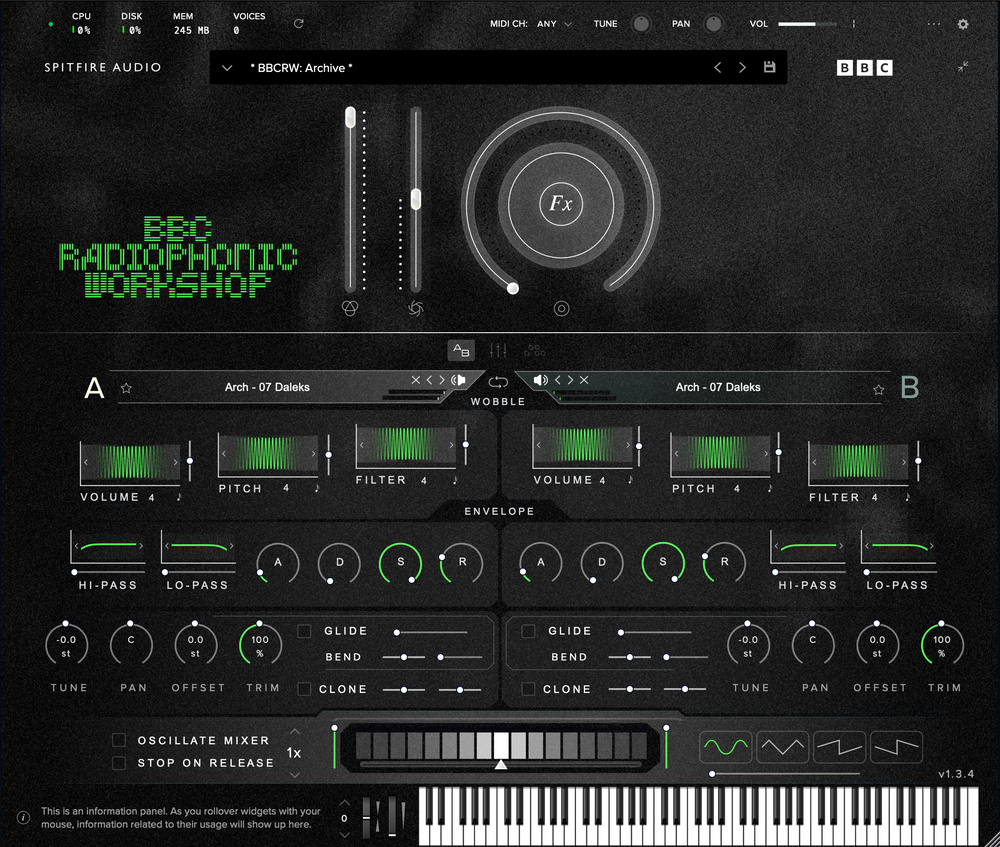
 Spitfire Audio’s BBC Radiophonic Workshop library is housed in the Solar plug‑in, also used for Jupiter by Trevor Horn and the Mercury instrument collection.
Spitfire travel through time to uncover the secrets of the BBC’s mysterious ‘special sounds’ department.
Since 2014 Spitfire have done their fair share of collaborations, joining forces with eminent film composers, producers, performers, orchestras and recording studios (including Abbey Road, AIR and BBC Maida Vale) to create their sound libraries. The latest Maida Vale tie‑in is one of the most intriguing: a deep dive into the BBC’s legendary Radiophonic Workshop, guided and overseen by Workshop archivist Mark Ayres.
Spitfire’s Paul Thomson explains how the plan took shape: “Having finished the BBC Symphony Orchestra project (reviewed in SOS November 2019) we started discussing ‘what can we do next?’ and the idea of something centred around the Radiophonic Workshop was bounced back and forth between us and BBC Studios. Having grown up listening to Doctor Who and The Hitchhiker’s Guide To The Galaxy as a child, this was incredibly exciting to me! Over the course of a few meetings we came up with the idea of archive plus new recordings; we brought in Mark Ayres early on to help us spec out what might be possible and desirable, and then went into the planning of the new sessions while exploring the archive.”
This 27.8GB library is housed in Spitfire’s Solar plug‑in, also used for Jupiter by Trevor Horn and the Mercury instrument collection. Owners of those libraries will need to install BBC Radiophonic Workshop in the same location as their Mercury and/or Jupiter folder. No other sampling platform is provided, but as long as your DAW supports one of the AU, VST2, VST3 and AAX plug‑in formats, you’re good to go.
BBCRW’s presets utilise Spitfire’s eDNA engine, which offers facilities for mixing, layering, crossfading and oscillating between its twin sound bays (though if you prefer to hear a single preset, you can always mute its companion). Each bay has its own complement of built‑in effects, so you can experiment with your own sonic treatments, but given the extraordinary imagination of the original sound designers, that’s hardly necessary!
Archive Content
The collection’s core archive sounds were collated by Mark Ayres, a self‑professed massive fan of the Radiophonic Workshop who was called in to write incidental music for Doctor Who in 1988. Eight years later, Ayres rescued the Workshop archive from oblivion, stepping in to catalogue thousands of tapes that were otherwise destined for landfill — an enormous (and largely unpaid) labour of love. The tapes were finally transferred to the main BBC archive on April 1st 1998, 40 years to the day after the Radiophonic Workshop was founded.
Many of these archive effects have a Doctor Who connection: ‘Time Winds’ is a brilliant electronic realisation of (ahem) ‘a form of temporal radiation which causes anomalies and glitches in space‑time’; the eerie atonality of ‘Time Lord Count’ nails the early Workshop sound, while ‘07 Daleks’ defies expectations by evoking the mournful sighing of soft alien winds. I was pleased to get my hands on the Doctor’s ‘sonic screwdriver’, and look forward to using its superpowers to repel any daleks looking to barge into my music room.
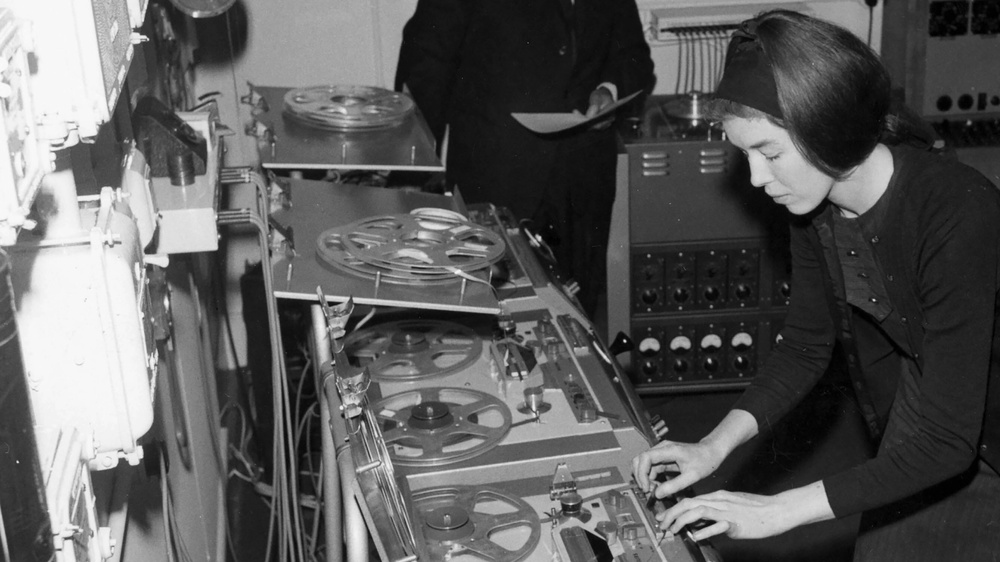 Delia Derbyshire edits a tape in Room 12, BBC Maida Vale Studios (1965).
Inevitably for a collection spanning decades, some presets sound decidedly outmoded — the ‘Dalek Truth Machine’ preset in particular sounds like someone got a synthesizer for Christmas circa 1971. That said, I enjoyed the vintage Space Age vibe of ‘Dominator Saucer Int’, which brings to mind the flying saucers seen wobbling about on strings in 1950s sci‑fi films. Returning to the more recent past, my favourite archive soundscape is longtime Radiophonic Workshop composer Elizabeth Parker’s beautifully atmospheric ‘Dawn of Emptiness’.
Noises Off
The early RW composers constructed complex rhythms, melodic sequences and uncanny soundscapes from unpromising sources such as a glass bottle, a wood block, an old autoharp and even a tatty green BBC lampshade. Inspired by this DIY spirit, Spitfire created fresh acoustic sounds with the assistance of former Workshop members Peter Howell, Paddy Kingsland, Roger Limb, Glynis Jones and Dick Mills and associates Mark Ayres and Bob Earland, all of whom also contributed synth performances.
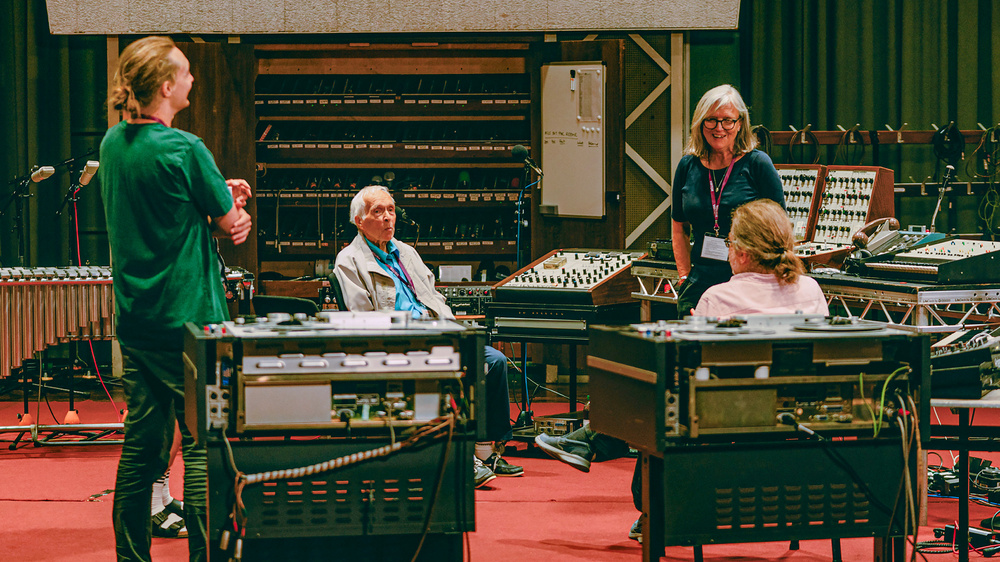 L‑R: Jared Fountain of Spitfire Audio, Roger Limb, Glynis Jones & Mark Ayres pictured at BBC Maida Vale Studios, July 2023.
The new ‘found sounds’ include a convincing fire crackle (hopefully no arson was involved), a strangely rhythmic paper rip, an animal growl resembling a snoring gorilla and a splendidly ethereal stroked wine glass. Multi‑instrumentalist Kieron Pepper provided an assortment of struck and bowed junk percussion (mainly of a metallic light industrial nature), while the ‘Maida Vale Sounds’ consist of small percussive and Foley noises recorded around the studio complex.
Rather than regard these merely as sound effects, I’d suggest that high‑pitched noises such as wine bottle cork plops, mouse clicks and plastic spoon hits would make interesting loop elements, as heard in the inventive creations of early 1960s Workshop composers Delia Derbyshire and John Baker.
Acoustic Instruments & Synths
By some miracle the Workshop’s original homemade, plank‑like steel‑string guitar has survived. Its basic plucked sound is underwhelming, but when heavily effected it can emit an impressive ’60s‑style twang. Of more general use are a multisampled vibraphone (a popular instrument in 1960s TV soundtracks) and marimba, the latter played with medium mallets. Both feature straight hits, and the vibraphone offers some ear‑catching glissando sweeps.
The fun continues with classic analogue synths programmed by the Workshop members. Dating from 1969, the EMS VCS3’s ‘Pad 1 Lg’ tones incorporate a dusting of white noise and subtle filter movements, while its ‘Pad 2 Lg’ vibrato reminded me of a Clavioline. Introduced a few years later, the duophonic ARP Odyssey contributes portamento glides with unpredictable octave swoops and a so‑called ‘bass drone’ energised by a syncopated rhythmic pulse (unfortunately not tempo‑sync’ed).
I also enjoyed the quintessentially Radiophonic sounds created on the 1975 Roland System‑100 semi‑modular synth: these include the sonar‑like ‘Filtered Noise 1’, ‘Rand Space 1’s interstellar wind effects and the mad robotic burbling of ‘Rand Space 2’.
Tape Loops, Warps & Additionals
Emulating the pioneering tape techniques of 1960s RW composers, Spitfire created new tape loops featuring many of the abovementioned sounds with additional processing by Bob Earland’s modular system. My favourite loops are the detuned free‑form tin whistle outbursts with long repeat echo (perfect for emulating the call of the mythical Selkie), atonal autoharp glissandi and the sort of eerie whistling you might hear in the soundtrack of a BBC Two MR James ghost story.
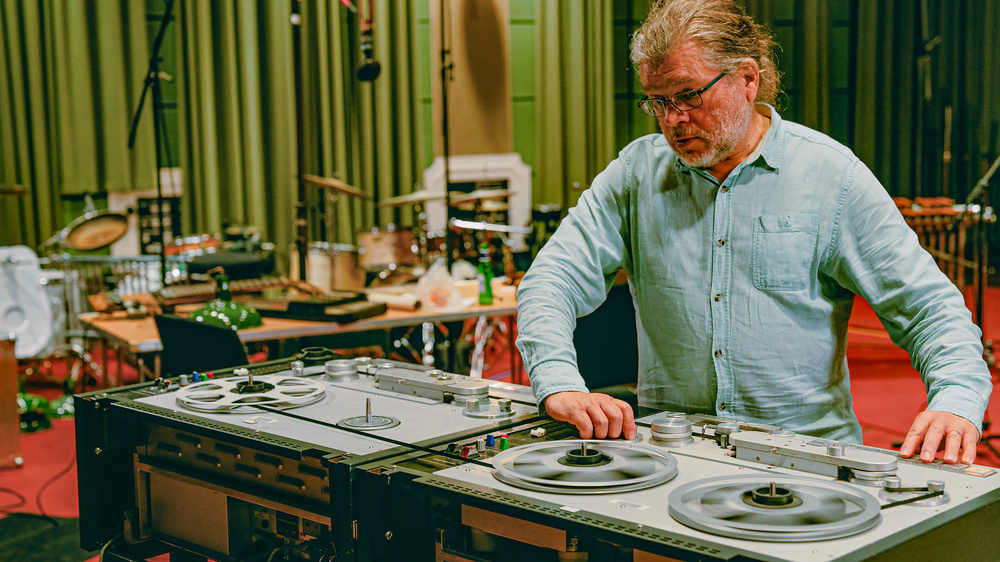 Radiophonic Workshop archivist Mark Ayres plays a tape loop at Maida Vale Studios in July 2023.
Two inventive sound sets complete the library: ‘Warps’ (Spitfire‑speak for heavily processed samples) contains some decent sci‑fi effects, while the 90 ‘Additional Presets’ are creative sound pairings which utilise the eDNA engine’s twin sound bays.
These additionals contain some gems: the menacing ‘5 Big Booms’ and massive, see‑sawing ‘Bad Wolf’ have great cinematic impact; ‘Lost In The Forest’ builds to a disorientating cacophony; and ‘Into the Pit’s hellish effects and despairing cries are a warning to the sinful. The queasy ‘seasick in a space ship’ wobbles of ‘Glowing Ore’ provide light relief and ‘Delaware Road Revisited’ evokes late‑’50s BBC experimental radio dramas, but for me the star turn here is ‘Doo‑Wee‑Ooh’, an exact recreation of the Doctor Who theme’s swooping lead sound. Brilliant.
This fascinating project represents 40 years of a unique British institution.
Conclusion
This fascinating project represents 40 years of a unique British institution, spanning the electronic music of late 1950s experimental BBC radio drama, Delia Derbyshire and John Baker’s 1960s musique concrète masterpieces, the early synth soundtracks of the 1970s and hybrid orchestral synth‑and‑sampler scores of the ’80s and ’90s.
Thanks to a great joint effort by all participants, owners of BBCRW can now celebrate and perpetuate the Workshop’s historical and cultural importance with a fresh crop of sonically inventive, Radiophonic‑enriched soundtracks.
- Suggested further reading: The Story Of The BBC Radiophonic Workshop, SOS April 2008.
- Suggested viewing: The Alchemists Of Sound (2003 TV documentary, titles music by yours truly).
Alchemists Of Sound
The BBC Radiophonic Workshop was set up in 1958 to provide ‘special sounds’ for radio dramas and TV productions. The corporation’s attitude to its new department seems curiously half‑hearted: crammed into a small room with a minuscule budget and redundant equipment, Workshop staff were hired on 90‑day contracts and termed ‘assistants’ rather than ‘composers’. Nevertheless, the team approached their assignments with imagination and enthusiasm, turning base audio material into sonic gold.
In those days the weapon of choice was the tape recorder. Audio sources were limited to a few test bench oscillators, a noise generator, the ‘wobbulator’ (a modulated sine wave oscillator) and found sounds, but once a noise was captured on tape it could be played forwards and backwards, slowed down, sped up, turned into a repeating loop, cut into sections, spliced and re‑sequenced. Recordings could also be enhanced by (to quote one RW member) “an echo device that had to be turned on the day before you needed it”.
Despite these limitations, the Workshop hit the jackpot in 1963 with Delia Derbyshire’s stunning realisation of Ron Grainer’s Doctor Who theme. The iconic ‘daggada‑dang’ bass line was derived from a plucked steel string stretched over a metal tray; the swooping melody line was performed one note at a time on an old valve oscillator; while the ‘clouds’ effects requested by Grainer were realised with filtered white noise. Every note was painstakingly pre‑recorded at the right pitch onto a piece of tape cut to the required rhythmic duration; these tiny pieces were then spliced together in correct musical order and played back on four manually synchronised tape machines. The resulting electronic masterpiece enthralled UK TV viewers and put the Radiophonic Workshop firmly on the map.
- Recommended listening: Quatermass And The Pit sound effects (Desmond Briscoe, 1958), Dick Mills’ ‘Adagio’, ‘Veils & Mirrors’ by Glynis Jones, Brian Hodgson’s TARDIS take‑off noise, John Baker’s ‘Structures’, Vendetta incidental music and ‘Reading Your Letters’, Peter Howell’s ‘Greenwich Chorus’ vocoder chorale, Roger Limb’s ‘Passing Clouds’ and Delia Derbyshire’s ‘Blue Veils and Golden Sands’, ‘The Delian Mode’ and ‘Ziwzih Ziwzih Oo‑Oo‑Oo’, a hymn of praise composed by robots that start to worship their space station’s power converter!
Pros
- A unique collection of Radiophonic Workshop archive recordings spanning 40 years.
- Features new found sounds and early synths recorded at BBC Maida Vale by original Workshop members.
- The sound effects are ideal for sci‑fi, fantasy, horror, psychological dramas and quirky electronic music.
- Also contains some beautiful soundscapes.
Cons
- Contains little rhythmic material.
- Could be too specialised for some composers.
Summary
Spitfire’s BBC Radiophonic Workshop gives unprecedented access to the unique sound world of a revered British institution. Featuring priceless archival otherworldly sound effects and soundscapes, the library also comprises vintage synths and musique concrète ‘found sounds’ performed by original Workshop members, along with historic instruments, tuned and junk percussion and a set of tape loops, processed ‘warps’ and additional presets created by the Spitfire Audio team.