

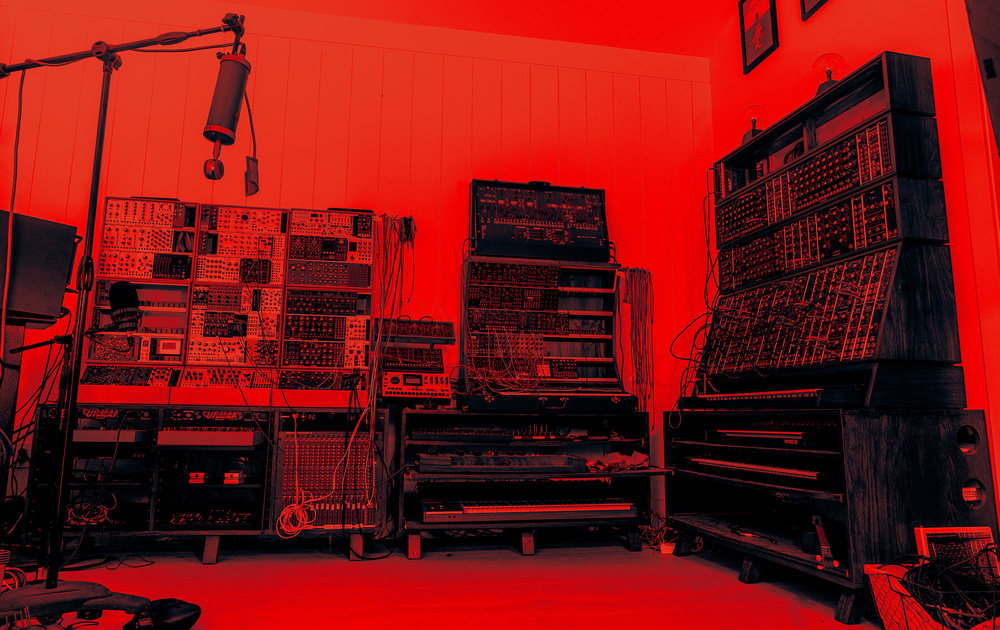
The Synth presets are a treat, featuring sounds created using an ARP 2600, Moog Matriarch, DFAM, Polygogo, Therevox, Oberheim OB‑X, Folktek Resonant Garden, Super Gemini, Solar 42 and the Newton Brothers’ expansive Eurorack modular system.
Spitfire have teamed up with composers the Newton Brothers to create something that’s truly terrifying.
American composers the Newton Brothers have spent the past decade and a half terrifying audiences in creative ways with their scores for projects like The Grudge, Five Nights At Freddy’s, The Devil’s Hour, Ouija: Origin Of Evil, and more. With the release of Tenebra, in collaboration with Spitfire Audio, they share the tools of their trade to help composers conjure up all manner of nightmares, one meticulously‑sampled menacing note at a time.
With a download size of 11.35GB, Tenebra runs in Spitfire Audio’s Solar plug‑in, powered by their eDNA (Electronic DNA) technology, and contains more than 100 sounds, each of which was “born from experimentation”, according to the literature. Orchestral instruments, field recordings, human voices, percussion, modular synths and unconventional instruments are processed and ready, providing the building blocks for a suspenseful composition.
Overview
A great place to start, before exploring the 130 presets on offer, are the 10 factory presets that give you an overview of the core sounds that this library was built on. This is good for new composers (to learn what the foundation sounds like), and experienced composers (who often like to modify sounds from scratch). Here, you will find the full range of sounds that Tenebra offers: from staples like glassy, piercing tones (Bells & Glass) evolving, textured drones (Drone), impactful percussion (Perc) and creepy human sounds (Humanity) to more unique sounds from the composers’ personal synth collection (Synths), the dark side of an orchestra (Orch‑Nocturna), and the Newton Brothers’ signature sounds “mangled by the Spitfire Audio team” (Warps).
This is just the tip of the iceberg because after the factory presets come the other presets, with creepy but vague names like Angry Bees Dancing, Docking Off Jupiter, Freddie’s Basement, and Here & There, for example. I must give SA a shoutout from a usability perspective: if you mouse over the information icon to the right of each name, you get a clear sonic description of each patch. Angry Bees Dancing is a “buzzy pulsing synth”, Docking Off Jupiter is a “gritty atmospheric bass”, Freddy’s Basement is a “dark airy texture”, and so on. This is incredibly helpful, especially during the early days of using the library when you’re not yet familiar with it and just want to get to work instead of wasting time interpreting what Here & There could possibly mean for your composition. (It’s an “eerie wailing texture”, FYI.) A tip for new composers: when exploring the library, play the short audio preview next to each name and then read the corresponding text description. Sounds can be very hard to articulate sometimes and this is good practice for becoming more precise with your own descriptions.
Sounds & Textures
The Synth presets are a treat, featuring sounds created using an ARP 2600, Moog Matriarch, DFAM, Polygogo, Therevox, Oberheim OB‑X, Folktek Resonant Garden, Super Gemini, Solar 42 and the Newton Brothers’ expansive Eurorack modular system. You have complex textures, gritty leads, arpeggiated basses and eerie pads, and that’s before you even begin manipulating the sounds.
Another standout is the Strings, with slippery glissandos, unhinged risers, chaotic swells and terrifying ghostly bends. One of the highlights of Tenebra is that while it’s built around experimentation, it’s not so esoteric that it abandons what we’ve come to know as the core sounds of a horror and suspense score, a solid string component being one of them.
The Bass category has two interesting presets: Graveyard Haunting Bass featuring Purgatorys Cello as sound A and Red Flute Flutters Kit as sound B. As you go higher in pitch, the timbre changes to something bordering on sound design. It sounds chaotic, like everything is going crazy, so you can progress in tension within one patch itself. Terrifying For Huge Chords Pad is also interesting because the higher notes turn the dark, gritty bass into an alarm‑like sound. This is a useful characteristic seen across the library — textures and sounds within one patch vary as you travel around the keyboard.
The library also boasts a selection of some unusual instruments including a bowed medieval citole, a “perfectly imperfect bowed piano”, and the Waterphone, an iconic horror instrument developed by musician and composer Richard Waters, whose sound many of us have wrongly assumed to be that of a particularly creepy violin. It’s a delight to have access to some of its varied textures and performances.
Effects
Half the fun of Tenebra is in the samples it contains, and the other half is in the engine that runs it. Solar is described as being the most up‑to‑date iteration of the eDNA engine, originally created for Spitfire’s Earth library, and now expanded. It is a powerful interface that allows almost too many options for sonic manipulation. I say too many only because it can be intimidating at first. If there’s something you want to tweak, it’s likely to allow you to tweak it.
Each preset consists of two sounds — one each in sound bays A and B — with individual controls per sound for the following parameters: wobble (volume, pitch, filter); ADSR envelope; high‑ and low‑pass filter; tune, pan, offset, trim; and glide, bend and clone.
The FX knob at the top can be configured to control multiple parameters. Alt+right‑click on any parameter to assign it to the knob.
The two sounds in conjunction can be manipulated via the Oscillate Mixer, which crossfades between bay A and bay B. Turn it on and it moves on its own, but you can also manually control its movement via the mod wheel. The crossfader multiplier increases or decreases the speed of the Oscillator Mixer and you can also select the shape of the oscillator, speed, direction strength, and start point of the oscillation.
This is a useful feature in a preset featuring two distinct sounds, but it’s even more fun to turn it on with two identical sounds loaded. I tried it with two instances of a sound called Moms Chimes and it created a sort of vacuum in the centre of the image field that was more felt than heard but was distinct enough to make a difference. On headphones, it generated the sensation you get when your eyes are closed and someone holds a finger close to the middle of your forehead. A horror library awakening your third eye? That’s not spooky at all!
While the Oscillate Mixer facilitates crossfading between two sounds, what happens if you want to control the individual volume of each sound? That’s where the Trim knob comes in. You can balance the levels between the two sounds to your liking, and can even use it to fade in one sound after the other one has been triggered. One more layer of creativity unlocked.
Bays A and B have identical parameters on the main page, but when you go deeper into the FX section, you notice the difference between the two. Each of the bays has a pre‑assigned effects rack that differs a little from the other. Bay A has Shape, Phonic, Peak, Amp, Distort, Flanger and Chorus. Bay B has Form, Sonant, Notch, Digital, Bias, Convo and Phaser. Both have aux sends where you can control Delay, Reverb, Convolution, Chorus, Flanger and Phaser. At the end of the signal chain are the Master FX including EQ, Grain, Tape Saturation, and a Limiter for final polish. Another shoutout for the excellent Tenebra manual, which features a clear and easy‑to‑understand eDNA FX signal‑flow diagram so you can understand exactly what the signal path is and adjust effects accordingly.
The final section to explore is the Gate Sequencer, which is simple to understand. Two rows of step sequencers control both sound bays independently, and you can mute or unmute each step to add rhythmic movement to the sounds. Several parameters are adjustable including the length of the sequence, and the speed, depth and shape of the gate. A cool feature is that you can swap the sequenced patterns between the two bays easily using the Flip icon, to test which pattern works better with which sound.
Hold down a chord and the sounds seem to do the work for you.
Conclusion
There’s no place more fitting for ‘vibes’ — the defining characteristic of present day pop culture — to shine than the world of horror music composition. Something either feels terrifying or it doesn’t and arguing about the technical merits of a composition will do you no good if it has left your audience cold. Tenebra is so good with vibes that it almost feels like cheating — hold down a chord and the sounds seem to do the work for you.
Online forums are littered with people who scoff at sample libraries that have famous names attached to them. For example, the oft‑echoed sentiment that “buying a Hans Zimmer library is not going to make you compose like him!” Indeed. The point being missed here is that the best sample libraries that involve famous composers offer us a selection of their musical vocabulary, and, by extension, access to instruments and sounds that you would not otherwise have access to, in one place. Think about it: as a non‑famous, non‑wealthy composer, would you have access to an orchestra, a rare medieval instrument, a Waterphone, vintage synths, and a selection of haunting glass tones all in one place? Unlikely. If the price works for you, this is a wonderful toolkit of well‑curated sounds to inspire your next creepy creation.
Pros
- Large selection of character‑filled samples.
- Detailed and precise sonic manipulation.
- Easy to link parameters to MIDI CC.
- Light on CPU resources.
Cons
- None.
Summary
Tenebra by the Newton Brothers is a rich library filled with evocative presets and extensive effects for customisation of the sounds. From horror, thriller and suspense staples like chaotic swells, eerie drones and dread‑inducing bass to unusual instruments, unconventional performances and complex textures, this is a library that you will get more and more out of as you grow as a composer.
