

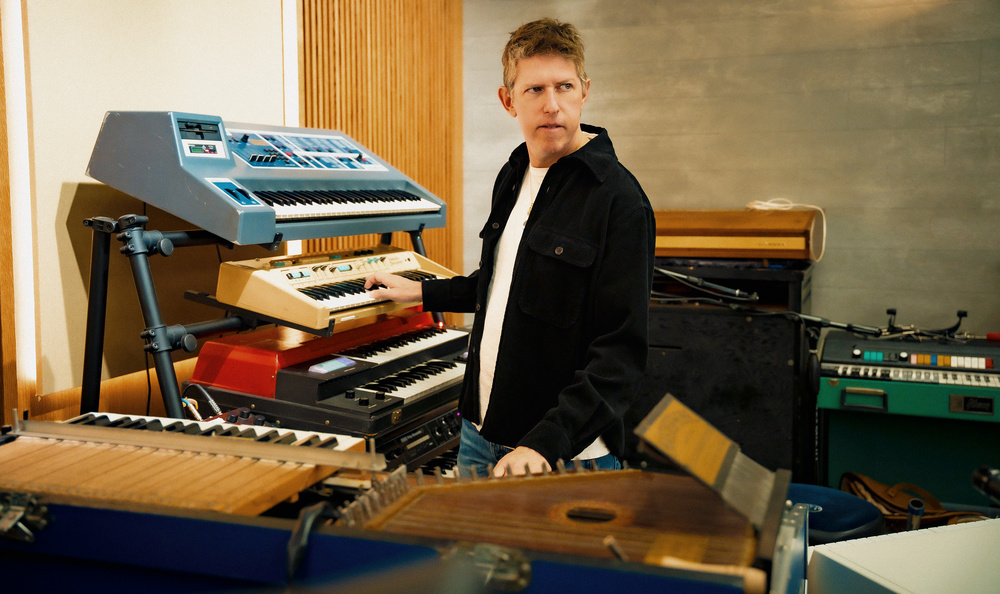
 Super-producer Greg Kurstin.Photo: Brantley Gutierrez
For their first major‑label release, Wolf Alice hired super‑producer Greg Kurstin to channel their inspiration.
“I came from indie music and jazz, but had my biggest breaks in pop,” smiles Greg Kurstin. “I’m fine with that. It doesn’t matter who it is or what the genre is, a good song is a good song, whether by David Bowie, Talking Heads, the Beatles or the Ramones. I’ve always been a sucker for a good pop song, so my tendency is to go there.
“I’ve had contrasts going on all my life. I started out playing guitar in post‑punk bands, but also played jazz piano. When I was 15, I discovered Mingus, Coltrane, Miles and hard‑bop, and got heavily into that. It took over my life. I was planning to become a jazz musician! Then, in the early ’90s, I accidentally got signed to David Byrne’s label Luaka Bop, with the indie band Geggy Tah. I learned how to write, produce and program, using drum machines, samples and sequencers. Afterwards I became a side musician with Beck and the Flaming Lips, still operating in the alternative rock world. Eventually, in the early 2000s, I decided that I wanted to be a songwriter and producer, but at that time, the only people who needed songwriters were pop singers, because indie bands were self‑sufficient.
“But I also do weird music. So I move around a lot in different genres. As a producer, with any project I’m working on, I don’t want to put my stamp on it so people could say ‘That’s a Greg Kurstin production.’ Instead I’m trying to help an artist or a band achieve what they’re trying to do, in the best possible way. That’s the goal.”
As a producer, with any project I’m working on, I don’t want to put my stamp on it so people could say ‘That’s a Greg Kurstin production.’ Instead I’m trying to help an artist or a band achieve what they’re trying to do, in the best possible way.
Following hits with Lily Allen, Adele, Sia, Kelly Clarkson, Pink, Lady Gaga, Beyoncé and many others, the latest act to benefit from Greg Kurstin’s broad experience is rock band Wolf Alice, whose fourth album The Clearing is their first on a major label.
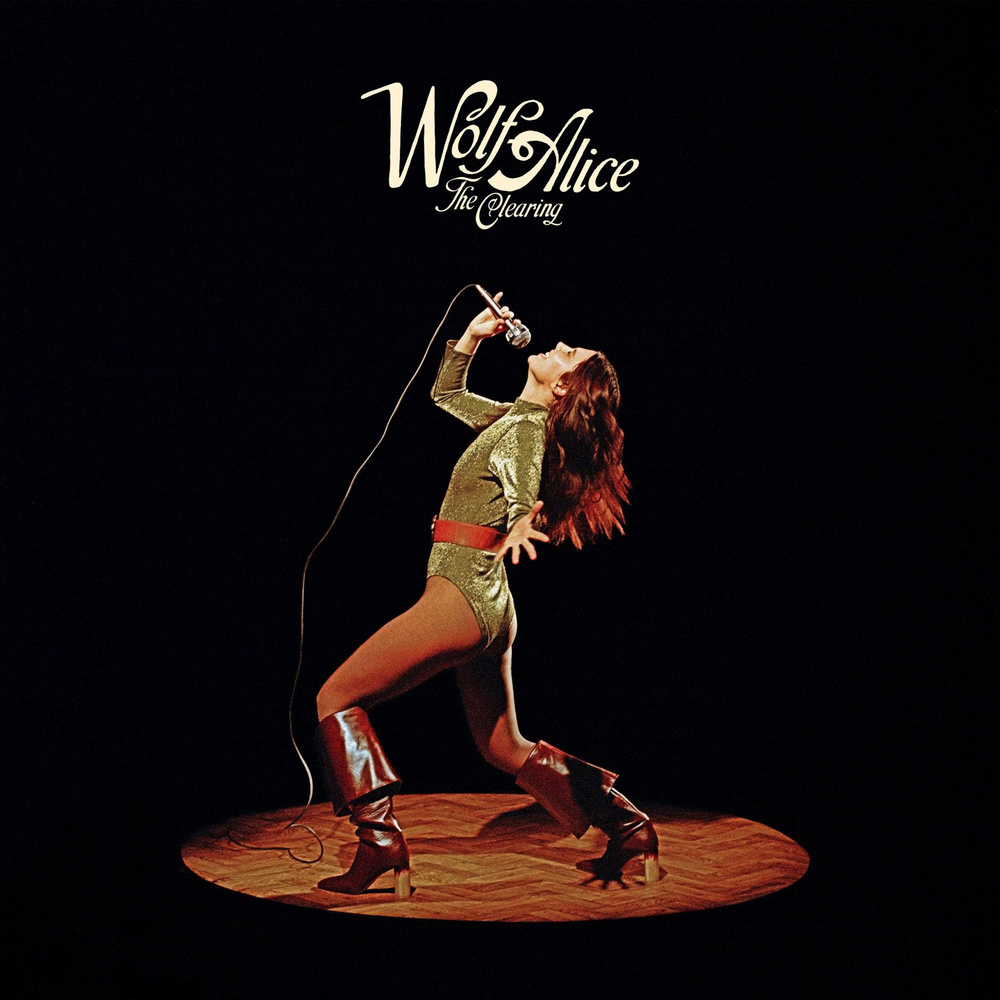 The Clearing is Wolf Alice’s first album on a major label.“Wolf Alice were probably attracted to my range,” says Kurstin. “They know who they are, as a band, so they don’t need someone who is too much like them. They wanted someone who could help them expand their sound. They don’t want to be labelled as a rock band. They went into different territory with their new record, and I really appreciated that. I was excited to learn with them, and to figure out with them how to get the sounds that they were going for. That was the fun part of this record, because I don’t think I’ve made this kind of record with anyone yet. It was a little bit dangerous, for all of us, because we’re all trying to figure it out. That’s very exciting in the record‑making process!”
Organic Mood
“When I first met them, they told me that they wanted to track as a band, with at least the rhythm section playing together and if possible more. Sonically, they wanted to do something very organic. Joff [Oddie, guitarist] said he wanted to hear the wood of the instruments. So there are many acoustic instruments on the album, like upright bass, acoustic guitar, piano, strings and so on. They wanted even the electric guitars to be very warm and not ultra‑processed. There are of course production tricks on the record, but they wanted to focus more on the arrangements.
“I love getting into arrangements, rather than the tricks of the computer or editing and stuff like that, because that’s the jazz part of me. I was saying things like, ‘Let’s work out what everyone’s going to play. What is your part? What is the bass going to do? What is the guitar going to do?’ We were working out the different parts, and trying to arrange the songs in the best possible way. It’s a more ’60s and ’70s approach, perhaps ’80s as well, also with sonic references to those eras. They did not want to make a retro record, but rather to approach the songs in the way that bands might have done in the ’60s or ’70s, and still keep it modern.”
All tracking sessions for The Clearing took place at No Expectations Studio, which is part of Kurstin’s management, record and publishing company of the same name. “Most of the songs were finished before the band arrived. I received demos of the songs, sometimes [singer] Ellie [Roswell]’s Logic demos, sometimes recordings of the band playing together in their rehearsal space. They had done a lot of work rehearsing and arranging these songs together. I would sift through everything, and analyse what the best things were about these demos, and what the best production approach would be for each song.
“I don’t want to take too much credit for the arrangements, as the band and Ellie had many great parts already. Ellie’s demos had a lot of really great gems that we could use arrangement‑wise, and sometimes sonically. So often it was not a matter of coming up with ideas, but more of helping the band recognise what was already great in what they had done. But sometimes they would look to me for parts. I really love getting into bass parts, in a Paul McCartney‑esque way. When I listen to the Beatles, and also when I worked with him [on Egypt Station, 2018], I would often just listen to the bass parts, which really resonate with me.
“My role with Wolf Alice was to clarify the arrangements, to get good performances, and occasionally suggest a rewrite. A few songs were only 75 percent finished, and later on in the process we did some co‑writing sessions to complete these songs. I functioned like a sounding board, bouncing off ideas with them, finding parts that worked, and occasionally I got bossy and told them, ‘Play this.’ Sometimes we’d start an arrangement of a song from scratch. In fact, there was a two‑week trial and error phase at the beginning, but we ended up scrapping most of what we had done. There was a lot of them playing in my live room together, sometimes with me jamming with them, until we felt we got the arrangements down.”
Vintage & Modern
As well as state‑of‑the‑art 21st Century gear, No Expectations Studio also features a lot of vintage analogue equipment, including a 3M M79 16‑track two‑inch tape recorder, an EMT 140 plate and an enormous collection of outboard, keyboards, synths and drum machines. “I have a big control room. The live room is also big enough for a whole band to fit in and play together. It’s inspired by Studio B at Henson Studios in LA, which has an oblong shape, and I kept one of my walls concrete because of that room. I wanted to have that little bit of live ‘bounce’. I have a Steinway B grand piano in there, as well as pump organs, Mellotrons, a Chamberlin, a Celeste, a B3 organ, vibes, a marimba, and tons of weird keyboards. The live room is one space, but there’s a sound lock room between the control room and the live room that is an iso booth, where we record vocals.
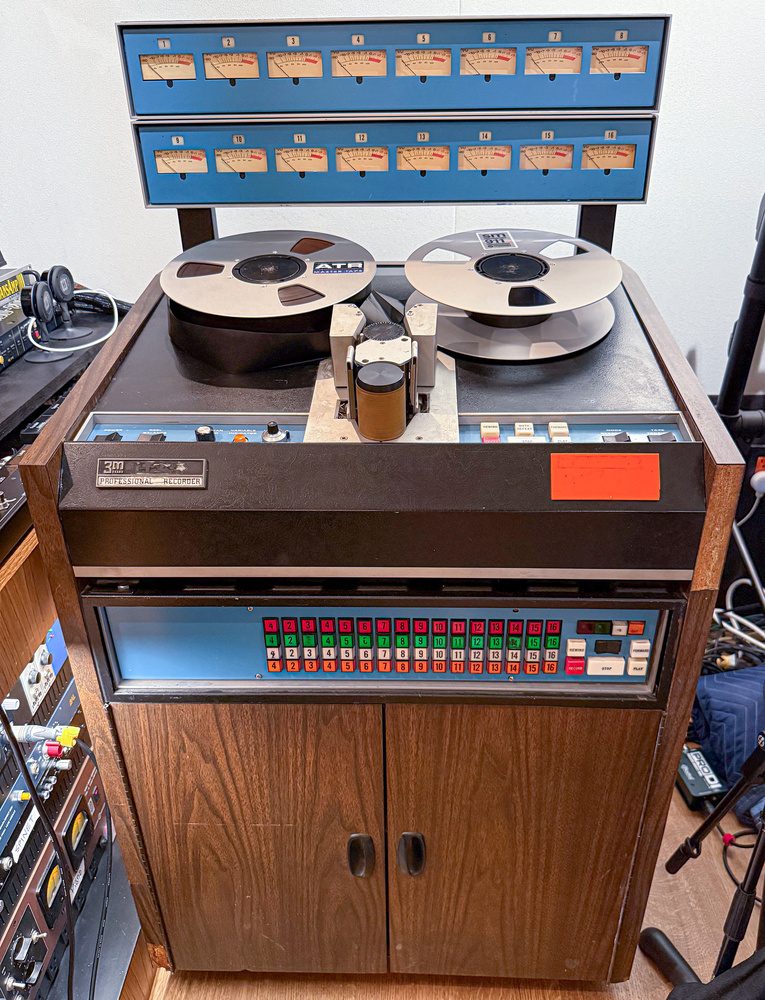 The studio’s 3M 16‑track offers the desired degree of tape coloration.
“In the control room I have an API 2448 desk. It splits into two, which makes it ideal because I can have the mixing console sections on the sides, and in the middle I have a regular desk with my MIDI keyboard and my computer, instead of having the keyboard on the side and listening with one ear. Everything goes through the API apart from a number of things that go through my Speck Electronics X.Sum 32:4 line mixer, and my vintage Altec 1567A, that submixes some mics. My monitors are ADAM S3Vs. I love them. I’m very used to their sound. Familiarity is what it’s all about for me with monitors. I know what I’m getting when I have them in front of me. My interface consists of two 32‑channel Lynx Aurora 32‑TB3 32s.
“I have my guitar amps all here in the live room, as well as more drum machines, like the Linn LM‑1, Roland CR‑78, and EMS Synthi, which are all through my API. Many of my keyboards go through my Speck mixers. I like the Speck mixers because you can mute and unmute all channels at once. All guitars I record here go through my Fairchild 660. I think we printed all drums and acoustic guitars for the Wolf Alice record on my 3M tape machine. The drums in particular really benefitted. [Bassist] Gus Seyffert is my tape machine guru. I had an MCI, but it wasn’t colouring the sound enough. It was too transparent. So Gus sold me this 3M, which does what you’d like a tape machine to do in this day and age: colour the sound.
“My studio is set up so that you can run anything through anything with a hit of a button. We can go out of Logic, run the signal through the pedalboard or a guitar amp and run it back in. It’s all wired to do that instantly. I am always constantly trying to improve the workflow. Everything in Logic has its dedicated input. So the vibes are ready to go, the congas are ready to go, the celeste is ready to go, the drum kit is ready to go. All drums and celeste and B3 and pianos and guitar mics go through their own dedicated channel on the API desk. Everything has its own EQs. I like to make the drums sound like they are already mixed. For example, the kick and snare mics are already bussed to a compressor, like a dbx plug‑in or something, to give it punchiness. But I am always changing after the fact.”
Building Blocks
Once the arrangements were more or less in place, Kurstin, with his engineers Julian Burg and Matt Tuggle, recorded the band into Logic. “They did all play together, but we’d only keep the drums with the drummer responding to the band, as well as to a click. We’d also analyse the bass performance, and if 50 percent was a keeper, we’d fix the rest. Sometimes we’d re‑track and really home in on parts. Then we did the same with the guitars. So the bass and guitar parts were sometimes scratch performances, intended purely to get a good performance out of the drums, and we’d be perfecting these parts later on.
“Rather than try too hard to get everyone’s parts perfect at the same time, we found that this was a really nice way of doing it. It did feel like a live performance, with the drummer reacting to the band, but at the same time we could fix things. It was similar with the vocals. We would always have a scratch vocal when the band played live. Ellie would be singing into an SM7 in the iso booth and we sometimes kept those takes, but most of the time she redid her vocals after the tracks were laid down.
Greg Kurstin: We used just two microphones for the entire kit.
“Normally I prepare a Logic template before working with a band or artist, with samples, loops, soft synths and effects ready that I think will fit, but as we were leaning towards live performance, I did not do that in this case. I only created a template for each drum sound. While we were trying to figure out a great drum sound, we had a breakthrough moment when we stumbled on a sound that felt like the essence of the record. This was when working on ‘Safe In The World’. We used just two microphones for the entire kit. One was an RCA 77 right above the kick drum, kind of in between the rack tom and the floor tom, pointing at the snare. It’s picking up the kick and the snare but not the cymbals.
“I EQ’ed in some more low end for the kick, and could have used just that one mic, but I added the Sony C37A for overheads, to pick up the cymbals and if needed more hi‑hat. The majority of the drum sound on the album was recorded like that, with some EMT 140 plate added, and also sending the drums out to the tape machine, running at 15 ips. Once we had stumbled on that sound, I created a template with that. However, on ‘Bloom Baby Bloom’ we used a very different approach, with lots of room mics, including the two Coles that I have in the back of the live room, and a Neumann U67 about 10 feet away from the kit. There also was a lot of processing on the drums, for example with the Soundtoys Decapitor. On the track ‘White Horses’ we put the drums through my vintage Roland Vocoder VP‑330. The drums triggered a bass note drone, which gave it a unique texture.”
Wolf Alice also made good use of other vintage equipment at No Expectations, for example, Kurstin’s “1965 Fender blackface Deluxe Reverb amp, which was the main guitar amp for this record, though we might also have used a small Fender Tweed. Joff is very good at creating guitar effects. That’s one of his specialities. Besides being a great guitarist and an amazing acoustic guitar player, he’s really good at creating these soundscapes with pedals. I think he went nuts on my effects board! He really fell in love with my Digitech XP‑300 Space Station. On ‘White Horses’ he put an EBow on the acoustic guitar and created a drone that we fed through lots of effects.”
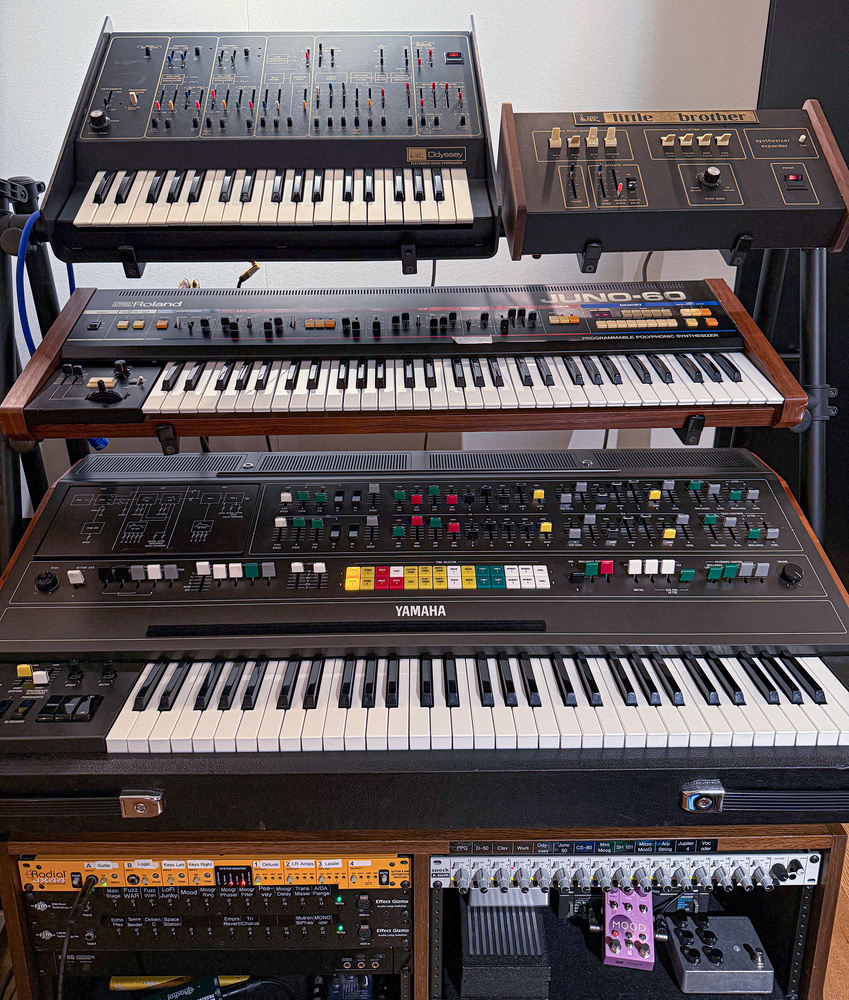 No Expectations hosts an impressive array of vintage instruments, including (top to bottom) ARP Odyssey and Little Brother, Roland Juno‑60 and Yamaha CS80.
Alice Band
In addition to Wolf Alice’s basic line‑up, extensive use was made of strings and piano, while Kurstin added colours with synths, piano, Mellotrons, Chamberlin, Marxophone, strings and baritone guitar. On the songs ‘Play It Out’ and ‘Bloom Baby Bloom’, Rowsell played the piano.
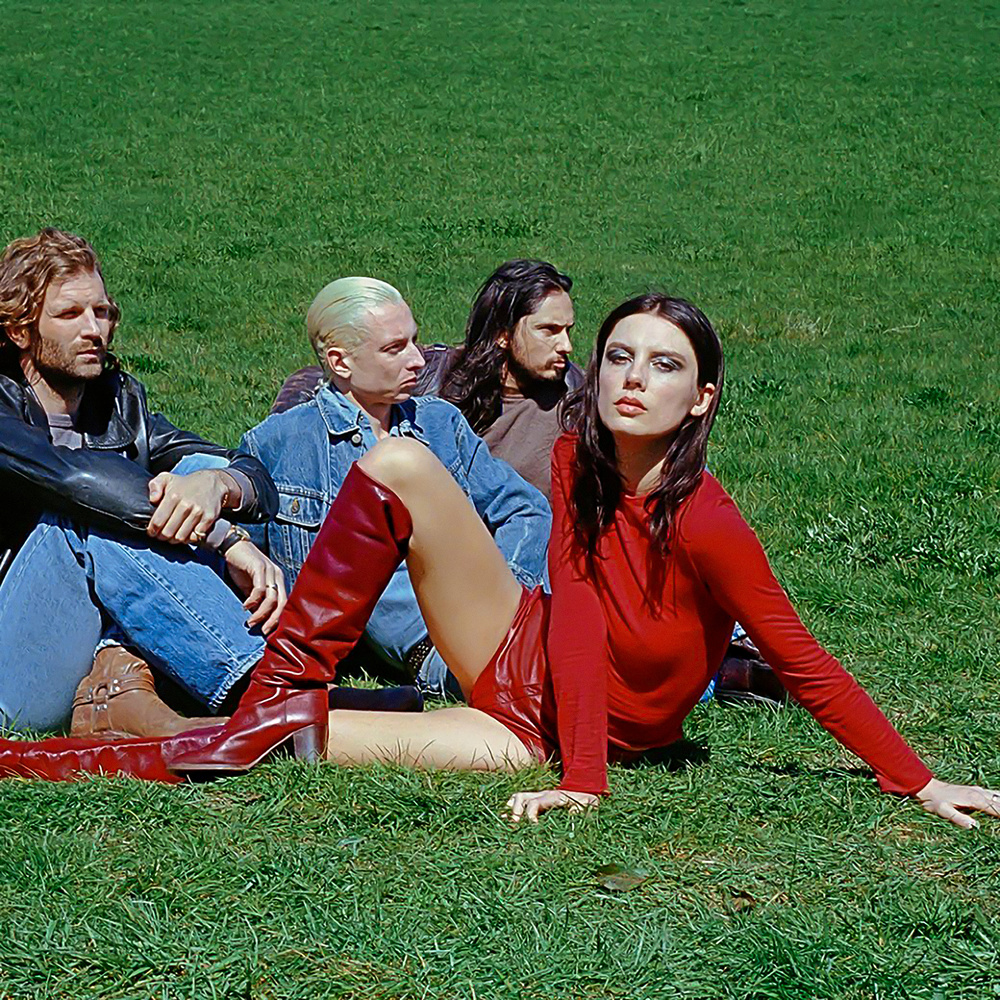 Wolf Alice.“These two songs are really centred around her piano parts. Her vocals and lyrics are amazing, and the entire arrangement and production were about finding ways to enhance her vocal and piano. We did not want a hi‑fi piano sound, but rather the impression of a piano in a room, and to make sure you could hear the ambience of the room. We used some small condensers on the piano, but I think we also had the RCA 44. Her voice is pretty dry and raw on this song, and we wanted the piano sound to match that. Also, in her demo for ‘Leaning Against The Wall’, Ellie had done some programming that I really liked, but it sounded a little ‘in the box’ compared to the rest of the album, so we sent those parts through some guitar amps and picked them up with my drum room mics, to get the ambience.
“The strings were a collaboration. Some of the parts came from Ellie’s demos, or from the band, and I received the MIDI and in Logic Studio Strings I separated out the different parts and added new ideas. I have a quartet of string players that I love to work with, and they came in and we recorded them mostly with ribbon mics. For my synth parts I tended to use the Yamaha CS80, which I played on ‘Thorns’ and on ‘Just Two Girls’. I also played a Minimoog and a Roland SH‑101, both on ‘Bloom Baby Bloom’, using the 101 arpeggiator for some really fast arpeggios. I also used some Roland Juno‑60 on that song, to enhance some soft‑synth parts of Ellie’s demo. I played Chamberlin violins on ‘Just Two Girls’ and the Marxophone on ‘Play It Out’, which we put through tons of effects from my pedal board. There’s also a Juno‑60 bass in that song, and an Optigan.
“We really were in that head space of wanting to get out of the box, because it does have a different sound. So guitar pedals and outboard instead of plug‑ins. Or sending the vocals on ‘Thorns’ through my Leslie, which I normally use for my B3 organ. I don’t think we used many computer effects except for some occasional CamelPhat, which is now a Logic effect, called Phat FX. I did use Decapitator a lot for distortion. But I also used a lot of Roland RE‑201 Space Echo on everything.”
Kurstin stresses that he’s equally happy to work in the box where it’s appropriate for the project. “Sometimes when I’m away I’ve had to finish production and all I had was a laptop. I actually love that too.” And even when tracking is mainly live, as with Wolf Alice, his mixes lean heavily on plug‑ins. “I use a lot of Soundtoys, UAD and Waves stuff when I’m doing my rough mixes. This was also the case with Wolf Alice. I gave my rough mixes for the album my best shot, and I then handed them to Spike Stent, who understands what you’re going for, and then elevates it and makes it sound amazing.”
A Fresh Voice
“Ellie [Roswell]’s vocals were often recorded with an SM7,” recalls Greg Kurstin, “but we also used a Telefunken ELA M 251, particularly on her smoother vocal parts, and occasionally a Neumann U47. But it’s all about how she sings. She’s such a good singer, I can put any microphone in front of her, and it will sound the same. She really knows how to use the dynamics of her voice, whether to belt or sing softly. Her vocal mics went through a Neve 1073LB 500‑series, and then a [Universal Audio] 1176 compressor/limiter. We would do three or four takes, and she sounded great each time, which made my job very easy.
“I’m not a producer who asks artists to do 50 takes. The essence is usually in the first four takes. We might analyse later and decide to do a phrase one more time, but I like to keep it fresh and keep it moving. I like for the performance to have the emotion. That’s the most important thing. A lot of the time the earlier takes will have that, before the vocalist might get tired of singing. If it was a matter of nudging a certain note later in Logic, whether in terms of timing or pitch, we did that, but that would have been the extent of what we did.
“We have the technology to do very extensive vocal production if we need to, but the idea of this record was to go for more raw, emotive performances and not over‑analyse things or go for total perfection. That was the case with the guitars, bass, drums and vocals. We did not go to too crazy adjusting timing or using Melodyne or whatever. They wanted it to be like a live performance, one‑take thing. They really did their homework and they played great.”