

Join us as we travel back in time to see how the story of one of the most important machines in modern music began.
Most of us would be happy enough to have one famous musical invention to our name, but some people have produced so many that they almost seem run‑of‑the‑mill. Roger Linn is a case in point. Products he’s created have helped define the sounds of genres and, arguably, even entire periods in popular music. And none has been more influential than the original grid‑based sampling beatbox, the Akai MPC60.
The LM‑1
Roger Linn was born in California in the 1950s. Unlike many of his later peers, Linn didn’t have any formal training with electronics or engineering, and instead was a musician who taught himself what he needed to know in order to satisfy his sonic curiosities. In the early days, he’d open guitar pedals and tweak and modify them to produce different flavours of effect.
A keen instrumentalist and songwriter, at only 21 Linn landed a gig as a touring guitarist for Leon Russell. Linn subsequently managed to persuade Russell to use the fruits of his career to buy a synthesizer for use in the studio, and Russell wound up purchasing a modular system from a fledgling company called E‑mu Systems. Experimenting with this new technology, the ability to use the E‑mu’s sequencer to modulate its filter as external audio ran through it was particularly compelling to Linn.
Whilst working with Russell, Linn also first experienced a musician using a rhythm machine to lay down a beat that the band would record to. This was done partly for timing, but also because it meant that if Russell then wanted to re‑record the drums or something else rhythmic, there would be a rock‑solid timing reference to work from.
This ability to create drums artificially was interesting to Linn as it was an ingredient he struggled to produce for his own demo recordings, having never learned to play them himself. However, there were two problems: firstly, the machines were all based around preset, factory rhythms and couldn’t be programmed, (with a couple of exceptions — see the ‘Outliers’ box), and secondly, the analogue drum emulations of the day weren’t known for their realistic sound.
 Roger Linn.Setting out to solve the first problem, in 1977 Linn became competent with computing and built a programmable drum machine and sequencer using a COMPAL‑80 and a Frankensteined sound board from a Roland rhythm unit. The sequencer could then control a synthesizer via CV and gate to boot. This custom machine was used on Leon Russell’s album Life & Love, which Linn co‑produced, engineered and provided guitar for.
Next came the second problem. Analogue drum machines that employed oscillators, noise generators and envelopes sounded like alien interpretations of acoustic drums, rather than the real thing. Whilst the sounds are steeped in nostalgia, charm and history nowadays, at the time manufacturers were looking for a more realistic solution. Fatefully, it was Linn who got there first because, fortuitously, around this time, it was becoming possible to record digital audio at a price that might just be within the realms of practicality from a commercial perspective. Whilst RAM was highly expensive, drum sounds were inherently short and were therefore a perfect, skinny contender for a product that was loaded with digital recordings of real instruments (although longer cymbal sounds would have to wait on the sidelines for the time being).
Linn booked session drummer Art Wood into a studio and captured the sounds he’d need for his new machine. At 28kHz and 8‑bit, the resulting lo‑fi recordings were raw and crunchy, but, crucially, they were a huge breakthrough for the time. Nestled into a sleek chassis with hands‑on controls and extremely useful new features such as tap recording, auto‑correct, adjustable swing, pattern chaining and more, the resulting LM‑1 was an instant hit, despite having a $5000 price tag upon its release in 1979. Once the LM‑1 was out, it’s not an exaggeration to say that the drum palette of popular music was changed forever, and despite there only being around 500 units produced, the LM‑1 was heard on the hits of the Human League, Fleetwood Mac, Michael Jackson, Queen, Prince and Vangelis amongst many, many others, and remains a prized possession to those who own them.
With the success of the LM‑1 in the bag competitors were working hard to try to catch up. With the technology improving and coming down in price, it was clear there needed to be a successor, and that came in 1982. The first instrument had used the initials ‘LM’ because the company had been founded by Roger Linn and Alex Moffet. However, Moffet departed in the early ’80s and so the successor was simply titled the LinnDrum, rather than LM‑2. With a smaller profile, better fidelity, and more features and sounds, the LinnDrum went on to become one of the most famous drum machines of all time. With the LinnDrum outselling the LM‑1 at almost 10:1, if a song was in the charts in the ’80s, the chances are that there was a LinnDrum on it. It would take so long to list all the artists that used the LinnDrum that it would dominate this article, so probably the best way to sum it up is by mentioning the fact that there is an archive on the Internet that lists songs that contain confirmed use of the LinnDrum, and at the time of writing, it has nearly 1900 entries!
Near Misses
Following the accomplishments of the LM‑1 and LinnDrum, you’d be forgiven for thinking that Linn Electronics rode the success happily into the sunset but, alas, history is littered with cruel twists of fate for inventors, and Linn’s story is no exception. Had it not gone wrong, however, we probably would have never wound up with the star of our story, the Akai MPC60.
But before we get there, we’ve got to roll back to 1984 when Linn unveiled their third drum machine, the Linn‑9000. The 9000 was a bold attempt to move forward and significantly, the unit was able to sample, had programmable hi‑hat decay, doubled as a midi sequencer and contained a grid of square, touch‑sensitive rubber pads and a liquid crystal display. All seemingly quite familiar...
Whilst it was a powerful box that, like its predecessors, appeared in hit records, the 9000 was riddled with technical problems. As well as costly power supply issues on early units, the firmware was buggy and prone to crashes. In fact, on a personal note, I once had a conversation with the late Bob Heatlie who recalled his unit losing an album’s worth of work for a Neoton Família album he was producing the day before he flew to Hungary for the sessions. His Linn‑9000 found itself in landfill!
There was also a sister MIDI sequencer called the LinnSequencer that was unfortunately endowed with the same buggy operating system of the Linn‑9000, and the two products, combined with fierce competition from other manufacturers, made the outlook rather grim for Linn Electronics as 1985 drew to a close.
In 1986, Linn arrived at the Winter NAMM show with a prototype of a new product, the LinnDrum Midistudio, but this never saw the light of day as the company went out of business only a few weeks later. The photos of this never‑released product show a clear evolution from the Linn‑9000 with sampling, midi sequencing and a hi‑hat decay slider on the left of the rubber pads, now arranged in a 4x4 grid...
Seeing Red
The demise of Linn Electronics proved to be something of a blessing in disguise, because it opened the door for a new opportunity; Japanese company Akai (originally founded back in the 1920s) had established themselves with reel‑to‑reels and hi‑fi equipment in the preceding 20 years and had branched out and founded a music division, Akai Professional, in 1984. By 1986, they’d tested the waters with a few synthesizers, such as the AX80 and AX60, and had begun developing samplers like the S612 and VX7000. Whilst they were good at the production, sales, finances and logistics, Linn had a track record with innovation and product design and his availability was an opportunity too good to miss. With Akai now backing him, Linn picked up where he’d left off at his own company and began working on a more refined and complete version of the Linn‑9000, Sequencer and Midistudio that would ultimately hit the stores in 1988. The team at Akai who worked with Linn included Dave Cockerell of EMS fame, who had already created the S612 sampler and who would later work on the classic S1000 with two other famous engineers, Tim Orr and Chris Huggett.
Initially the new product was titled the ADR‑15, with the letters being an abbreviation of Akai DRum machine, but this title belied what was to be the full functionality of this new device. The concept was to make a multitrack digital sequencer and, indeed, the final production name MPC stands for ‘MIDI Production Center’. However, the MPC was still a drum machine if the user wished, as it was able to play back its own sounds too. These could be loaded from floppy disks, but crucially, the MPC had an input on the rear and 13.1 seconds of mono audio (or 26.2 seconds with the memory expansion) could be sampled into the unit and then be edited and saved onto floppy to be recalled later. This feature was one of the reasons that the MPC became such a widely used and, ultimately, iconic piece of music technology.
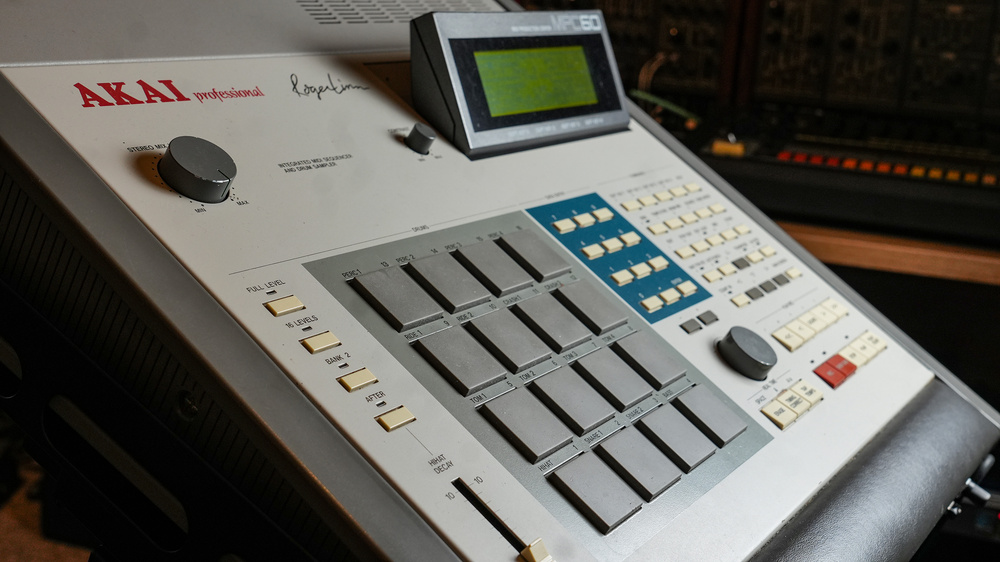
The MPC60 included the 4x4 grid of pads introduced with the LinnDrum Midistudio, and suggestions for drum allocation were displayed on the panel legend, with the fundamental hi‑hat, snares and bass drum on the bottom row with toms, cymbals and percussion filling the top three, although any sound could be assigned to any pad.
Next to the grid was the programmable hi‑hat decay slider that was carried over from the Linn‑9000, along with some toggle options that included the ‘16‑levels’ button. This spread a single sample across the 16 pads with staggered volumes from high to low. Whilst this facilitated dynamic programming, it wound up being used by musicians to create a faux delay effect where fading, rhythmic repeats could be tapped into a sequence by hitting the loudest pad first and then following it with a trail of the quieter pads, descending in volume.
The MPC60 has a small but clear display that can be tilted forward for interaction from a seated position. Whilst it’s a simple green and black affair, common for the era, it is well laid out and easily navigated using the command and data entry buttons to the right of the panel. Linn has stated that he’s not a fan of trawling through manuals and wanted to make the MPC60 as intuitive as possible and, from personal experience, I managed to successfully create my first beats on my unit without having read the manual or even having used an MPC of any description before. In fact, the MPC60 has a Help button that will conveniently bring up a summary of functions for a given page, but as firmware updates ran on over many years, the memory it used was grabbed for other functions and pressing Help now brings up a message that directs the user to the printed manual.
Sequencing on the MPC can be achieved using the classic ‘pad‑tapping against a metronome with autocorrection’ method that Linn introduced back with the LM‑1, but precise step sequencing and editing is also possible. The unit can also record polyphonic Midi data played by a keyboard (such as the Akai MX73), which can then be relayed to external Midi instruments via one of the four Midi outputs on the rear of the device, whilst the MPC60 plays along with its own sounds.
The transport section of the unit references tape machines (and subsequent digital audio workstations) with functions such as record, rewind, fast‑forward, locate, overdub, auto‑punch, etc. There’s also an onboard mixer menu with panning, stereo and individual outputs, an effects send and various sync connections. Roger Linn was particularly interested in the timing and groove of his drum machines and great care was taken to ensure that the clocking was prioritised in the operating system, giving the MPC60 a very musical feel straight out of the box.
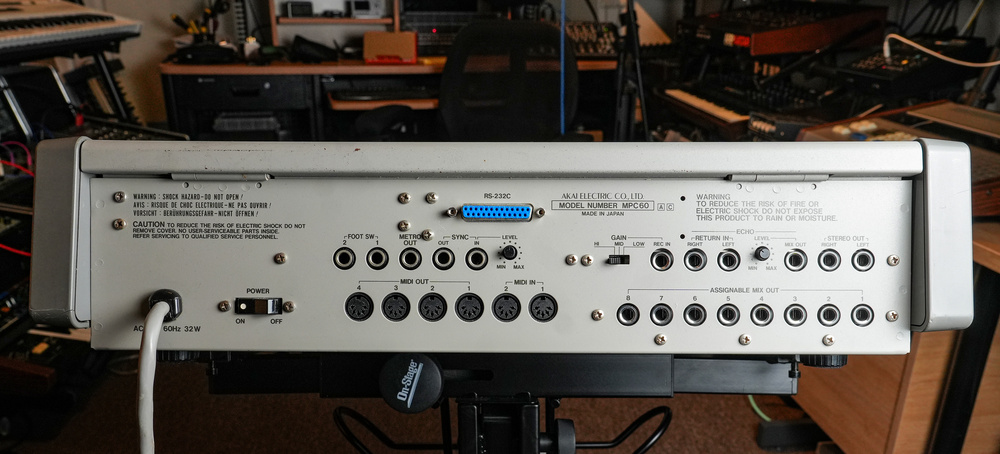 Two big reasons for the MPC60’s success can be found on the back panel: the ‘Rec In’ input that allowed users to capture their own samples, and the four MIDI outputs that meant the MPC60 could simultaneously sequence up to four external instruments.
It’s interesting looking at the rear of an MPC60 and considering the power it offered at the time, as it could provide fully realised drum parts whilst simultaneously sequencing up to four other Midi units, which Akai cleverly produced too, (eg. VX90, S900). It’s not an exaggeration to say that a whole song could be worked out and programmed on the MPC60 and the result could be taken to the studio where it could be recorded to tape in one go, all ready for guitars and vocals to be overdubbed.
To that end, the MPC60 was utilised for pop productions by bands such as Level 42, Erasure, Hall & Oates and Prince, but really, it was the use of the MPC60 in hip‑hop and rap that gave it its acclaim. The 26.2 seconds of sampling at 12‑bit and 40kHz, combined with easy chopping, the hands‑on (or fingers‑on) pad‑playing interface and a powerful sound made the MPC60 a dream for countless artists from the late ’80s into the ’90s, as they could sample longer sections of music or cut out loops that could be triggered at the start of a bar, as well as being able to assign standard one‑shot sounds.
The list of musicians who used the MPC60 or its updated sequel, the MPC60 II, is a Who’s Who of the era: Dr Dre, J Dilla, MF Doom, DJ Premier, De La Soul, Warren G, Ice Cube, Public Enemy, DJ Mike Magic and many, many more.
One artist who became particularly synonymous with the MPC60 is DJ Shadow, who produced his debut album Endtroducing with little more than an MPC60 II, turntables, an ADAT and a serendipitous relationship with a record store.
One artist who became particularly synonymous with the MPC60 is DJ Shadow, who produced his debut album Endtroducing with little more than an MPC60 II, turntables, an ADAT and a serendipitous relationship with a record store that allowed him to trawl through their extensive private basement archives. The platinum‑selling LP from 1996 serves as a blueprint for MPC‑based music creation and a masterclass in sampling.
As well as the MPC60 II in 1991, there was the ASQ‑10 that was essentially the sequencer of the MPC60 (without the sampling section), and the also‑adored MPC3000 in 1994 that was used by 2Pac, Daft Punk, the Chemical Brothers, Mark Ronson, Alicia Keys, Q‑Tip and Wyclef Jean amongst countless others. J Dilla created his distinctive lolloping drum programming style by switching off the autocorrect functionality on his unit, and his approach had a dramatic influence on modern music‑making that’s still felt to this day. His limited‑edition MPC3000 was posthumously donated to the Smithsonian.
 The MPC interface has become almost iconic, the combination of a 4x4 grid of pads with screen and buttons identifying its successors to this day.
Afterwards
Following the success of the MPC60, MPC60 II and MPC3000, you’d be forgiven for thinking that Linn and Akai worked together for decades, but alas, the unpredictable music business intervened again and with serious problems behind the scenes at Akai, the Professional wing ultimately wound up being acquired by InMusic, which it remains a part of to this day. Whilst new MPC models continue to be produced, Linn was left out in the cold, with the 3000 being the last unit he is credited with.
Thankfully, Linn’s story didn’t end there. Far from it. In the early 2000s, he founded Roger Linn Design and developed the AdrenaLinn, which was a multi‑effects unit, amp modeller and, fittingly, drum machine. The tempo‑sync’ed processing of the AdrenaLinn harks back to his early experience of sequenced modulation from the E‑mu Modular System in the ’70s, and the unit found favour with artists such as Green Day, John Mayer and Red Hot Chili Peppers. This lead to a collaboration with M‑Audio on the Black Box in 2004, before Linn worked with Dave Smith of Sequential fame to create the Tempest drum machine in 2011 and the innovative LinnStrument performance controller in 2014.
Linn was awarded a Grammy for Lifetime Technical Achievement in 2011 and he remains active in the industry. You don’t have to look far to see how his ideas still influence product designs to this very day.
Outliers
Whilst programmable drum machines didn’t really become common until the release of units like the Roland CR‑78 (1978) and TR‑808 (1980) and Linn LM‑1 (1979), there were actually some earlier examples that were produced in small quantities or for specific purposes that are worth mentioning. Firstly, the Eko ComputeRhythm from 1972 was an analogue drum machine that was fully programmable via a 16‑step front‑panel grid. Patterns could be loaded from punch cards and it even had individual outputs, channel mixing and mutes. Despite pre‑dating Roland and Linn’s inventions by years, it’s estimated that only around 20 or so were made and it was largely unknown, even though Jean‑Michel Jarre and Manuel Göttsching did make notable use of it.
PAIA’s Programmable Drum Set from 1977 was also, well, programmable. However, this was a small kit‑type affair for electronics hobbyists and not a professional instrument. In 1978, famed engineer Roger Nichols created a sampling computer called Wendel that provided the digitally sampled, programmable drums for Steely Dan’s Gaucho album. Absolutely cutting edge and astronomically expensive, it was a one‑of‑a‑kind invention. However, the later Wendel Jr was a commercially released product in the mid‑’80s.