

This quirky 500‑series module is designed for colour and attitude rather than cleanliness.
 I always enjoy learning about the story behind small boutique pro audio companies, and that of Garbage Ideas appears to be the classic ‘engineer meets tech’ tale, where a connection is made, and they decide to develop a product they think people will like. The engineer in this case is Atlanta‑based Jason Kingsland, who’s worked with artists including Band Of Horses, Belle & Sebastian and Bryan Ferry. Although proficient with a soldering iron and capable of repairing and maintaining much of his own gear, he decided to free up his time by taking on a young local tech, Vic Fischer. The pair soon began to explore how certain pieces of esoteric equipment behaved and why, with a particular focus on Jason’s love of ‘wonky’ old compressors that did something unusual or musical to the audio passing through them.
For review here we have the first fruits of that pair’s endeavours. Called the FK Comp, it’s a 500‑series module that very much nails its flag to the mast as a creative studio tool. It pairs a FET‑style compressor with a Class A line‑amp circuit, and is intended as a simple‑to‑use device that can control the dynamics of a source or deliver more aggressive saturation‑style effects.
Trash Talk
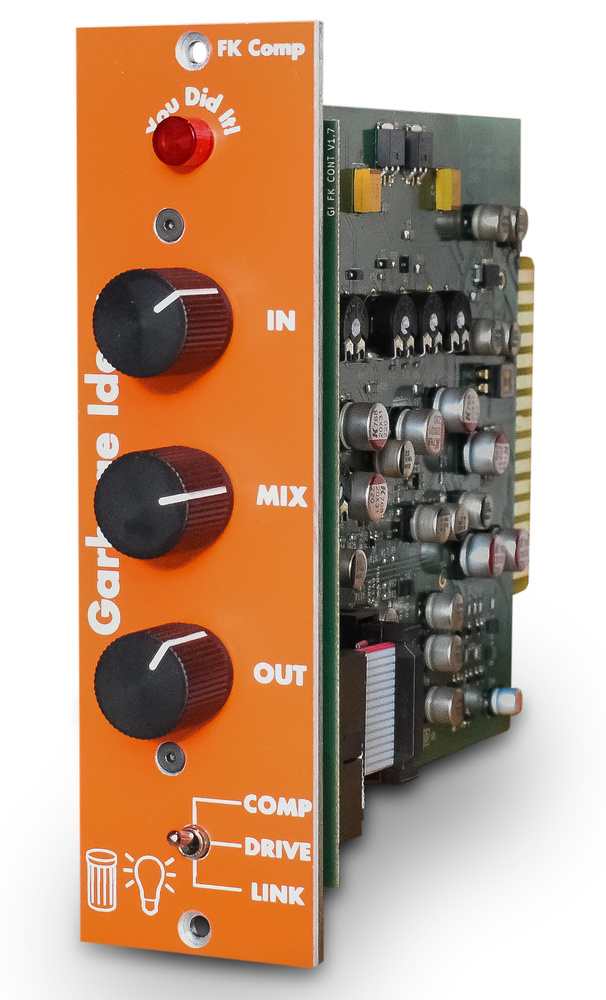
Controls‑wise things are unfussy, which is good. Input and output knobs control the levels coming into and from the unit and, in the traditional FET‑compressor style, you use the input knob to bring the signal as far above the compressor’s threshold as desired. Amusingly, a single LED at the top lights when 15dB of gain reduction is introduced, and its label proudly announces ‘You Did It!’. I’m not sure how useful this is as a meter, but it certainly has the practical effect of encouraging you to dig into the processing, and invites you to just use your ears.
The FK Comp has two distinct operating modes. Comp brings the assertive compressor circuit into play, while Drive disengages the side‑chain circuit, so that compression is disabled — this allows the device to serve as a line amplifier with up to 30dB of gain that can be driven into distortion, with the output control letting you achieve that at sensible levels. There’s also a Link option, which is the same as Comp but, in 500‑series racks that support it, two units can share their control signals, with both units reacting to whichever signal is higher at a given time. Lastly, fittingly located in the centre of the control panel, we have the all‑important Mix knob to facilitate parallel processing.
There are probably better options out there for pulling the dynamic range down by a few dB when tracking, and most will be drawn to this unit by the suggestion of some character and attitude. But while the limited (pardon the pun!) metering meant that it often took me some time to judge the FK Comp’s contribution when using it more conservatively, it did seem to do a nice job of adding a little control, and it could serve as an all‑round compressor if you needed one.
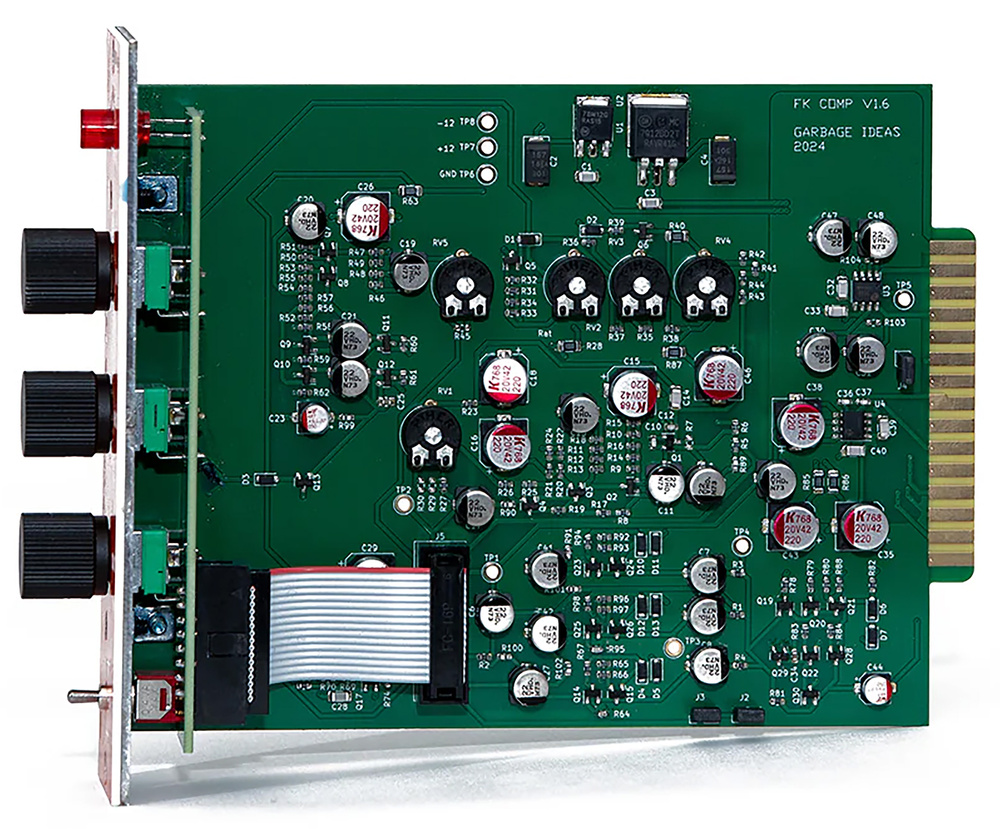 Most components are surface‑mount devices, and balancing of both the input and the output is performed electronically.
Alongside the aggressive FET compressor, the summing stage of the FK Comp’s circuit intentionally produces a couple of ‘musical’ sounding effects, which have obviously been carefully tuned to work in real‑world tracking and mixing situations. Deliberately designed so as to be non‑linear and not clean‑sounding, the summing stage (which is required for the dry/wet Mix control) has the effect of increasingly rolling off the top end of a signal as it receives higher input levels. Simultaneously, the circuit produces increasing amounts of harmonic distortion in the mid to high frequencies, and, generally speaking, the greater the THD generated by the circuit, the more the bandwidth of the amp reduces. This is arguably ‘wrong’ from a technical audio electronics perspective, but it works superbly in practice when compressing something (drums or vocals, for example) heavily. Effectively, it automatically tames those higher frequencies that can otherwise quickly start to sound nasty with this sort of processing, and it tightens up the low end too, which can again be desirable with more in‑your‑face processing techniques, particularly parallel compression/distortion.
When recording drums... I found it easy to get seriously pumping compression effects without the cymbals tearing my ears apart.
Dishing The Dirt
This bandwidth‑reducing effect described can best be heard, in my experience, when using the FK Comp as a mono drum room or ambience mic. I have always been a fan of ‘blown out’ character mics when recording drums, but often find they require too much additional processing to make them work in the mix. For the couple of sessions on which I used the FK Comp, I found it easy to get seriously pumping compression effects without the cymbals tearing my ears apart. With the Mix control and the summing stage coming after the output level knob, it wasn’t difficult to find the sweet spot that added excitement, yet didn’t completely destroy the fidelity of the drum mix.
It was a similar story on vocals, and a technique I’ve often found myself using of late is to put a dynamic mic like an SM58 next to a more typical large‑diaphragm option when tracking a singer. With the safety net of having a ‘proper’ vocal mic up, I like to heavily compress the dynamic mic, and put a hardware delay or reverb on it — it’s a great way of getting the singer in the mood, and I’ve been pleasantly surprised by how often this mic has ending up staying in the mix. Getting that aggressive in‑your‑face modern vocal sound without it becoming too harsh around 2‑4 kHz can be challenging, and I was pleased to find that the FK Comp did a great job of focusing the saturation and ‘vibe’ in just the right areas. I also achieved great results when using the FK to transform boring DI’ed bass guitar sounds into full‑blown fuzz parts, or to just add a bit of grit to the midrange.
Instant Gratification
We Brits love a bit of self‑deprecation, especially when it’s unwarranted, and this first release from Garbage Ideas seems to me to be a good example: it’s far from being garbage! If you’re a fan of characterful, fun tools that you can quickly try out when recording or mixing, then I think this little orange device could definitely have something to offer. I’ve always thought the 500‑series format works best when it allows equipment to be significantly more affordable, and the FK Comp certainly ticks that box too. Affordable, instant gratification, paired with just enough of a learning curve that you’ll discover additional uses over time? It seems like a pretty good idea to me!
Pros
- Simple, fun control options.
- Great for heavily compressed drum and vocal sounds.
- Very affordable.
- Onboard Mix control makes it versatile.
Cons
- None.
Summary
The debut release from Garbage Ideas, the FK Comp is a simple‑to‑use FET‑style compressor paired with a non‑linear amplifier stage that encourages you to lean into the more characterful side of compression.