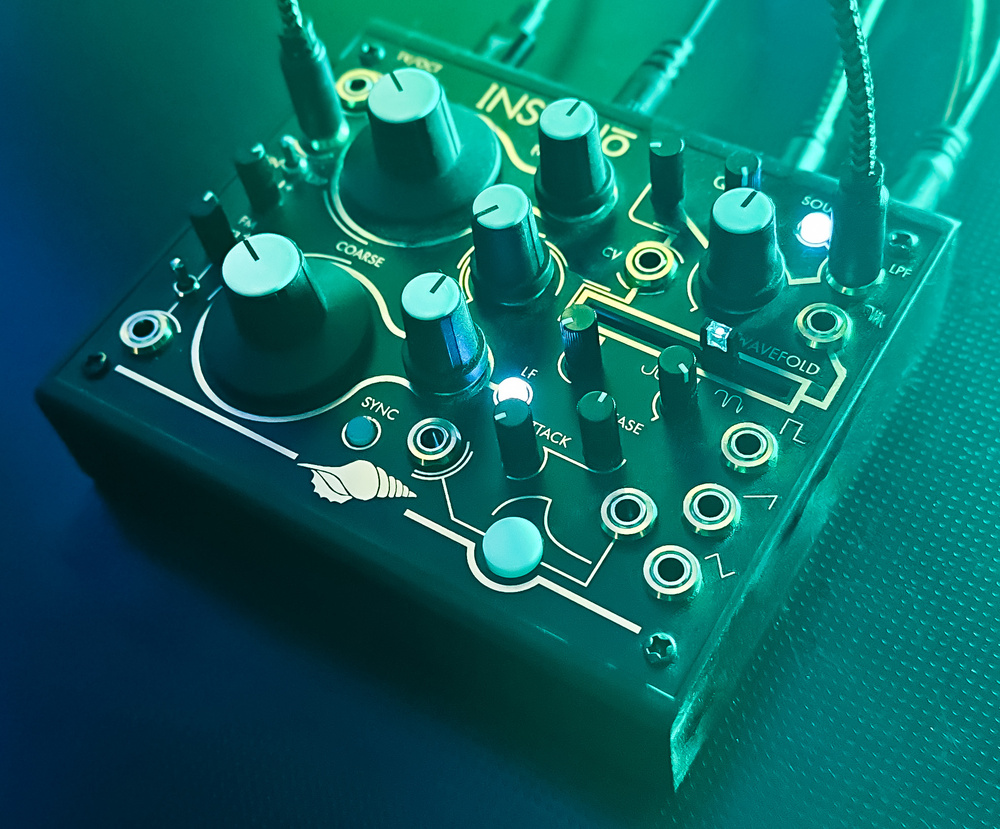
Instruo’s first foray into standalone synthesizers is both ambitious and original.
Instruo are an A‑list brand in the Eurorack community, known for their innovative, feature‑rich modules. The Seashell is the company’s first standalone synth, taking its inspiration from their Cš‑L complex analogue oscillator module. But it’s a more ambitious concept than a Eurorack module with its own case (although it will play with your Eurorack gear). It’s a versatile semi‑modular synth that runs standalone via MIDI or CV, or integrates into a computer‑based setup, with audio streaming and software control over USB.
The Seashell is beautifully built and surprisingly small, significantly smaller than the familiar 3U of Eurorack. Unlike some desktop synths from Eurorack shops (think Make Noise Strega or Bastl SoftPop II for example) you can’t pop the panel out and mount it in a rack: it’s an all‑in‑one metal enclosure, with connectivity on the rear as well as up front.
There’s a power supply but you can also power the unit from USB‑C, which, combined with its digital connectivity, makes the Seashell a terrific laptop companion. I’ve found that analogue synths powered by USB can suffer terribly from noisy interference, but happily this is not the case with the Seashell.
Standalone Basics
The Seashell’s compact panel is dominated by two large tuning knobs for the dual oscillators. It might not seem an obvious decision to devote so much of the limited real estate to oscillator frequency, but with quantisation, sync and cross‑modulation on board these are performable controls. In its initialised state, the Seashell’s two sources route into the filter, and the single envelope generator controls both the filter and the amplitude at the main output and headphone feeds on the rear panel. A gate/envelope trigger button lets you start exploring the synth with no connections other than some headphones.
As a synth the Seashell combines a ‘bottom‑up’ block that defaults to a sine wave passing into a wavefolder, with a harmonic oscillator (saw/pulse/triangle) that can run at audio or LFO rates. Similar to the Buchla Easel’s complex and modulation oscillator pairing, but with the addition of a filter like Majella’s Implexus.
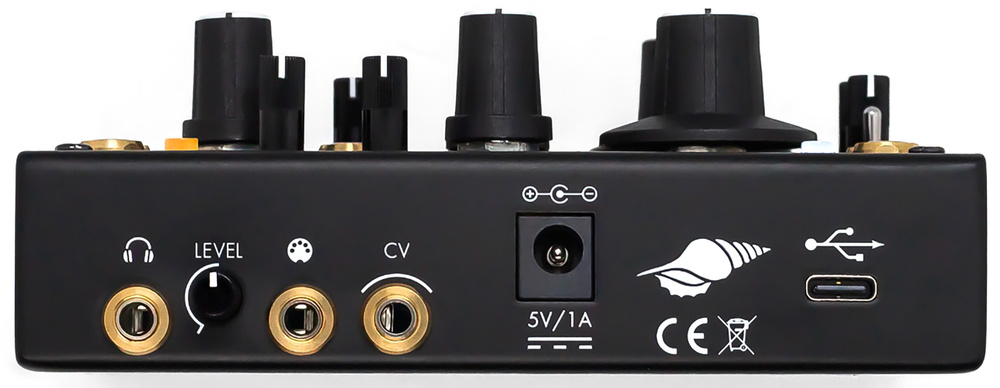 At the back of the unit we find 3.5mm sockets for line/headphone output (with associated level knob), MIDI in and assignable CV in, along with a 5V power socket and USB‑C port.
Each oscillator in fact has multiple modes, or rather their various derived sources can be routed through the main voice path in different ways. When controlling the Seashell from the hardware these are selected by stepping through a series of combos via the Source button. The initial mode is folded sine plus pulse. Tapping Source moves you to dual (unfolded) sawtooths; a second tap and it’s folded sine plus saw, and so on. There’s no mixer for the oscillators, instead half the modes route just one source into the main filter path. Even here there are various ways the other oscillator can come into play. Osc 2’s three signal flavours are always available at dedicated patch outputs, and the folded osc 1 signal also has a dedicated persistent output, as does the filter if you want to take a pre‑VCA feed.
Visual feedback for the source mode is provided via a single LED, using a mixture of colour coding and pulsing. Similar systems are used to show envelope mode, oscillator sync mode and pitch tracking for the oscillators. The scheme is logically consistent, but it’s one of those things that you have to learn, and then likely re‑learn if you have a break from the synth.
Native Sound
Sonically, the wavefolded source provides a range of progressively warm, harmonic starting points, with a classic West Coast flavour. The pulse and saw options from oscillator 2 (and the triangle it provides via patch point) are all incredibly solid and smooth. The same adjectives serve for the filter — a 12dB/octave resonant low‑pass design. As well as traditional subtractive operation, the filter is designed to give low‑pass gate style results if you disable the VCA and modulate the cutoff from zero with the envelope set to exponential mode.
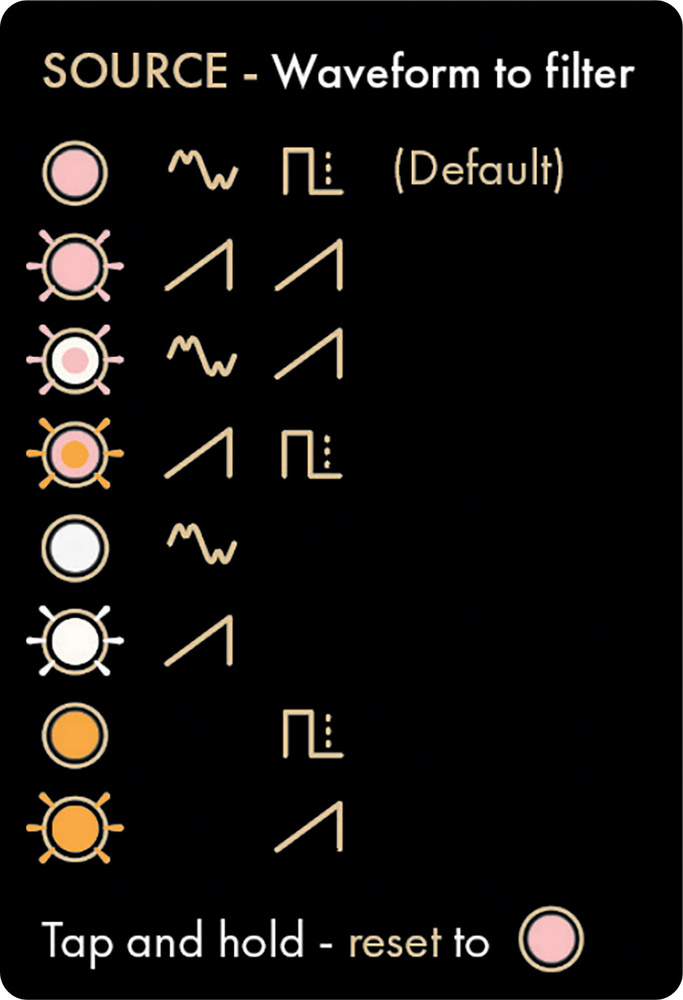 The Seashell’s eight source combinations are accessed on the hardware by stepping through the Source button, or via the control app or plug‑in.The wavefolder can be hand cranked from a slider, or modulated by the envelope or the CV input that’s shared with the filter. There’s also an attenuator that sums in whatever is present at osc 1’s FM input, which is osc 2 unless you’ve patched something. This ‘analogue symmetry’ control is effectively an animated bias that changes the folding character.
In modes without the wavefolder you get more traditional subtractive monosynth sounds. The Seashell is not above serving up some wonderful sticky and squelchy acid if you like, and a detuned saw and pulse combo can paint rich Moogy textures despite the filters having little in common. As you explore more you can find sci‑fi soundscapes and filthy drum & bass vocal basses.
The other key component that creates Seashell’s ‘native’ sound, if it can be said to have one, is the Diffusor. This is a stereo spatial processor designed to give the synth some life and presence at source without relying on post processing. Dialling this in from the central pot first introduces some subtle spread, which then morphs into a reverb at higher settings. This is great at low and high settings, although through the middle of the range it introduces a ringy resonance a fifth above the fundamental which I found a bit wearing.
After my first session exploring these top‑level Seashell features I felt I’d sussed out what it could do as a synth. Not so. Of course we’ve not even looked at the digital hybrid features that make it so interesting, but there’s also a lot more sonic potential to unlock.
Oscillator sync is provided with three ratios: osc 2 can sync osc 1 at its current frequency or at lower octaves. Then there’s FM routing to either oscillator via dedicated inputs and attenuverters, and independently switched linear and exponential ranges. Each oscillator is normalled to its counterpart’s FM input, so circular FM is available with no patching. Results can range from subtle vibrato using osc 2 in its LFO mode, to bubbling chaos and noise with bi‑directional cross‑modulation. Adding sync to the FM mix constrains the more extreme results to tonal, animated sounds.
Digital Hybrid
Connected to a computer via USB, the Seashell has another life. First, it’s an audio interface, with its main stereo output piped to the host, and able to monitor a mix of stereo audio coming from the computer with its own internal sound. Second, it syncs with a companion plug‑in and standalone app, giving you remote control, recall (mostly) and hands‑on automation.
This opens up some interesting workflows. I configured the Seashell as my audio input in Live, then made an instrument track on which I put both the Seashell control plug‑in and an External Instrument device. This meant I could play the Seashell from my MIDI keyboard and monitor the audio via a single track.
The synth can be controlled from the plug‑in, and any movement of the physical controls takes over on the plug‑in UI. Here’s the really cool thing: by adding all the Seashell plug‑in’s parameters to its Live device panel, I could record the movements of physical controls on the panel as well as MIDI notes into clips in Live. And because this is using plug‑in automation rather than MIDI CC data you get smooth vector‑based curves. It also means you can use your DAW’s internal modulation sources if it has them.
The plug‑in also opens up a lot more functionality in the synth that’s not available from the physical panel. The first thing you’ll see is the Transpose section, which can be enabled for either oscillator. Despite the name this is essentially a quantiser, locking pitch to the selected notes in each octave. Using this you can adjust the pitch controls melodically and dial in offset intervals or octaves easily. Lovely results also come from modulating oscillator pitch while Transpose is active, giving you delicate glissandi, pseudo arpeggiation or chip tune trills.
Osc 1 has a sawtooth‑to‑wavefolder mode only in the plug‑in, and an additional bias (DC offset). Osc 2 gets pulse‑width modulation, probably the most significant thing missing from the physical panel. Both of these parameters are linked to Animate controls, which apply a fixed LFO modulation. This is on by default, so even when running hardware‑only you get some PWM.
The software envelope section gives easy access to all modes and trigger options, linear/exp toggling and discrete ADSR controls. (On the hardware, Release controls both Decay and Release, though with a fine‑tuned ratio).
Connected to a computer via USB, the Seashell has another life.
Extended Access
Diving even deeper, the Seashell plug‑in has an Extend panel mode, revealing a hidden LFO and modulation matrix. The matrix has four definable slots for source and destination with a generous list of options. As well as setting a nominal modulation depth at each intersection, there’s a global mod scaling macro knob. When the Extend panel is open, the Diffuse effect amount on the hardware becomes this macro control. In fact everything that happens in the Extend panel is only active while it’s open. When the hardware is running standalone it remembers the last state of the Extend functions. Button combos let you toggle Extend features on or off and also access the Diffusor.
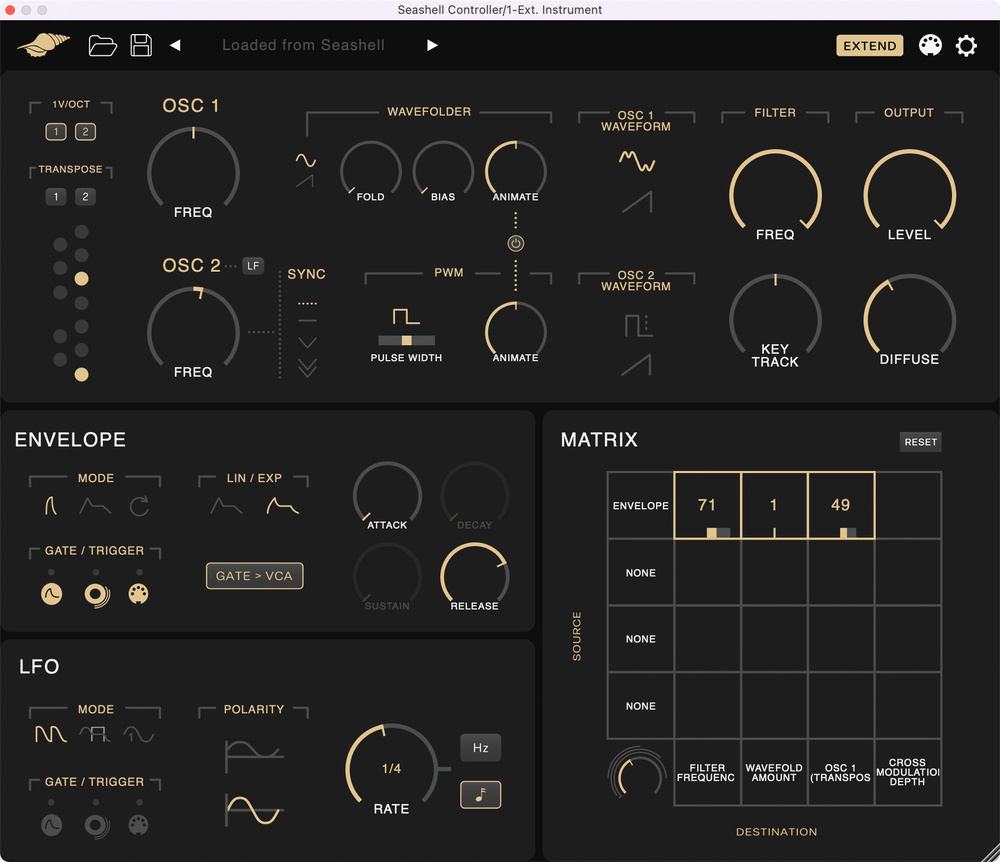 The control app in its Extend view.
As you explore the software‑based options you notice that some controls on the physical panel, such as resonance, cannot be addressed remotely. This puts some limits on the concept of total patch recall. However, some patching, like filter modulation and FM, can be done digitally in the mod matrix as well as via the analogue attenuators. The macro control also gives you a means to add missing panel features like pulse width.
Final Word In Your Shell‑like
As a synth the Seashell is versatile and has a distinct solidity and presence, but might not give you the best bang for buck if you’re only going to use it standalone. If you like working with hardware instruments but tend to produce in a DAW, it offers a unique, hybrid workflow, and access to much more sound‑design potential than the physical panel. With a Seashell and a laptop you could track a whole song, sequencing, automating then printing parts as you go.
Pros
- Sonically versatile.
- Fantastic computer integration.
Cons
- Plug‑in currently VST only.
- Needs the software control for full potential.
Summary
A classy desktop synth that offers a unique hybrid workflow.
Information
£649 including VAT.
When you purchase via links on our site, SOS may earn an affiliate commission. More info...