

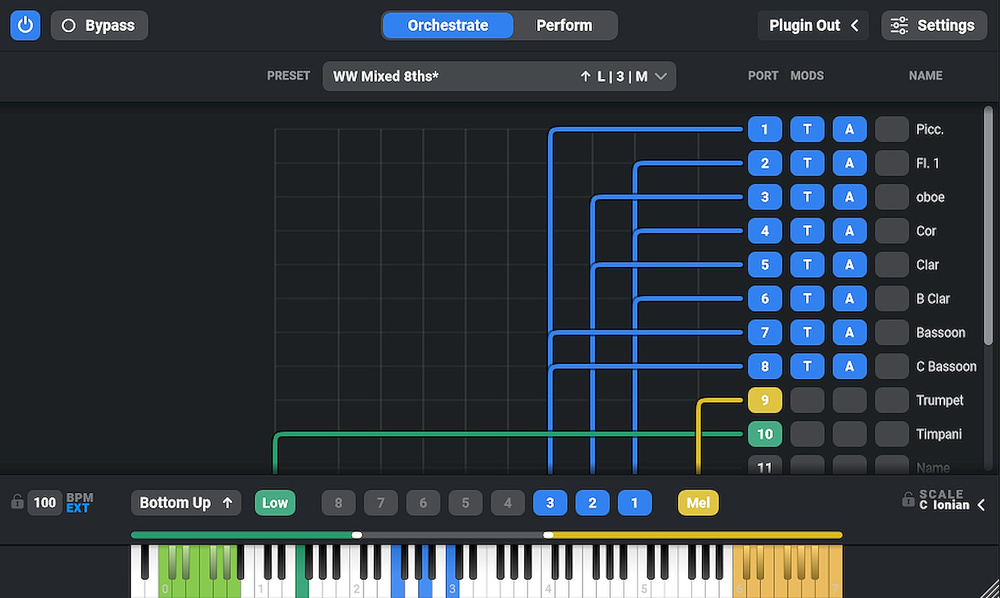
Divisimate Core is a welcome extension of Nextmidi’s orchestration software.
Nextmidi have responded to popular demand with a new incarnation of their groundbreaking Divisimate orchestration software in the form of Divisimate Core. For those unfamiliar with the Divisimate concept, the fully detailed review of Divisimate 2 can be found here: www.soundonsound.com/reviews/nextmidi-divisimate-2, but briefly, Divisimate splits incoming chord data to different instruments in real time, making arrangements a far less laborious process.
Independence Day
DM Core runs as a VST3 plug‑in (no standalone version), inserted as an instrument with its associated MIDI track. Whereas Divisimate 2 (DM2) can only run one instance hosting an entire instrumental template in that one instance, DM Core takes a modular approach. An unlimited number of instances can run simultaneously in a project; each instance can be dedicated to a specific category of instruments — eg. one for strings, one for brass, one for woodwinds — separating your template out into smaller manageable groups. Each instance addresses 16 different instruments across 16 MIDI channels, each channel routed to its own virtual port unique to that instance, making it totally independent from other instances. The target instruments ‘listen’ to the MIDI output from their particular instance of DM Core, each on their own channel. This requires that the DAW allows MIDI output from instrument plug‑ins, and that the MIDI tracks of target instruments can ‘see’ that output as a MIDI input source. Some DAWs can’t do this, in which case DM Core can only run two instances, using the ‘normal’ 32 Divisimate virtual ports; ports 1 to 16 for the first instance, ports 17 to 32 for the second. This constraint negates the unlimited modular potential of DM Core, so it’s worth checking your DAW’s capabilities before taking the plunge.
Modular Benefits
Whilst DM2 excels at controlling a large template from a single MIDI performance, it can sometimes feel unwieldy, if not a tad overwhelming when programming independent parts for different instrument groups. DM Core offers a more manageable workflow, each instance having its own set of performance presets tailor‑made for its particular instruments. It’s also easy to make changes to one instance’s parts without affecting those of any other instance, either by editing DM Core’s source MIDI track and re‑recording its output, or making changes to any parts that have already been ‘bounced out’ to individual MIDI tracks. All DM Core instances’ current states are saved along with the project, just like any other virtual instrument, guaranteeing they’ll reload just as you last left them.
DM Core vs DM2
Anyone familiar with DM2 will feel at home with DM Core, as they share much of the same functionality. There are differences, however. Modifier plug‑ins for DM Core are Transposer with optional scale lock; Trigger for sending articulation keyswitches, MIDI CC messages and Program Changes when new performance presets are selected; and Arpeggiator, which although forgoing the advanced mode of DM2’s Arpeggiator, remains a versatile rhythmic pattern and MIDI CC texture generator in its basic mode. DM2’s Transformer plug‑in is omitted, as is the Repeater plug‑in, the latter made redundant by the more sophisticated Arpeggiator. Gone too are DM2’s Multipads, as well as the Merge, Overlap and Retrigger orchestration transition modes.
Wireless remote control (via iPad or mobile phone app) has been replaced by MIDI remote options: CC31 and/or Program Change messages for changing presets, and an eminently useful custom Global keyswitch area (separate from the Global articulation keyswitches) configurable for a variety of per‑key functions such as preset selection, Global scale, root note, bypass, divisi mode or quick‑loading a whole new performance bank. The best location for these keyswitches is at the opposite end of the keyboard from the Global articulation keyswitches, for obvious reasons!
DM Core comes with three dedicated Performance banks for Brass, Strings and Woodwinds giving over 200 presets ranging from numerous ‘traditional’ voicings to fixed chord voicings, and Arpeggiated rhythms.
Divisimate will quickly become an indispensable tool.
Conclusion
Which version is right for you? If performing live with Divisimate, the standalone DM2 app offers in‑depth control of a large orchestral template comprising a theoretical maximum of 512 instruments, making it the obvious choice. It also performs admirably when programming/recording, although working individually on smaller groups of instruments can require some reconfiguration. If you work exclusively in a DAW and need to orchestrate and arrange instrument groups independently, DM Core’s modular plug‑in approach is ideal, allowing unlimited instances for custom subgrouping of instruments. Whichever way you lean, Divisimate will quickly become an indispensable tool.
Summary
DM Core is a welcome addition to the Divisimate universe. Its open‑ended modular approach is ideal for those who prefer to orchestrate and program different instrument groups independently, offering literally limitless possibilities.
Information
$149 including VAT. Upgrade pricing available.
$149. Upgrade pricing available.